
CHAVELITA (Libro. Español – Inglés)
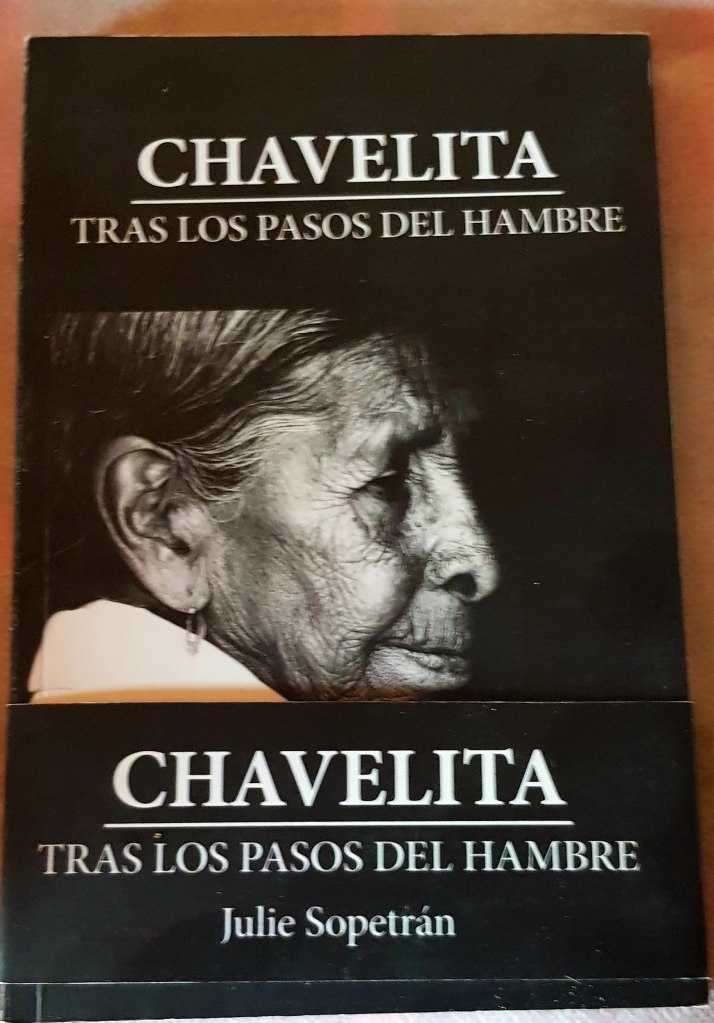
CHAVELITA
CHAVELITA
TRAS LOS PASOS DEL HAMBRE
ON THE TRAIL OF HUNGRY
HISTORIA ORAL
Libro de Julie Sopetrán
Dedicatoria:
        A Lucy Pompa, con mucho cariño, quien un día
        me escribió para preguntarme por su bisabuela...
        y también para su familia.
INDICE
UNAS PALABRAS
UNA PEQUEÑA REFLEXIÓN – Julie Sopetrán
MAPA ITINERARIO DEL RECORRIDO DE ISABEL ANDANDO CON PANCHO VILLA
Capítulo 1 LOS PRIMEROS AÑOS EN LA HACIENDA
Don Porfirio
Vida de Isabel en la hacienda
Vida familiar
Noviazgo con Marcelino Amezquita
Capítulo 2 EVOLUCIÓN Y TIEMPOS DIFÍCILES
Madero
Las guerras de la muerte
Carranza y Villa: estudios en blanco y negro
La Retirada
Capítulo 3 VIDA DE ISABEL EN LA TIERRA SOÑADA
Marcelino, su enfermedad y muerte
Notas de curanderismo y brujería
Los trabajos y los días de Isabel
Reminiscencias
Capítulo 4 LOS AÑOS DE ISABEL EN CALIFORNIA
Lo que hace ahora
Dios y el demonio
Capítulo 5 EL LEGADO DE RAMÓN VÁZQUEZ
Epílogo Loa a Isabel. Poema de Julie Sopetrán
Mapa itinerario del camino que siguió Isabel.
UNAS PALABRAS
La vida de Isabel Amezquita comienza con un poco de ironía, debido a la mala información que dieron sus padrinos en la Iglesia al bautizarla. Sus palabras me dejan pensando…
«Fíjese, yo agarré nueve años al siglo. Nací en Santa María, otra tiendita cerca de la Hacienda de Castro (en el Estado de Jalisco) México. La hacienda era de un general que se llamaba Juan Castro. Desde Santa María a la Encarnación de Díaz, había siete leguas de retirao. Pero yo tengo aquí un papel que le voy a enseñar donde dice cuando yo nací…»
Encarnación de Díaz está localizado en las tierras altas del Estado de Jalisco. Su riqueza consiste en la agricultura y el ganado vacuno. El campesino trabaja duramente debido a que la tierra no es muy fértil. Allí se produce trigo, maíz, fruta, olivos y magüeyes. La Encarnación está cerca de Guadalajara y Aguas Calientes.
Isabel mira entre uno de sus bolsos y saca un papel escrito a máquina que dice lo siguiente:
«El párroco que suscribe, certifica en debida forma que: en el libro de bautismos número 50 y la hoja 128, existe un acta que dice: Al centro.
En la Iglesia Parroquial de La Encarnación a veintidós de Noviembre de mil ochocientos noventa y uno. Yo el Presbítero Don Pedro Pérez, con licencia del actual párroco, bauticé solemnemente y ungí con el Óleo y Crisma Sagrados, a una niña de cuatro días, nacida en Santa María, a las ocho de la mañana a quien puse por nombre Exiquia, hija legítima de Vicente Vázquez y de Teresa Limón; abuelos paternos Juan Vázquez y Nazarea Hernández; los maternos, Miguel Limón y Micaela Ponce; padrinos, Margarito Magdaleno a quien advertí su obligación y parentesco espiritual. Y lo firmamos Felipe Ramírez-Pedro Pérez (Rúbricas) Es copia fiel del original. Encarnación, Jalisco 18 de Junio 1969. El Párroco.»
Isabel, tiene algo que decirnos acerca del acta anteriormente transcrita. Pero antes de empezar su explicación me enseña una carta de su hermano que dice entre otras cosas:
«Enero, 21, 1962
Mi inolvidable y apresiable hermana:
Encontré tu carta de nacimiento del Sr. Cura Joel S. Delgado, Notaría Parroquial de Encarnación de Díaz, Estado de Jalisco, México, y copio dicha carta que dice así: «Registré cuidadosamente el acta de Bautismo de su nombre, Exiquia Vázquez, mismo que encontré el 22 de Noviembre 1891″ Naciste el día 10 del mismo mes de Noviembre y el nombre tuyo es como dice, o sea Exiquia…»
Por lo que hay una confusión. Al preguntar a Isabel acerca de la fecha exacta de su nacimiento, pues ella siguiendo los datos fieles a la copia del acta transcrita anteriormente, dice que nació cuatro días antes del 22 de Noviembre… «bauticé a una niña de cuatro días». En ese caso cuatro días antes del 22 de Noviembre, es el día 18 de Noviembre. Y no sabe por qué su hermano dice que nació el 10 de Noviembre. Isabel dice: «Pues no sé. Pero yo creo que nací el 18 de Noviembre, como dice el cura. Creo que mi hermano estaba equivocado». Por esta confusión Chavelita se siente enojada. Le pregunté por qué el nombre de Exiquia y de dónde le vino el de Isabel.
«Pues mire… ¿Sabe lo que le digo? Que yo creo que mis padrinos estarían borrachos, todo lo dieron mal. En México, era costumbre que la madre se quedara en la casa y no fuera a los bautizos, sólo el padre. Mi padre dijo que me llamaran Isabel, como mi madre. Los dos estaban de acuerdo y mi nombre es Isabel y no Exiquia o María Eziquia, como dicen muy mal dicho. Mis padrinos eran buena gente. Yo tuve dos padrinos: Luis Villanderos y Margarita, su hija. Era un señor viudo que vivía en el rancho con varias hijas, pero toda la información la dieron mal. Esta señorita Margarita, era soltera y nunca se casó, oiga, nunca.»
«Así me pusieron ellos, todo equivocado, pues mi madre se llamaba Tomasa y ahí ponen Teresa. Y no es Teresa, mi madre es Tomasa Limón. ¿Y sabe? ¡No me sirven estos papeles! Todos son falsos y están mal. Fui a reclamar eso porque me bautizaron con mentiras, oiga, sí. ¡Con mentiras! Mis padrinos hicieron todo mal y ahora todo eso es falso. ¿Qué le parece?»
Pues me parece muy mal, Isabel. Muy mal.
JSopetrán

Photography by Patricia Bolfing – Half Moon Bay (California)
Una pequeña reflexión
Esta es una historia tan universal como particular. Es la historia de una mujer mexicana, campesina, cuya lucha individual viene a representar, la lucha común de las innumerables mujeres del pueblo mexicano que han sobrevivido siglos de adversidades, desde la conquista a la colonización, desde el absolutismo a la revolución. Esta es la historia gráfica, oral, de lo que observamos en las pinturas de Orozco. La historia de la mujer metida en su rebozo. Siempre en pié de la marcha. Caracterizada sobre todo por la pobreza y el sufrimiento. Esta marcha es, sin embargo, la marcha del movimiento que va adelante, marcada por la fe y el valor de sus raíces.
Isabel Vázquez de Amezquita, a los ochenta y ocho años de edad, hace que este movimiento sea específico y particular. Ella es consciente del significado de su historia, no por haberla vivido ella sola, sino por haberla vivido con todo su pueblo.
«Muchos pasaron por esto» dice con una voz fuerte y veraz. Y por ello, su historia tiene implicaciones profundamente universales, históricas.
Pero aquí no tenemos sólo a una heroína, Isabel no es una de esas mujeres que tomaron parte activa en la revolución mexicana, no fue una de esas mujeres que montaban a caballo y disparaban tan bien como cualquier hombre. Ella es una de esas mujeres cuidadoras del maíz, ella entraba a la revolución con sus metates de piedra en las espaldas. Ella cocinaba, barría, limpiaba, vivía de cualquier manera mientras sus hombres soportaban los esfuerzos y las luchas siguiendo a los guerrilleros. Ella fue una mujer del silencio. Fue una mujer valiente, molinera del maíz que daba luz a los caminos y alimento a los hombres rotos por la guerra.
De recién casada, Isabel siguió a su marido, obrero de una hacienda, se unieron a las filas de las tropas de Pancho Villa. Porque Villa controlaba los ferrocarriles del Norte y, por consiguiente, necesitaba obreros que reconstruyeran los ferrocarriles destrozados por los carrancistas. Por cuatro años, desde 1915 hasta 1919, Isabel y su marido Marcelino, vivieron una vida miserable, sin casa, siempre caminando, corriendo y escapando y pasando hambre.
Chavelita, me cuenta que ella dio vida a su primera criatura en una cañada, al mismo tiempo que iba a empezar una batalla entre los villistas y los carrancistas. Después, la criatura ya ciega, porque sufrió un ataque de viruela, murió de hambre así como los demás niños de Isabel, que nacieron por aquellos caminos.
Mientras la historia habla de las pérdidas de una mujer (pérdidas de hijos, padres, hermanos, patria) su tema central es el triunfo de la supervivencia.
He de destacar que Isabel nunca se rindió ante la lucha. Continuó trabajando y criando a sus nuevos hijos, fue una madre valerosa en la marcha adelante de la revolución, con sus pies plantados firmemente en la tierra, con sus ojos raramente mirando al cielo. Ella no teorizaba lo abstracto, vivía la realidad, la sentía, la ratificaba.
Isabel percibe el mundo en un plano claramente definido, donde la persona humana tiene o no tiene que comer, trabaja o no tiene la oportunidad de hacerlo, si es así entonces es cuando sus hijos se mueren de hambre. Siempre mira el trabajo como una oportunidad. Estas son las realidades extremas que vienen a formar sus creencias. Lo demás no importa demasiado o no tiene consecuencia en la vida, excepto, su creencia en Dios.
Llegar a los Estados Unidos, la salvó del peligro de morir a balazos en la revolución mexicana. Para el inmigrante no le es fácil buscarse la vida. Ella da las gracias por la ocasión que tiene de trabajar para alimentar a sus hijos.
Cuando Marcelino Amezquita cruzó el Río Grande por El Paso, él llevaba su corbata bien atada, el símbolo de su dignidad y su deseo de trabajar. Isabel lo siguió, iba apretando a su pecho un niño moribundo. Y esto era todo lo que llevaban de Juárez. La corbata de Marcelino y el hijo agonizante, ambos, eran el símbolo de urgencia de sobrevivir y el deseo de trabajar.
Y lo hicieron, por casi veinte años trabajaron duro y mejoraron socialmente. Tuvieron más hijos. Tres sobrevivieron. Luego, Marcelino enfermó y murió. Isabel quedó sola para trabajar, para llevar la carga ella misma, ella sola. Así lo dice con fuerza: «Es la carga», se ríe con su acostumbrado buen humor… y me dice:
«Todo esto hace al burro que siga caminando».
Es muy importante notar que esta historia no se marca solamente con la tristeza, sino también con el buen humor de Isabel. Ella es consciente de sus pérdidas, pero también es consciente de sus triunfos.
Estos triunfos incluyen una progenie semejante que son quienes la quieren y la veneran.
Además de sus tres hijos, que ya tienen sus sesenta y tantos años, Isabel tiene muchos nietos, biznietos y tataranietos. Tantos tiene, confiesa con orgullo, que a veces pierde la cuenta.
Su nieta Lucy es la más devota, me dice, Lucy que también es abuela. Y además de sus hijos y nietos, Isabel tiene un buen círculo de amigas, mujeres inmigrantes como ella, quienes pasan el tiempo charlando del pasado. Bromean y hacen chistes del pasado entre ellas y, a veces se ponen a rezar como si todas adoraran a un mismo Dios.
Al estar alrededor de Isabel, con sus amistades y con sus hijas y nietos, en ese espacio, se siente la afirmación de la vida. Una empieza a conocer nuevas razones para sobrevivir. Se desarrollan los nuevos valores y se empieza a tener un poco más de fe en la providencia. Yo en Chavelita encuentro una gran inspiración frente al Arte de la Verdad. He conservado en esta historia su propio lenguaje, su manera de ser y estar, de decir y hacer y así siento con ella y con sus sentimientos, sus buenos sentimientos, luz de una presencia que renueva el ambiente y lo limpia.
Por ley de vida, pronto, ella saldrá de este mundo, pero cuando se vaya, todos, vamos a ser sus herederos, esa herencia tan rica, de haberla conocido, de haber hablado y compartido con sus palabras, su propia vida.
«Me voy a morir al año que entra» – Me dice sonriente.- «Acuérdense que se lo he dicho este día. Mi cabeza me dice que ya no debo estar aquí, pero yo le digo a esta cabeza mía que se espere un ratito más»
Se ríe. Su rostro resplandece de alegría. Y su risa no tiene edad.
Julie Sopetrán
Redwood City, California 1978-79

Photography by Patricia Bolfing – Half Moon Bay (California)
Capítulo 1
Los primeros años en la hacienda
Isabel, nació en una época muy importante para su país. Ella nació un año después que Porfirio Díaz, el gran dictador militar que expropió la tierra y dictó la ley de 1894, favoreciendo a la aristocracia y dejando al pueblo en la completa miseria.
En 1910, un total del 96% de las familias rurales no tenían ninguna propiedad. Lo indígenas mexicanos se quedaron sin tierras y sólo los ricos se apropiaron de estos bienes que no les pertenecían. Aproximadamente diez millones de indígenas (la tercera parte de la población) perdieron sus bienes y vinieron a ser siervos y criados de los grandes propietarios. Pero los errores de Porfirio Díaz, no sólo fueron de esta índole. La educación rural fue completamente abandonada, ignorada por el gobierno.
En 1910, el 80% de la población mexicana era analfabeta. La Iglesia se benefició con este gobierno, los extranjeros adquirieron beneficios, pero el pueblo de México, sufrió las consecuencias de esta Corporación de los llamados «Científicos», como llegó a ser el gobierno de Díaz.
Isabel nació bajo esta dominación militar, creció, pasó su infancia sin escuela rural, sin educación, esa educación a la que tenía todo derecho.
Ella me dice en su entrañable lenguaje:
«Pues no fui a la escuela, no sé leer. Mi hermano sí aprendió a leer muy bien, pero yo no. Allí en el rancho no había escuelas, no había profesores, no había nada de eso…»

Photography by Patricia Bolfing – Half Moon Bay (California)
Don Porfirio
Y ella también me habla de Don Porfirio.
«Sí. Porfirio fue dictador durante 34 años. ¿Pero sabe lo que le digo?
Que no era malo, porque cuando él estaba en el gobierno, había mucha comida y mucho trabajo para todos y en México hay mucha hambre. El que la tiene la come y el que no la tiene no la come. Porque los hambrientos no ayudan a los demás, los que tienen tampoco ayudan y Porfirio Díaz daba comida».
No. Isabel no entiende de gobiernos ni de políticas, ni de historias que ella no haya vivido. Para ella los libros son algo importante, pero no los puede leer. Sólo recuerda lo que le contaban sus abuelos.
«Yo recuerdo que mi abuelo me decía, y también lo decían otros hombres trabajadores, que Porfirio Díaz, era un soldao mexicano que nació en el Estado de Oaxaca, su familia era pobre y su madre tenía algo de indígena, los curas fueron los que le educaron pero no se más. Cuando yo estaba en mi casa, con mi padre y mi madre, conocí a Porfirio Díaz en persona y fue en La Encarnación, porque él vino, y era bueno, y salimos a recibirle y recuerdo que nos decía: «Adiós». Y le digo que este era un tiempo cuando los trabajadores cobraran un peso por semana y entonces todo estaba barato. Traíamos a casa un centavo de aceite, y ahora no. Todo está muy caro. Pero le hablo de cuando Porfirio Díaz iba a visitarnos en tren.»
Isabel ríe, aprieta sus manos, yo la escucho con atención. Mi curiosidad aumenta he de comprobar si es cierto lo que me dice Isabel, para poder escribirlo.
Y sí, a la edad de 15 años Porfirio entra en el Seminario Pontifical de Oaxaca. En 1849, siguiendo la influencia de Benito Juárez, rector de la universidad, cambió sus ambiciones clericales y estudió leyes con Juárez, en el Instituto de Artes y Ciencias. Sin duda era un hombre de acción y durante la guerra con Estados Unidos en 1847-48, dejó su casa y sirvió a la Armada.
Díaz soportó a Juárez en las medidas anticlericales de la Constitución de 1857. Él se opuso a la invasión francesa de 1862 y defendió el ataque francés de Puebla. Más tarde, fue candidato a la presidencia del gobierno en contra de Juárez y de Sebastián Lerdo de Tejada. Fue elegido presidente en mayo de 1877. Sus métodos fueron demasiado fuertes a veces, otras, con resultados satisfactorios para México, como en las relaciones con otros países. Incrementó los ferrocarriles, y progresó en la economía. México había sufrido por mucho tiempo, la plaga económica. El pequeño grupo de ricos, fueron inmensamente más ricos y las masas pobres, como Isabel dice… «tenían algo que comer».
Muchos campesinos no estaban satisfechos con las migajas y surgió la revuelta agraria que terminó con las fuerzas de Díaz, comenzando así la revolución de 1910. Cuando él supo que no tenía alternativa de ganar, se marchó a Europa, llevándose sus tesoros. Murió en París en 1915.
La vida en la hacienda
Isabel continúa diciéndome que:
«En Potreros de los Ocotes, conocido por el rancho de los pobres, cada uno tenía su pequeña casa propia. Esto estaba localizado en el área de la hacienda del General Juan Pérez Castro, Hacienda de Castro, como así la llamábamos, el general de los ricos. Él quería comprar todo y quería comprarlo muy barato. Echó una presa y no dejó a los pobres que agarraran agua, ni leña, ni na de na. Después los pobres trataron de venderle sus tierras pero él no quiso comprarlas. Él era el dueño del agua, de todas las tierras, porque era dueño de todo. Y le digo, que este general está ahora quemándose en los infiernos.»
- Cuénteme Isabel… ¿Cómo era la hacienda?
- Era muy grande, había muchos trabajadores, allí había, mire, había muchos ganados de reses, borregos, había chivos, había bueyes, había vacas muy grandes, ganados, eran puros ganados, oiga, de caballos y de todo había en la hacienda. Vivía mucha gente. Más o menos que había veces que fíjese, la estadía era muy grande, se sembraban puros chilares, chile de diferente ancho, delgao, chico y de todo ¡Eh! de todo.»
Cuando Isabel con un gesto muy gracioso dice ¡Eh!, se queda pensando, como si estuviera viendo los chilares y evoca tantas memorias y tantas otras experiencias que transcribo:
«Pero lo iban sembrando así, na más y al tiempo que pasaban unos días y hacían pajeras y allí lo echaban después y se secaba muy bien el chile y luego pa vendelo, no sé a qué precio lo vendían. Yo no trabajaba. Yo miraba, veía lo que hacían, porque por entonces yo era una niña. Sí. Era muy niña…» – Comenta riéndose-. «Yo jugaba con mis hermanos, que fuimos creciendo allí en el rancho. No había nada en qué jugar ni teníamos juguetes, hacíamos caballitos y corríamos en esos caballitos que hacíamos con palos, íbamos corriendo como los tontos. Me gustaba jugar con mis hermanos, más que con las muñecas, porque no había muñecas y estábamos casi iguales mi hermano y yo. Él tenía dos años más que yo. Jugábamos mucho… Y cuando yo estaba chica, no había retratos. No conocía yo los retratos, oiga, porque aquello era un monte y era muy grande y yo aprendí a hacer lo que hacía mi madre.»
- ¿Y qué hacía su madre?
- Pues moler. ¡Echar tortillas! Yo molía mis tamales. Metate. No conocíamos los molinos y molía con metate, así, mire…»
Chavelita hace los gestos con sus manos y luego da palmas graciosamente imitando como lo hacía entonces.
-¿Qué es un metate, Isabel?
- Son bases grandes, hacinas y luego tienen una pata grande atrás y dos chiquitas adelante y allí están entonces, echa uno el tamal y ya uno lo muele y lo quebra y luego lo muele y luego ya hace la masa remolida y luego la tortean.
Isabel sigue dando palmas como si lo estuviese haciendo y sigue comentando:
«Y ya echan las tortillas en comales de barro, de hierro. Luego lo ponían en la lumbre, no había chimenea, no había nada. Nuestras casas eran de adobe, muy pobres, goteaban y todo cuando llovía mucho y pasaba una trabajo con ello. La gente batallaba mucho, mi hermano no. Porque mi hermano supo leer. Él iba de un lugar a otro; mi mamá sí sabía leer también. Pero yo no hacía apenas nada cuando era niña. Mi hermana grande hacía toallas, eso lo hacía yo también mucho después. En aquellos tiempos se hacían toallas con deshilaos, porque en La Encarnación, las hacían pa los ranchos, por docenas. Y la gente pobre de los ranchos ganaban bastante, había varias clases de toallas, eran dobles y tenían un deshilao así, y otro así y contaban tres y salía una flor grande. Las chiquitas na más un desilao pa un lao y otro pa otro lao. Las que eran prontas, no tardaban en hacerlas, las otras tardaban más. Y a veces tardaban mucho tiempo en hacerlas. Se juntaban una a un lao y otra a otro y se acompañaban dos y tres haciéndolas.
-¿Se acuerda de alguna canción de entonces, Isabel?
- Sí. Sabía muchas canciones. Y ahora que las oigo en la radio las recuerdo, aunque las cambian al cantarlas. Recuerdo pedacitos así…
(Señala graciosamente esos pedacitos que recuerda)
Y yo le cantaba a mi mamá así…
Le dirás a tu mamá
que no te ande regañando,
porque nos hemos de ir
y te has de quedar llorando.
Esta canción, le gustaba mucho a mi mamá, mucho. Y yo se la cantaba muchas veces, me gustaba cantala. Y ahora me acuerdo de una, la del abandonao, oiga, esa de…
Me abandonaste mujer
porque soy muy pobre,
y la desgracia que ya sea casao
¿Pero qué he de hacer
si soy el abandonao?
Esto son na más pedacitos. Y le voy a contar. Que cuando yo tenía mis dientes, me gustaba mucho chiflar, chiflaba canciones. Ahora no puedo porque los dientes papan y los de uno no. Yo chiflaba mucho cuando era niña y después también, me ha gustado mucho chiflar. Pero lo que más me gustó de chica era barrer. Más que nada, oiga. Cuando estábamos en secciones y estábamos en lugares amplios, en patios grandes, yo barría mucho, con luna y todo en la noche. Y cuando barro siento pues…
jale y jale y jale, y ejercicios, mucho ejercicio. Cuando sale la dieta no la dejan a una barrer, dicen que hace mal, pero a mi me gusta mucho barrer. Cuando era niña , yo quería bailar, me gustaba bailar, pero mi papá no me dejaba, me daban ganas de bailar siempre. Yo decía que no, aunque sí quería. ¿Y sabe lo que también me gustaba mucho? Pues los columpios me encantaban. Eran unos columpios grandes los que teníamos y jiiiiiiiip!»
Isabel se ríe mucho, disfruta recordando su infancia, como si volviera a sentir aquellos momentos. La dejo que hable y recuerde sus juegos…
«Le digo que a los árboles no subía, pero a los columpios sí, nos columpiábamos mucho. Aunque siempre prefiero barrer. Cuando barría, chiflaba recio, y bailaba con la escoba y me divertía mucho y tenía pajaritos. Tenía gorriones, muchos pájaros, los que más me gustaban eran los sinsoles, son chiquitos pero muy cantadores y cuestan dinero. Son como los pájaros prietos, son parditos. Y los gorriones me encantaban también. Los machos tienen el buche colorado y las hembras no. Todos son muy cantadores. Allí era monte y el chonce, que todo aprende, si usted canta algunas canciones, él las aprende también, como las cotorras y los pericos. Son muy chismosos estos pájaros. ¿Y sabe? Cuando yo cantaba, ellos cantaban también. Me gustaban mucho. Pero ya después no pude velos más.»
Chavelita es muy expresiva, vive cada instante de sus recuerdos y sabe comunicármelos con sus gestos.
«Más tarde, cuando mi padre se hizo un poco grandes, se fue de ese rancho que le digo, ya no trabajó más allí, porque se dio un golpe, y ya no pudo trabajar. Él tenía un brazo tieso, porque se lo lastimó de aquí. (Señala con su mano el codo) Se lo rompió este hueso de aquí y ya después con este huesito así pues araba la tierra como podía. Pero en el traque ya no trabajó. ¿Sabe lo que hacía mi papá? Pues magüeyes. Que había muchos magüeyes, de esos grandotes que dan agua y miel. Son unos magüelles grandes, están para este lao también. Y quebraba y sacaba agua y miel, y hacía pulque. Eso hacía mi papá, pa tomá, pulque. Es como un agua fresca que emborracha, sí, emborracha. No tiene alcohol pero lo mesmo fuerte del agua miel y el pulque se va haciendo y hierve y eso toman y se emborrachan. Lo hierven y nada más. Lo echan el agua miel y agarra fuerza y se emborrachan. Mi papá se emborrachaba y los señores que lo hacían pues también se emborrachaban. No me gustó a mí, nunca lo tomé. «

Photography by Patricia Bolfing – Half Moon Bay (California)
Vida familiar
Chavelita estaba sentada en una silla frente a su altar, retomamos la conversación y me siguió platicando…
«Pues mire, yo le doy gracias a Dios. Que vale más que lo tengan a uno así, que lo dejen libre, porque mi papá era muy duro. Él no quería que yo tuviera unas amigas. Sólo me dejaba jugar con mis hermanas y na más. Pero sí tenía una amiga buena. Y él me decía que no, «que no traigas amigas» Y decía yo que no eran malas amigas, que eran muy buenas. Y yo decía para mis adentros que yo no las voy a correr. Que me da vergüenza, de modo que cuando iban estas muchachas buenas mi papá no las dejaba y que no quería. Y me dicía: ´vale más que no te andes juntando con fulana´. Y así nos iba retirando, mi papá no me ayudaba en mi casa, oiga.»
Isabel se pone triste recordando a sus amigas y continúa hablando.
«Fuimos ocho, entre hermanos y hermanas, pero cuatro murieron. Solamente un hombre y tres mujeres quedamos vivos. Sí. Hemos sido ocho. Yo tuve dos hermanas, una mayor que yo y la otra más joven. Mi hermana mayor se casó y vivió lejos. Mi hermana más joven, Lucía, las dos hacíamos todo el trabajo juntas. Ella era muy buena, siempre hacía lo que yo le pedía. Me decía ´vamos a cantar´, y dicía yo, y si, las dos cantábamos. Ella se casó antes que yo. Después, ya no volvimos a vernos. Cuando yo dejé México, ella ya tenía muchos niños. Uno de ellos murió. Pero no recuerdo las canciones que cantábamos mi hermana y yo. Recuerdo otras cosas pero no las canciones , esas no las recuerdo. Mi hermana mayor se llamaba Justina, con ella me peleaba más. Ella no me quería a mi porque yo era muy floja y no quería moler, y ella lo hacía y yo no. Y mi mamá me ayudaba a mí. Y dicía mi mamá: ´déjala que tortee, que vaya a juntar tunas´. Las tunas son las frutas del nopal. Y ella mi hermana Justina, se enfadaba mucho conmigo. Pero yo echaba cal a las tortillas y salían nejas (feas) y las de ella salían blancas. Y ella preguntaba: ´¿Qué ocurre aquí?´pero yo no decía nada.
Chavelita sonríe de una forma pícara. Se levanta de su silla y se da un paseo por su salón. Se vuelve a sentar y continúa diciéndome:
«Le diré que mi papá maltrataba a mi mamá y yo me enojaba mucho por eso. Y por ese motivo yo duré más tiempo sin casarme. Recuerdo cuando era jovencita que no quería dejar a mi mamá sola. Mi mamá era una mujer muy buena. Y al final mi papá quedó solo y pagó por lo que hizo, porque él no era bueno para mi mamá. Y cuando mi papá se quedó viudo, se murió de una cruda que tuvo, sí, mire usted, de eso murió. Porque al quedarse solo, necesitaba a mi madre, porque mi madre lo cuidaba con medecinas, porque él se ponía muy malo de las crudas y de eso murió porque ya nadie lo curó.»
Isabel se pone triste, sufre recordando estas escenas.
«Le diré que yo no tenía muchas cosas, pero tenía un gato que me acompañaba, era pintito, muy bueno, me gustaban los gatos y también los perros. Pero mi gato era muy amigo mío y muy bueno. Y con él me acompañaba cuando era niña. «
Este recuerdo la consuela. Y me sigue comentando acerca de su familia.
«Mi padre, nunca me dejó trabajar, yo miraba a las muchachas que estaban trabajando y andaban muy bien vestidas, yo quería trabajar en las casas grandes, en las casas de los ricos, pero el dicía que no y que no. Porque se aprovechaban de las criadas. Y era cierto que se aprovechaban de ellas por aquellos días. El me dijo: ´¿Sabes lo que vas a hacer? Pues vas a trabajar aquí en casa.´Y eso hice. Molía y molía y ganaba un centavo y hasta tres. Y me dijo mi papá que mejor criar marranos y criar gallinas y criar animales y hasta me dijo que me iba a comprar una máquina para coser. Y me la compró, y aprendí a coser y también a criar animales. Yo luego me enseñé a coser y hacía naguas y chomites de lana, colorados, azules, de muchos colores. Y a los colorados los ponía un corte y parecían como la bandera de México. Y los chomites se vendían por yardas y se ponían, y todo eso se acabó ya. Y me decía mi papá: ´Aprétame diez centavos´ y yo decía que no, pa tomar, y después se emborrachaba y no, yo no le quería dar dinero para la bebida. Pero ya le dije que a mi papá le gustaba mucho beber. Tuvo otra mujer y le metió ella en la bebida. Cuando se emborrachaba le daba a ella lástima, pero era ella muy rezandera, porque sabía leer y le rezaba al Santo Niño y a todos los santos. Pero mi papé bebía y bebía.»
Chavelita me mira recordando aquellos tiempos de su familia. Y hace un descanso y se arropa con el rebozo y sigue hablando.
Le diré que cuando era niña no sólo me gustaba barrer, me gustaba mucho bailar ya le he dicho que bailaba con mi escoba, pero mi papá era muy delicado, y no quería que yo bailara nada. ¿Y sabe lo que le digo? Que antes mandaban los mayores, los papás. Ahora ya no. Ellos dicen ya tengo la edad… ¡Y ya tengo la edad! ¿Y a los cuántos años tienen la edad? Pues son demasiado jóvenes. Y yo tenía veintidós años y todavía estaba allí en casa y no me dejaban salir.»
Isabel mezcla cosas, deseos, recuerdos, emociones vividas en sus primeros años, su infancia, su adolescencia, el recuerdo de sus padres es muy fuerte todavía en ella.
«Cuando yo tenía unos ocho años, iba a un lugar llamado León de las Aldamas. Mis hermanos pequeños iban conmigo y ellos pedían agua, y yo iba a los lugares de negocios a ver si nos daban algo de comer. A mi me gustaba mucho ir a los lugares a mirar qué había y también me gustaba divertir a los chavalitos. Cuando era niña, no llevaba zapatos. Luego sí. Porque luego criaba gallinas, pero cuando no trabajaba no tenía zapatos. Cuando trabaja sí tenía. Cuando yo era niña, mi papá era pobre, muy pobre. A veces íbamos a Misa a San Matías, y mi madrina me decía: Vamos a Misa´ y yo no podía ir, le decía que no, porque yo no tenía zapatos, y ella me decía: ´Ven conmigo que Don Exiquio tiene zapatos´. Y luego yo le decía, no tengo naguas, y ella me dio naguas y por fin fuimos a Misa.
La sonrisa de Isabel, es tan amplia y tan hermosa como su altarcito, se alegra con los bellos recuerdos y casi llora con los tristes. Sonreímos y me sigue contando…
«El esposo de mi hermana Lucía, se llamaba Porfirio y le llamaban «El Presidente», se casó con mi hermana a los dieciséis años o diecisiete. Él era ya hombre más viejo y era pastor y tenía su mamá y él, pero era pastor de chivas y mi hermana era chaparrita y no era fea, era muy guapa. Allí pasamos temporadas y pasamos muchos trabajos, porque no teníamos comida. Poníamos trampas para los pajaritos y el pajarito caía en el maíz, y así caían los pájaros y ese el alimento que teníamos, porque ese año no teníamos nada. En Potrero de los Ocotes, fue donde se quedó mi hermana. Había un corral de piedra alrededor del lugar. Ahí fue donde iba un hombre a matar a mi papá. Le tiró, fíjese, le tiró un tiro, pero la bala se clavó en la puerta. Mi papá lo persiguió con su navaja y cuando volvió a casa estaba ensangrentado. Nos asustamos mucho. Pero no era nada. Mi papá le había cortado un dedo al que lo perseguía pa quitale la pistola. El hombre que era rico, se huyó en su caballo. Estaría loco.»
Isabel me cuenta esta hazaña de su papá, como una verdadera locura.
y sigue recordando más lugares.
«Cerca de Aguas Calientes, estaba El Tigre. Y El Tigre, estaba junto a
La Encarnación, más cerca que de Aguas Calientes. Allí trabajaba mi papá en el traque. Que el traque es el tren. Y también trabajó en un lugar que se llama Peñuelas. Trabajaba de velador, era muy traquero mi papá. Velaba en la noche porque entonces, había muchos trampas encima de los trenes, y yo creo que iban también americanos… Yo conocí a los americanos en México. Eran muy grandotes, pasaban a pie, por eso los decían trampas, porque se pasaban al tren y porque eran muy grandotes y cómo mataban marranos, oiga que llevaban unos cueros de marranos y los tendían allí en el suelo y dormían sobre ellos. Iban a mirar, a ver, pues cada año llegaban muchos trenes especiales.
Ellos disfrutaban viendo las ciudades bonitas mucho antes de que viniera la revolución, ahora están muy desastradas esas ciudades, unas partes las echaron a balazos, y después no las reconstruyeron.
«En la Encarnación, había muchos guardias que cuidaban si los rieles del tren estaban quebrados. Mi papá era un guardia y al tiempo de ir a mirar, vio a un señor y contó mi papá: ´agarren un tarrito, que ese hombre tiene las piernas mochas´ y así fue. Lo pusimos en un lugar que no había piedras y con un jarrito le dimos agua, y mi mamá que sabía leer, llevó el libro de oraciones. El hombre se quejaba y le dimos agua y le preguntamos que como se llamaba y nos dijo que se llamaba Celto, y que era de Guanajuato. Y mi mamá estaba muy preocupada y puso el libro entre sus manos y leyó oraciones, y ella me dijo que me asomara a ver si yo veía venir gente y mi mamá, leyó mucho. Yo Vi que venía un señor con un caballo a pie, pa no pasar la cerca. Y yo les indiqué que venía ese señor y me fui. Pero mi mamá se quedó y ese señor era un sacerdote, un padrecito que confesó a ese hombre. El sacerdote dijo que no lo dejáramos solo porque iba a morir. Y después llegó el comisario y el hombre murió. El hombre que estaba tendido en el suelo quedó muerto allí mismo. Y se lo llevaron. Porque en los caminos maltrataban y morían así como le estoy contando.»

Photography by Patricia Bolfing – Half Moon Bay (California)
El noviazgo con Marcelino Amezquita
Isabel, conoció a su esposo en la Hacienda de Castro.
«Lo conocí porque allí vivíamos, porque mire, ya después que nosotros nos cambiamos adonde le digo que hacía pulque mi papá, como a él le gustaba el pulque, íbamos para allá, era un ranchito que estaba allí y la hacienda se llamaba así, Santa María.»
Chavelita sonríe, recuerda con nostalgia aquel lugar.
«Mi papá hacía y vendía pulque en unos jarritos así, dos centavos y tres centavos, según fueran los jarritos. La gente compraba y se emborrachaban todos mucho, porque había veces que hacía mi papá tres o cuatro ollas grandes y lo vendía todo. Estábamos en este rancho, como le digo, y duramos como dos años de novios. Pero en ese rancho que era Los Soportes, entonces yo venía a Misa a la Hacienda de Castro y allí me lo encontré. Yo no sabía de nada, oiga, de nada, muy tontuna era yo ¡eh!. Yo no estaba enterada, no, no, pues es lo que le digo yo, que no sabía como había que ser novia. Ahora los besos se usan mucho y entonces no se usaban nada, a mi nunca me besó.»
Isabel se ríe y sigue contándome.
«Antes, se decían por señas, yo creo que ni las comprendía yo las señas. Pero con una seña que me hizo yo creo que si lo entendí. Él sí me platicaba, pero yo na más le oía lo que decía, pues no sabía corresponder a nada. Una vez, recuerdo que me dijo que si yo miraba bien a su madre, él estaría contento y yo le dije que si ella se portaba bien conmigo, yo estaría contenta. Y eso es lo que nos hizo hacernos novios. Pero yo no lo miraba a la cara, me daba vergüenza. En México había unos rebozos grandes y yo me cobijaba de atrás del pescuezo y así lo escuchaba y empezó a platicarme y me abrazó.»
Chavelita me mira con ojos picarones y sonríe y después continúa hablando…
«Allá, los padres decían que había veces que los hombres que no lo diera una facultad para que lo agarraran y lo hicieran para allá y lo hicieran para acá. Pero ni cuando nos casamos yo creo que me besó. No hubo besos para mi, pero él fue muy bueno conmigo y tuvimos diez hijos, cinco hombres y cinco mujeres. Pero eso sí, no me acuerdo que me besara. Platicábamos un poquito y me quería, y yo me dejaba querer, pero él era muy serio y no se andaba jugando.»
En el acta que leí al principio dice:
«Al margen. Sta. María-Exiquia se casó con Marcelino Amezquita el día 17 de abril de 1915. La partida se encuentra en el libro número 21. Folio 90. Sr. Pérez»
Isabel no tenía todavía los 24 años de edad cuando se casó.
Photography by Patricia Bolfing – Half Moon Bay (California)
CAPÍTULO 2
REVOLUCIÓN Y TIEMPOS DIFÍCILES
Isabel recuerda su boda, sus amores y retorna a su juventud, pero especialmente a la revolución, ella tomó parte en aquellos acontecimientos.
Madero
«Cuando entró Madero, Noviembre 6, 1911, yo tenía más o menos, unos veinte años, pero Madero no se recibió de presidente porque lo mataron. Muchos estaban en contra de él, ahora no recuerdo, pero tenía muchos enemigos. Creo que él era bueno, pero lo mataron.»
Isabel ha quedado pensando largo rato, como si al decir «lo mataron» viera la sangre o recordara aquel momento trágico de México. Fechas inolvidables de 1911 a1913. La sublevación militar derribó al gobierno y el presidente Madero con el vicepresidente Pino Suárez, fueron asesinados.
Francisco Madero, nació en 1873 en San Pedro, en el Estado de Coahuila. Fue líder revolucionario y presidente, estudió en la Universidad de California y pasó seis años en Francia. A partir de 1900, se hizo popular en la política. Él organizó el club democrático Benito Juárez, con sucursales en todo el país. En la campaña de 1905, expresó sus ideas en contra del gobierno de Díaz. Él fue el líder conocido por establecer el voto independiente de los mexicanos. En 1908, publicó la Sucesión Presidencial de 1910, un claro y razonado informe de los problemas de México y una crítica sobre los métodos reglamentarios del gobierno de Díaz. El libro fue suspendido inmediatamente pero esto le dio a Madero una fama política en contra de Díaz, que le pondría a la cabeza a la hora de competir con Díaz en las elecciones. Madero fue encarcelado por hablar en contra del gobierno. Más tarde, cruzó el borde y desde San Antonio, Texas, el 5 de Octubre de 1910, llamó a la revolución y anunció el plan de San Luis de Potosí, que era una definitiva plataforma política. En Chihuahua, se juntó a las armas rebeldes y otros estados se juntaron a ellos. Así, meses más tarde, Madero fue elegido por una mayoría muy numerosa de votos, como presidente de México. En Noviembre 6, 1911, su gobierno fue inaugurado. Madero hizo un sincero esfuerzo para gobernar de acuerdo con la Constitución. Sus ideales consistían en dividir la tierra. Conoció varias dificultades porque retuvo el viejo congreso de Díaz. Mientras tanto Zapata, Orozco y Feliz Díaz, se revelaban en el Norte y en el Sur y fue el general Huerta con su armada el que consiguió la salida de Madero. En Febrero 22, en la prisión, Madero conoció la muerte. Los guardias de Huerta lo mataron en 1913.
«Yo tenía 19 ó 20 años cuando todo este lío de Madero, no le dieron tiempo para hacer nada, oiga, nada. No sabemos cómo sería, pero que él era bueno, eso es lo que a mi me parecía.»

Las guerras de la muerte
Después de un grande silencio, Isabel pregunta: «¿Usted sabe algo acerca de la guerra de México?»
- «No, Isabel. Yo apenas sé nada de México. En España se habla muy poco de estas guerras de México»
«Pues fíjese que entre todos, había 16 generales, eso oía yo. Y le diré que después de la hacienda, pues nos venimos después, cuando se puso la guerra se salió mucha gente. Y cuando entró este, entró también Villa, y luego que mataron a Madero, pues vinieron los carrancistas y luego sepa Dios! ¡Tanto general! ¡Eh! ¿Y quién fue el que ganó? Pues le digo que fue Carranza. Porque Villa lo lo lo… ¿Cómo le dijera? Perdió. Porque lo sitiaron. Por eso perdió, si no lo hubieran sitiao, pero cuando supo ya no, ya estaba en un rincón, sitiao.»
Isabel se levanta a mirar sus frijoles, los mueve con una cuchara, los prueba, deja la cuchara en un lado de la mesa y vuelve a contarme su historia.
«Los Carrancistas nunca fueron buenos, eran malos. Los Villistas eran buenos, por eso yo considero a los de allá. Yo me acuerdo que cuando era chiquita, decían mis abuelitos que hacía mucha guerra allá porque pasaban las tropas a pie, se usaban las pistolas, los rifles y los sables, y eso era lo que llevaban, cuando pasaban por los caminos, brillaban los sables grandotes, que yo los vi, así de grandotes, (extendiendo sus brazos expresa Isabel cómo eran de grandes). Muchas gentes a pie, era como una cuerda larga, porque a pie, oiga, a pie, pasaban mucho los soldados hasta acá, decían que el que iba muy cansao, pues decían que dieran tres pasos al frente y uno atrás. Y el que caía, lo mataban y lo dejaban allí pelao. A nosotros no nos dejaban verlo porque éramos chicos, pero la gente y mis abuelitos lo veían todo.
«Después, naide quería hacer eso porque tenían miedo. Caminaban a pie porque no había tren, ni carros, no había nada, y ya le digo, ellos sí los miraban, estaban guerreando, y decían: «¡Están guerreando, están guerreando!». Y al otro lao se oía. Y en México, esa guerra que hubo que eran mexicanos con mexicanos, no tenían otra nación de por medio, y con esos guerrearon y no con otros. ¡Y ahora, sabrá Dios lo que pasa allí! Todos los presidentes, como dice el dicho: «El que tiene querer más poder.» Y sabrá Dios… Y yo digo, pues de una patada me muero. Ustedes que están todavía lo verán.
«Yo recuerdo eso. Hasta que la guerra vino, todos los presidentes eran buenos. Pero después, después todos fueron malos.»
Isabel sonríe, sigue hablando de las guerras y de sus inmensas tristezas.
«!Las guerras de la muerte!» -comenta-. «Mi esposo sólo era un trabajador. Él no se metía en política. Trabajaba en esos caminos de hierro. Cuando veníamos de allá, él trabajaba y tuve diez hijos con él. Sí, con mi marido y sólo con él. Siete murieron, quedaron tres, dos hijas y un hijo, y con esos tengo muchos biznietos y tataranietos. Me ha cundido mucho mi familia, le digo y na más que, ¡esta familia es mía! Porque mi esposo me dejó estos tres hijos, y eso me ha cundido mucho, mucho, sí, y he sufrido bastante. Porque mire, en 1915, salimos de Santa María.
«Me fui con mi esposo y su familia, su madre, sus hermanos. Toda mi familia quedó atrás, así que no tenía familia, no tenía a nadie. Me fui sola. Y no he vuelto a ver a nadie de mi familia después.
«Yo tenía dos años de casada, y estuvimos varios años, hasta el 19, levantando los caminos de hierro, porque los trenes venían zumbando y lo venían levantando nuestros hombres, y caminaba más y así en medio de los peligros veníamos y Dios nos ayudó, duramos cuatro años de un lao pa otro lao, estuvimos en México y no teníamos casa y andábamos por muchos lugares huyendo de los Carrancistas, porque después de Madero, ya le he dicho que entró Carranza.»
Isabel se pierde de nuevo, recordando los caminos recorridos, sus palabras se mezclan, sonríe, prefiere reír al dolor que le tiembla en sus labios, haciendo así del recuerdo, algo más fuerte que el llanto y la tristeza que le supone recordarlo.

Foto de Pancho Villa, mostrada por Isabel Amezquita
Carranza y Villa: Estudio en Blanco y Negro
Isabel, junta sus manos como si fuera a decir una oración, como si fuera a hacer una súplica. Por fin, estallan sus palabras. Su voz se transforma, se hace más fuerte y más enérgica.
«¡Villa era bueno y Carranza era malo! ¡Villa defendía a los pobres! Y nosotros éramos pobres. Y Carranza defendía a los ricos. Y nosotros no éramos ricos. Villa aborrecía a los ricos porque los ricos no querían a los pobres nada, lo que se dice nada. A veces iba un pobre a pedir trabajo aun rico y estos ricos los echaban a patadas con el sobrero quitao, que yo lo he visto, no eran buenos los ricos entonces, ni Carranza tampoco era bueno. Y las haciendas eran de ellos, de los ricos.
«Cuando la revolución también hicieron muchas cosas malas, tumbaron muchas casas, derrumbaron calles enteras. Y cuando fui con Lupe, todo estaba destruido. Y de Carranza no hablan, y ese fue más malo que ningún otro. A Villa que era bueno, no hablan nada. Carranza era un verdadero diablo, oiga. Nos hacían esconder las tortillas y golpeaban a las mujeres porque no daban de comer. Hacían cenizas con la carne, pues la quemaban y nos traíban, y decían: ´»Ya comieron los muchachitos» Y no era verdad. Los Carrancistas sacaban los santos de las iglesias y los corrían con caballos. Y se burlaban de las hostias, y echaban a los caballos a las iglesias a destruir y pisotear todo lo que había. Y en Mapimi, quisieron sacar al Señor Bendito y no pudieron porque era vivo y se engarruñó, se quedó parao el que lo iba a sacar. Y con los padrecitos hacían grandes herejías. Los padres iban a confesar a escondidas y los mataban a esos pobres clérigos.»
Isabel pasó hambre, dolor y miedo en esta revolución, en esta huída de guerra, en este camino horrible de muerte y miseria. Después de un rato, me pregunta si yo no he conocido a Villa o a Carranza. Le digo que no, pero prometo enterarme de quien fue el malo de Carranza.
Venustiano Carranza nació en 1859 en Cuatro Ciénagas, Coahuila. Se educó en la ciudad de México y regresó después al Estado de Coahuila adonde fue Senador desde 1901 hasta 1911. En 1910, unió la revolución de Francisco Madero contra el presidente Porfirio Díaz. Cuando ganó Madero, Carranza fue elegido gobernador de Coahuila, y cuando Madero fue asesinado, él continuaba en este puesto, desde donde protestó contra el crimen cometido. Después, Carranza vino a ser el líder de la revolución contra el General Victoriano Huerta, y fue reconocido por los revolucionarios con el sobrenombre de «primer jefe».
Carranza inició la importante reforma social y económica. La nacionalización del petróleo y el carbón, promocionó los dones comunes de los ejidos y protegió la ley de labor del campo. Estas reformas fueron más tarde incluidas en la Constitución de 1917.
Después, cuando el General Huerta fue forzado a dejar el país, Villa y otros líderes militares se tornaron contra Carranza.
A pesar de estos problemas que surgieron, Carranza promulgó la nueva Constitución de México, el 5 de Febrero de 1917, y en Mayo 1, del mismo año, fue elegido presidente. El quería reconstruir su país cuando los Estados Unidos entraron en la guerra mundial. México quedó neutral por decisión de Carranza que quiso guardar su país fuera de la influencia de Estados Unidos. Se esforzó por cooperar con los países de América Latina.
En 1920, en las elecciones presidenciales, dos candidatos líderes, Álvaro Obregón y Pablo González, se revolvieron en contra suya y del gobierno militar, entonces Carranza dejó la ciudad de México ante inseguridad. Se fue a Veracruz con el fin de organizar allí a sus seguidores. Pero en Tlaxcalaltongo, Puebla, fue asesinado por fuerzas de Obregón en Mayo 21, del año de 1920.
En esta época, Isabel ya no estaría en México.
-¿Qué recuerda usted de Villa, Isabel?
«Yo conocí a Villa en persona, era muy bueno, tenía bigotes, y era muy respetuoso, te miraba muy respetuoso, no era muy chaparro, ni tampoco era muy alto, era gruesecito. Pero mire, aquí lo tengo… Nosotros íbamos con Villa.
Isabel me enseña un viejo retrato de Villa y algunas fotos…
«Yo creo que ya era viejo, no estaba casao, dicen que tenía mujeres aquí y mujeres allá. Y hasta decían que una vez lo iban a matar a traición las mujeres porque las engañaba y ellas estaban enojadas con él.»
Isabel vuelve a la cocina, camina derecha, graciosa en sus movimientos, pone agua a los frijoles, los vuelve a probar. «Están ricos», comenta chupando la cuchara.
«A Pancho Villa lo conocimos al salir de allá, lo conocí cuando ya venía él de correr, y yo lo conocí allí en la Hacienda de Castro. Él pasaba con su gente que le seguía y con él nos vinimos todos nosotros.
«Porque si, porque Villa era muy bueno con la gente. Y ¿sabía usted que cruzó la frontera con 400 hombres y entró a los Estados Unidos, yo oí a las gentes. Él nos protegía mucho, nos defendía y robaba a los ricos para dárnoslo a nosotros los pobres.»
El día 9 de Marzo de 1916, Villa entró al pueblo que Isabel refiere. Este pueblo era Columbus, en Nuevo México. Allí entró y mató a 16 estadounidenses y quemó el pueblo. El Presidente Wilson ordenó capturar a Villa y a su banda. Pero para hacer eso tenían que entrar dentro de México. Carranza no dejó entrar a las fuerzas norteamericanas de Estados Unidos en México, para ello puso resistencia de armas en el borde. Al ver la decisión de Carranza, inesperada, las tropas de Estados Unidos se retiraron y Villa cesó en su amenaza internacional.
Pancho Villa fue un revolucionario de México. Nació el mismo día que Madero, 4 de Octubre, cuatro años antes que él, en 1877. Villa nació en Río Grande, en el Estado de Durango. Cuando era joven, no tenía casa, iba de un lado para otro y llegó a crear una banda, cambió su nombre real de Doroteo Arango, conocido en la región por sus crímenes y andadas. Él se unió a Madero en la revolución contra Díaz.
Villa fue capturado por Victoriano Huerta durante la campaña, pero él escapó a Texas.
En 1914, volvió a México y se unió a las fuerzas de Carranza, en contra de Huerta, que sacó a Madero y ganó la presidencia. Los dos generales ayudaron a Huerta, pero en el momento del triunfo, ellos no estaban de acuerdo en sus opiniones políticas. Carranza no quiso tratar con Villa, pensó que era un bandido y que no se fiaba de sus intenciones.

Photography by Patricia Bolfing – Half Moon Bay (California)
La retirada
«Nos vinimos en un tren y no na más nosotros, pues que vino mucha gente cuando perdió Villa, porque decían que Carranza era muy malo, así que nos vinimos con Pancho Villa porque él traía trenes, y cuántos caminos, oiga, aunque ya venía derrotado. Y luego nos vinimos con el General Contreras, por Cuencamé.
«Contreras era un buen Villista. Estuvimos con él cerca de seis meses. Este general tenía su casa y ahí nos vinimos, nos pusieron en un salón donde vivían mucha gente, y luego que estábamos allí, hacíamos cocina afuera. Teníamos poco de estar allí y ya decían que iban a caer los Carrancistas, y luego los Villistas que se iban a agarrar allí. Si le digo que salíamos, porque nosotros éramos Villistas. Muchas personas con las maletas cargadas, otras a pie, y todos andando, y cuántos caminos, y todos caíamos en un lugar que ni lo conocíamos. Y allí, sabe que allí tuvimos muy poco, porque no había trabajo y nosotros no teníamos dinero, éramos errantes, caminábamos… Porque le digo, que nosotros trabajábamos pero a veces, muchas veces, no nos daban trabajo y otras, era por comida, y así pasábamos el tiempo del camino.
«Cuando venían los Carrancistas, ellos tenían carne, se divertían allí en los cerros mataban bueyes y los robaban y se lo pasaban bien con la carne. Estábamos siempre en todo el peligro de esas guerras y cuando nos hallaban ya estábamos en una haciendo cerca del río Naza. Y en esa hacienda había mucha comida, pero mucha, allí si que comimos. Y ala gente le caímos muy bien, los hombres trabajaron, nosotros moliendo como traíbamos los metates, y allí pasamos una temporada, pero no teníamos casa. En ese lugar tuve una de mis niñas. Teníamos después un salón y ya le digo que allí nos miraron muy bien y había comida pero estaban los Carrancistas encima. Le digo que ellos mandaban ¡eh! mandaban mucho. De manera que llegamos y estábamos todos, hombres y mujeres revueltos, yo no sabía nada de la familia, y ya le he dicho, allí fue onde tuve mi primera niña, en una casa de caña, porque dijo mí suegra a los hombres que lo hicieran así que clavaran paredes, que hicieran la casa y había unas cañas grandotas, así, y después ellos hicieron dos cuartos y allí tuve la primera niña que se llamaba María Nicolasa, porque nació el día 2 de Febrero, el día de La Candelaria. Y como le digo, allí nació en la choza. Y me dijo mi suegra: «Van a caer los Carrancistas.» Y es que mi suegra estaba preocupada y me dijo más… «Pa que no pases el susto así na más te voy a bañar muy pronto porque va a ver pelea con los Villistas.» Y yo recién levantada. Pero ella me atendió muy bien. Mi suegra, ella nos miraba y cuidaba y andaba yo junto con otra concuña, porque eran dos hijos casados y un soltero y entonces hicieron esas casas de cañas entre todos los hijos y nos hicieron un cuarto y cortina y todo.
«Cuando entraron los Carrancistas, ya teníamos casas de caña ¡eh!, de pura caña!! Y el frío no entraba. Pero mi suegra me dijo: «Las balas si pueden entrar» Y me dijo que fuera a una casa con unos señores que había cerquita y cuando sucedía eso de la guerra pues iba corriendo con la niña y allí me escondía con la señora, así lo hice, corrí prontamente con mi niña y me escondí allí con ella y sepa Dios lo que herían, no sé.»
-¿Recuerda la fecha, Isabel?
«No. No sé. Cuando se acabó el tiroteo salí de allí, pero al mesmo tiempo oí que había escondido un soldado allí y las mujeres como eran muy mitoteras, salieron y le abrazaron. La señora donde yo me había escondido me preguntó si están allí los Villistas, pero ya le dije que no, si Nina más mataron y se fueron por el cerro.
«En Chihuahua, estuvimos bien a gusto porque había comida. A veces nos quedábamos en el monte porque no llevábamos nada, el tren de Villa nos dejó en Cuencamé, allí no había peligro, pero cuando llegaron a pelear tuvimos que salir, batallamos mucho hasta llegar a Chihuahua. Siempre teníamos detrás a los Carrancistas. Allí encontramos una casita alquilada. Villa nos protegía, él con la gente pacífica no peleaba, con los mortificados nunca peleaba Vila. Los Carrancistas arrasaron todo, se llevaron toda la comida, sin dejar nada a los pobres, los trigales estaban grandes y hermosos, y entraron los caballos de los Carrancistas y todo lo arrasaron, lo pisotearon, entraron los ganaos y toda la comida destrozada, llena de orines y suciedades y entonces dijo mi esposo: «Nos vamos a Torreón». Y nos fuimos. ¿Y sabe usted lo que comíamos? Pues cuando nos daba hambre, comíamos de ese sotol, de esos magasitos y los patinaba debajo y comíamos cuando nos daba hambre. Dicen que la gente que se quedó en ese rancho, se murió de hambre. Y si nosotros nos hubiésemos quedado allí, nos hubiésemos muerto también.
«yo iba en un tren de trabajadores, cuando íbamos a Torreón. A mí me pegó la viruela, y la niña mamaba y le pegó y nos corrieron del tren porque yo estaba virulenta, y todos nos fuimos, mi esposo y yo y mi suegra y el hijo Cesáreo y Refugio y mi cuñao y concuña y ella llevaba una niña y yo otra. Y a ella también se le murió la otra.
«Mi suegra me curaba cuando la viruela, me curaba con agua fresca porque mi niña quedó ciega, le salieron en los ojos y por eso yo le pedía a Dios que me la llevara. Y esa enfermedad quema y es una toda de color pinto y si se rasca deja huella y daba mucha comezón. Estuve dos meses y se quitaron hasta se secaron. Eran viruelas de las buenas. Hay locas que son peores, pero se secan pronto y las otras tienen como agua y a veces en los tayones pues se revientan.
«Así que llegamos a Torreón, yo ya llevaba a mi niña, estaban allí las casas solas, la gente había salido porque no tenían comida y no había nadie, y comíamos mesquites cocidos, porque no tenían comida y no había nadie, y comíamos eso, mesquites, porque en este tiempo llevábamos nosotros un burro y lo cargaban los hombres, iban al monte allá en Torreón, íbamos al pueblo, no tardamos mucho, nos llevaban en un cinco, íbamos y había comida en los parianes y en los mercados, pero ni una cascarita tirada, no, nadie nos daba nada. Puros mesquitos comíamos y eran cocidos.
«También había un vendedor allí, velando las casas, porque les hacían diabluras. Iba la gente allí y se metían en las casas y mi suegra se metió allí y allí nos metíbamos nosotros tras de ella. Mi suegra se hizo amiga del velador, Y le daba media libra de masa para que la torteara al señor que velaba y así nos agarraba una tortilla pa nosotros. Y a mi me daba un pedacito y decía que porque estábamos criando.»
Isabel recuerdo esta tortilla como algo muy especial, como un manjar delicioso, único, exquisito y todo esto ocurrí en Torreón.
Torreón era una villa muy importante. Allí tuvo lugar una de las más violentas batallas de la revolución, ocurrida en Marzo, entre el 20 de este mes y el día 2 de Abril de 1914. La ciudad estaba defendida por el General Refugio Velasco; sufrió un ataque salvaje, feroz, las tropas iban al mando de Pancho Villa, que a la vez iba reforzado por un grupo de generales y más de ocho mil hombres, 29 cañones, municiones, facilidades médicas, etc.. Y todo era transportado por tren. tomó la ciudad el 2 de Abril, Velasco se retiró. Esta batalla hizo victorioso a Villa y le dio fama de un gran soldado y de un gran héroe.
«Pues sí, mire usté, una tortilla ¡puros mesquites eh! Y estábamos criando. De modo que allí se acabó la comida y ya, ¿Para ande ganábamos? ¡Pa ende! Ya dijo mi esposo, que dieron una vuelta y hallaron un reenganche y nos fuimos a San Pedro de las Colonias, y hallaron un campo de trabajo. Y dejamos atrás la miseria y la batalla.
Allí se metieron a trabajar. No pagaban con dinero, pero sí con comida. Y los hombres día y noche trabajaban, levantaban los caminos de hierro, porque los Carrancista los tumbaban todos y andábamos en el peligro constante, en el mero peligro, oiga, pero no nos pasó nada, por eso le digo que Dios nos cuidó, sí, porque cuando nosotros salíamos de allá de México a correr caminos, dejé solos a mis padres.
» A veces no teníamos ni jabón pa lavarnos. Allí en Cuencamé, recuerdo que había jaboncillo y decían jaboncillo a aquello que sale de las peñas y eso era el jabón, porque pa bañarnos no teníamos. Pues le voy a decir a usted la pura verdad que hasta piojos teníamos. Mi cuñada tenía la cabeza sangrienta porque no teníamos jabón. Llegó un señor que vendía jabón y vendió a mi suegra un jabón y así nos bañamos en el río.
«Pero se nos acabó el dinero y quedamos otra vez muertos de hambre. Cuando finalmente conseguimos llegar a Chihuahua, allí estuvimos muy poco… pero un poco más confortables, pero tuvimos un tiempo muy difícil hasta conseguir Chihuahua.
«Muchas veces nos parábamos en los árboles. Y allí finalmente encontramos una casa pequeña donde vivir y con comida. Yo recuerdo que un tostón de oro era medio dólar, un pese na más, n oro valía dos pesos, con eso nos estábamos manteniendo, hasta que pudiéramos pasar a Estados Unidos. Pues siempre esperábamos papeles que no venían nunca, esperábamos luego en Juárez, cerca de El Paso, ya traía un niño que nació en Chihuahua. Eliodoro, y otro murió allí también, pero ese niño que nació allí, no tenía comida. Pues echamos pa otra parte y siempre con guerra. Y Villa siempre nos ayudaba. Pero Carranza nos perseguía siempre por donde íbamos.
«Recuerdo cuando salíamos de México y dejé a mis padres solos.»
Isabel rompe a llorar como si fuera una niña. Una niña que de repente se le hubiese roto su mejor juguete, llora con amor, con dolor, con recuerdos que hieren su alma dulcificando al mismo tiempo ese llanto sereno y frágil.
«Cuando salimos de allí, recuerdo que mi madre, mi padre, nos echaron la bendición, y sí, Dios nos ayudó mucho, mucho»
Sigue llorando, es un momento de silencio, recojo sus manos, mis palabras quieren ayudarla, sé que es inevitable esta emoción, la fuerte sensación de todo lo vivido.
- No llore Isabel. Yo estoy a su lado. Y a veces es bueno hablar de lo que hemos vivido tan intenso. Cuando me haya contado todo se va a sentir mejor.
«Sí, sí. Quedamos en las bendiciones de mi madre, que nos echó a los dos, a mi esposo y a mi y ya no la volvía ver nunca más, pero no más yo, mucha gente pasó por lo mismo, por eso yo considero a los que están allá, porque pienso cómo estarán todos. Las guerras donde guerrean, son muy tristes, muy tristes. Porque yo pasé por eso y considero las naciones que están unas en contra de otras, y esta nación donde ahora vivo, como digo yo, Estados Unidos, es muy bueno para mi, porque no hay guerra, yo no hablo de ningún presidente porque yo tengo aquí toda mi familia y me miran bien a todos y Estados Unidos se portó muy bien conmigo, gracias a Dios.»
Isabel sonríe ampliamente de nuevo, todo su rostro se ilumina de pronto, vuelve a la cocina, camina despacio, con la vista cansada pero con la energía todavía viva de su esperanza y de su felicidad que es su familia. ¡Cuánta miseria y dolor pasados! ¡Cuánta vida queda atrás para los que olvidan! Es como una herencia sin hijos, sin dueño, y todo va quedando en el camino para quien pueda y quiera apreciarlo.

Foto: Julie Sopetrán
CAPÍTULO 3
VIDA EN LA TIERRA SOÑADA
Dos años antes de que Villa muriera, Isabel con su esposo y un niño en los brazos vino a Estados Unidos.
«Nosotros entramos por el Río Grande, el río de Texas, un señor nos habló de venir a este país, porque en México no teníamos comida, no teníamos nada y mucha gente venía para Texas. Estuvimos antes como siete meses trabajando allí, donde le decía antes, donde trabajaban día y noche los hombres, algunos se desmayaban porque no comían y tantos unos como otros pasábamos muchos trabajos para vivir y luego acá la vida fue mejor. Pasamos el río a pata seca, caminando sin burro ni nada, sin ropa, sin cosas.»
Isabel mezcla alegrías y tristezas, parece recordar la huída a Egipto de María y José con el niño, pero sin burro, solos con la noche y el silencio, el miedo y el hambre.
«Un amigo nos salvó de to. Nos dijo que aquí estaríamos mejor, y nos ayudó a pasar el río, lo pasamos a pata, nosotros nos escondíamos, los hombres tenían miedo que pasara yo, que el niño comenzara a llorar en la noche y ellos se iban escondiendo y yo también, y una señora muy buena antes de salir me dio una costadita y mi niño no lloró, yo lo tenía a mi niño muy apretado contra mí y me escondí entre matorrales, y el río no traía agua porque era verano, mi niño no lloró y pasamos, pero mi niño murió en Texas. Ese niño que nació en Chihuahua, tenía mucha hambre, no estaba alimentado y murió en uno de aquellos lugares, murió de una diarrea na más pasar el río. Los otros que tuve antes, murieron en México y en los caminos.»
La emoción es inevitable en Isabel, la pérdida de sus hijos marca en ella un gesto de dolor.
«Pasamos sin ropa, lo dejamos todo en Juárez.
«Cuando cruzamos el río, ahora le voy a contar lo que pasó. Había un canal lleno de agua, y veíamos las luces en la distancia. Mi esposo se puso una sábana grandota para proteger al niño y na más. Los hombres llevaban corbatas puestas para que parecieran mejor y consiguieran trabajo enseguida. Había cuatro hombres. Cuando finalmente vimos la luz, caminamos hasta la casa. Allí había una mujer, su nombre era Pilar, y también había un hombre y tres niños. Ese señor nos ayudó mucho, pues éramos doce.
«La señora nos dio una taza de café; esta familia eran mexicanos que vivían en Texas, y nos dio café. Nos llevaron después a un rancho a unas casas que tenían las paredes caídas, el señor nos dejó en la noche y nos ayudó. Al día siguiente todo era distinto. ¡Y ándele que allí nos recuperamos! No encontrábamos camas, pues na más barríamos el suelo y allí nos quedábamos. La señora aquella me dio el cuerito de un borrego para acostar al niño, pero nosotros nos acostamos. ¿A que no sabe cómo? ¡Pues a chaqueta pelá en el suelo! otro día, la señora les dio de comer a los hombres y a todos nosotros. Y el señor buscó trabajo. Y ellos muy guapos se pusieron con corbatas y to. Y consiguieron trabajo pa hacer un garaje. Duraron cinco días allí y ya desde ese día teníamos comida. Todos los días nos traían alimentos y todos estábamos contentos porque le diré que todo estaba lleno.
«Mi concuña iba panzona y sin cama y sin na de ná. Pues había que comprá una colcha; todos se preocupaban y yo también. Pero necesitábamos una colcha pa cuando llegue el día, pensaba yo. Y duró dos meses más. Mi suegra fue la partera y yo le tenía y le ayudaba a mi suegra en esos quehaceres. Pero recuerdo que mi cuñada tuvo mal tiempo, comía tostadas y atole. No comía chili, no comía frijoles, porque le daba teta al niño, no tenía tetera. Pero pecho les dábamos a los hijos. Yo no tuve pecho para Lupe y sólo le di tetera. Se crían buenos y fuertes con pecho.
«Le dijeron a mi esposo que trabajara en ese mis rancho y allí duramos dos años. Ese rancho era de Ysleta, pero no recuerdo como se llamaba. Sé que estaba cerca del pueblo de Ysleta. Luego mi esposo trabajó en el Reclamex, era una oficina del gobierno y entramos a otra casa y vivíamos de renta.»
Alrededor de 1920, la familia de Isabel emigró a Nuevo México, siguiendo la cosecha del algodón.
«Cogíamos un tren hasta Carlsbad, allí fuimos a piscar algodón. Yo iba gorda de Lupe y ella nació en Carlsbad en 1920. Ella era mi cuarta. Recuerdo que iba a piscar con ella. Compramos bogue pa meter los bebés, y yo la llevaba en el bogue y allí estaba acostada y hasta que aprendió a correr.»
En Texas comenzaron una vida nueva. Encontraron trabajo, casa, amigos, y también un país nuevo y al mismo tiempo familiar ya que, en Texas todo era más fácil y allí había muchos mexicanos, refugiados de la revolución que buscaban paz y trabajo. Familias que ya ganaban un dinero y una libertad diferente a la experimentada en años anteriores; Los hijos de Isabel crecían como cualquier americano con raíces mexicanas; otra educación, otros problemas diferentes, otra cultura, sería la que diera cobijo a esta familia de Isabel.
Lupe, la hija mayor de Isabel, cuenta algunos detalles de la vida en Texas.
«Mi papá nos llevaba a la iglesia todos los domingos. Todavía conservo el libro de Misa de mi papá. También conservo su llavero. Mi papá tocaba la guitarra y mi mamá tenía muchos pájaros de diferente clases. Esto ocupaba el tiempo de mi mamá. Mi abuelita se enojaba porque mi mamá no trabajaba porque estaba con los pájaros. Ella en la noche los tapaba con mucho cuidado y los quería mucho.»
continúa Lupe, «Durante la Depresión, mi padre tenía un ranchito y le llamaban «Mister» en el pueblo de Ysleta. Él era muy limpio, decía: «una cosa es ser pobre y otra limpio». Hay que ser pobre pero limpio,y le gustaba vestir muy bien.»
Así comenzaron una vida nueva, pero lo más triste es que el esposo de Isabel se enfermó, y ni la medicina ni el curanderismo pudieron evitar esta tragedia.
Marcelino, su enfermedad y muerte
«A mi esposo le pusieron un mal, me lo embrujaron. Fue una señora la que hizo el mal. Él tenía un amigo, muy amigo, y lo llevó adonde esa señora. Porque ella estaba con mi cuñao, con el hermano de mi marido. Era la querida de mi cuñao, pa mejó decilo. Como tenía al hermano así, pues mi marido no la podía ver, no la quería. También dijeron que ella le había puesto un mal a mi cuñao. Y mi cuñao se murió. Mi esposo fue al camposanto a velo y allí estaba ella. Mi esposo fue a enterralo, y la vió a ella. Y ella le dijo que le abriera la caja. Y mi marido le dijo que no. Y de modo que también lo fregó, ¡bien fregao!.
Pues cuando él vino de allá, ya no supo si lo había llevao a enterrarlo o no, ya él nos preguntaba y dicía: ´¿Dónde está Cuco que no lo he visto?´. Se murió, decíamos nosotros. Y dicía cosas como que quién lo fue a enterrar y que se murió y todo se le olvidaba, lloraba mi esposo y ya ahí comenzó el mal porque lo había embrujao esta mujer y él se sentía muy mal. Un amigo fue el que lo llevó allí con ella para que lo quitara el mal y ella le dio un trago y lo volvió loco.
-«¿Sabe lo que le dio a beber, Isabel?»
-No. ¡Sepa Dios! Se lo dio en alcohol por eso andaba como borracho. Duró así cuatro años. Enfermo y siempre mal. «
Marcelino fue llevado a un médico.
«Yo no quería echarle al hospital, me lo decían que lo llevara, pero yo no quería. Pero lo llevé al hospital. Dije que aquí se tiene que morir, en su casa. Él tenía a su mamá conmigo. Teníamos una casita con dos cuartitos. De modo que ella estaba en su cuartito y yo en el mío. Yo iba a trabajar y ella se quedaba cuidando marido y le daba las medicinas.
«Finalmente el doctor, le dio de todo y no le hallaba más. Y no tenía remedio, porque no tenía pensamientos. Ya me dijo el doctor que ya le había dado de todo, oiga, de todo, y usted sabe que hay que hacer lo posible por la vida. Hay gente que dice que se le metió el diablo y muchas cosas más.»
- ¿Usted cree en eso, Isabel?
«Pues sabe que si, porque hay quien lo haga que me dan al diablo. El que hace mal… El diablo es como una persona que no la quiere a usted. Si la persona no lo sabe, paga a quien se lo haga, y luego usted no sabe ni lo que tiene. Le puede hacer el mal en cualquier cosa. En una comida, en la ropa, en todo. Y las hay porque a mí me decían, porque mire mi esposo duró cuatro años, pero dos años que no sabía nada, nada, le daba en la tina y na más. Comía una cosa y ya se levantaba. Pero después ya no. Por eso no nos conocía y eso es lo que me decía el doctor que no hallaba enfermedad alguna, que todo le había curado y no le hallaba y me decían que el curandero tal vez lo podría curar.
«Mi esposo murió joven. Creo que lleva muerto 40 años. «
Isabel está confundida en este dato, creyendo que él tenía 24 a 26 años. Actualmente, él era mayor y murió en 1937 a la edad de 47 años. Murió en Texas, y según Isabel, ella lleva en California 24 años.

Foto borrosa, Isabel tal vez con su suegra o algún familiar.
Notas de curanderismo y brujería
«Yo había oído hablar del curanderismo, de futano y del curandero mengano. Pues «tráigale» «tráigale» cuando me decían todo el tiempo. Y yo lo llevaba para que le curaran pero no le hacían nada. Un señor que era muy bueno, le dijo: «Mirra al tratar de sacarle el mal a su marido, el mal que es ella misma, no saldrá ella, saldrá el diablo en su lugar; demodé que el diablo no podemos hacer nada.» Y sabe que, varios curanderos mueren, los matan, cuando curan tienen el peligro que los maten. Es muy peligroso andar con esto. Y Nina más no la quieren a usted y le hacen un mal. Quiere hacer un bien y le hacen un mal, sea por envidia, por coraje, por lo que sea. Y esa señora era muy mala. Y el padre me decía que dicen en los sermones, me refiero a esos padres creyentes, pues dicen muchas cosas. Porque esa señora tanto mataba a los jóvenes como a las muchachas. Y hacían cosas a la fuerza. Si cuando una muchacha no quería a un muchacho, les pasaba un dolor y se morían. Y la conocí yo a esa mujer y la tenía miedo y a poco me hizo a mi también un daño.
«Y me decían los curanderos, allí en Texas, que le diera yo un golpe, pero que yo le tenía miedo ¿Cómo se lo daba? Yo andaba muy recio, y allá en este rancho, me caí, salía a las seis de la mañana porque estaba lejos y llegaba a pie en la tarde a la casa y en la mañana salía a las seis y en la tarde tenía que estar a las siete, porque era largo camino y llegaba a pie a la cama. Y andaba recio y me di una caída y me lastimé una pierna, hace como 27 años. Porque aquí vamos ya a 24 y en Texas estuve mucho.
«Mi muchacho estaba casao, ya le digo, y me di la caída y nunca se me quitaron los dolores y ahora con una señora de aquí me curó, anda aquí en Sunnyvale, es mexicana, pero ya tiene muchos años aquí y va mucha gente a verla. Y esa señora, ¿no sabe usted que me quitó el dolor? Y na más frío me daba y se engarrotaba y ya se estaba engarruñando la pata.»
-¿Cómo le curó, Isabel?
-«Pues soba y soba, masaje y le decía yo que me dolía la rodilla y me untó una medicina y ya estaba una rodilla más grande que la otra, y esa señora me ha quitao el dolor y ahora ando bien, por eso yo creo que me tocó alguna cosa porque mucha gente me envidia. Y yo como me he portado bien, me han envidiado, porque yo era seria y no hacía ruido. No platicaba, na más caminaba y caminaba, a veces hasta dormida me quedaba de tanto caminar…
Los trabajos y los días de Isabel
«Siempre estaba caminando, yendo y viniendo, en tanto calor. Y las tres de la mañana eran cuando me levantaba para dejar la comida a los muchachos para que fueran a la escuela. En el trabajo, me dormía na más. a veces les ofrecía lavales alguna cosa a los patrones pa ganar más y así poder mandar a mis muchachos a la escuela. Y me dormía, porque trabajaba mucho, pero usaba un sombrero grande, pues me tapaba los ojos. Cuando llegaba el patrón, él no sabía si yo estaba dormida y yo, que era muy lista, para enseguida abría los ojos, ya le digo, pues no se enteraba. Pero ese señor me quería a mi, porque consideraba, había veces que tenía hasta cien hombres y repartía el trabajo de cocinar a cuatro mujeres: 25 una, 25 otra. Y repartía 100 hombres, ándele, pues que estos hombres comían mucho. Y tenía algodón, y tenía flores y tenía melones, y tenía un rancho hermoso, este patrón mío. Él se llamaba Francisco Guarnal, en Texas. Pues ese señor, ¿sabe qué me decía? Pues me dicía: «Cuando tú tengas que hacer comida para mucha gente, no vengas a trabajar.» Él se refería a los hombres que iban a piscar. Algunos iban tarde, y los que van a trabajar todo el día, van temprano. Les daba de almorzar temprano, y los otros hasta que salían después, porque empezaban tarde, por el algodón que estaba mojao. Tenían que estar listos para el almuerzo. Había hombres que eran muy buenos y me ayudaban a freír los huevos, y mire, a veces me faltaban a mí tortillas y tenía que ir a la tienda y venir prontamente, y ellos iban en mi lugar. Tenía una señora que hacía las tortillas de harina. Pero yo tenía una estufa muy grande que era de leña. Seis quemadores tenía. Era muy grande. Esa estufa me ayudó mucho. La echaba yo cañetas, unas con dulces y otras con sal, pues me ayudaba mucho con eso. ¡Y tanto hombre, oiga! Y me pongo yo a pensar, cómo Dios me ayudaba, con tanto que hacer. Y sí, Dios me ayudaba, que se lo digo yo a usted que me ayudaba.
«Yo he trabajado noche y día, y hasta como dice el dicho, hasta ahora que me caí aquí. Con mis muchachos. Tenía que trabajar por estos nietos que mi hija tuvo. Tenía su casa, pero el papá no les hizo mucho aprecio porque se fue de soldao y duró tres años. Porque no me quería dejar mi hija y me ayudó, y él de soldao en la revolución esa de los japoneses.

Photography by Patricia Bolfing – Half Moon Bay (California)
«Yo trabajaba en un rancho día y noche. Antes de morir Marcelino y tuve que irme a trabajar, tenía muchas gallinas y pollitos, tenía todos reunidos. Los pájaros los tenía en jaulas y había veces que tenía chonte y otros gorriones, pero cuando ya no tuve tiempo, ya no tuve nada, ya na más que trabajar. Tenía que salir, porque dice el dicho que: «La carga hace andar al burro.» Sí. Sabe que cuando entré aquí me ayudaban con comida, con ropa, pero con dinero no. De modo que yo salí a trabajar y ganaba un peso por día. Y había veces que en el azadón, el desaique limpiando algodón, y ahí donde trabajé en ese rancho habían muchas flores. El trabajo era todo sentao, una se sentaba en botes, pero muy calientes estos botes, sobre todo en tiempo de calor. Se calentaban tanto y estaban muy fuertes, yo trabajaba en aquellas matas, y luego les quitaba el botón y las dejaba lo grande. Y luego se caminaba hasta otro, y así. Éramos muchas mujeres, 20 trabajando y ahí me ayudé mucho. Y de modo que cuando el señor tenía su rancho, agarraba muchos mojaos de Juárez. Porque allí está cerquita, y a los de Juárez los perseguía, los estos de federales, pero él los agarraba. Y trabajaban en el rancho.
«Luego ya me cambié yo, porque ahí en Texas tenía dos lotes que me había dao mi hermano y me cambié. Me cambié a mi terrenito, porque me dijeron que un señor me iba a hacer un cuarto. Pues era mi compadre para que no me molestara con mi marido.
«Cuando asistía pues no trabajaba, yo hacía la comida, hacía frijoles, huevos, tortillas y galletas. Me ayudaba mucho con eso y también había molino y hacía tortillas de masa. Las hacía a mano y las de harina con el palote. Así. (Isabel señala con la mano y se ríe mucho) Se amasa la harina y luego se hace pasteles con los palotes, después se pone la tortilla en el camal. Mire, este es el comal y éste es el palote y luego con eso hago todo. (Muestra en la cocina cómo se hace) Y hacía muchas cuando estaba en el rancho. A veces iban también los americanos, esos grandotes, iban a pie, esos que los llamábamos trampas, unos hombres grandotes y llegaban adonde hubiera comida. Cuando les pegaba el hambre. Ellos no sabían hablar español, puro inglés, y allí los de México creo que algunos sabían el inglés, de modo que pa pedíle de comer a usted decía así, y tenían hambre. (Isabel se pone la mano en el estómago, dándose palmaditas.) Sí, si, esta era la forma en que pedían de comer y respondíamos que había tortillas. Y les daba la comida que tuviera, pensaba que, pobrecitos. Y también en México, recuerdo que mi papá era muy bueno y había veces que hasta se quedaban allí en la casa, en la sala y ya le dije a mi mamá: «A esos hombres tan grandes, hasta miedo me dan.» Pero se acostaban allí y en la sala dormían. Y muchas comidas hacíamos.
«Como le había dicho, yo trabajé en ese rancho por quince años o más. Pero mi hija vivía aquí en California, y mi hijo político me decía que me viniera con ellos a vivir aquí. Me enviaron dinero y vine. Otra vez estaba aquí con mis niños. Yo era feliz en mi trabajo y mi vida fue mejor, más completa.»

Photography by Patricia Bolfing – Half Moon Bay (California)
Reminiscencias
«Muchas cosas han pasado en mi vida. Muchas cosas, toda mi vida. Ahí tengo la carta de mi mamá, ella murió cuando yo estaba en Texas. Y no la volví a ver más. Yo quería ir pero no fue posible porque estaba la Revolución de los Cristeros, ellos eran muy malos, todos. Eso no lo pasé yo, pero me platicó una señora amiga mía, que se llama María. Yo quería ir, pero mi hermano me aconsejó que estaba muy malo el camino y no fui. Tumbaban los trenes y era muy peligroso andar por allí. Muchas cosas me pasaron toda mi vida, muchas.»
María Jiménez cuanto lo sucedido en esta revolución de los Cristeros que ella si vivió. María es amiga de Isabel y se reúnen a platicar muchas veces. María visita a Isabel con frecuencia, siente cariño, amistad por Isabel. María vivió en México durante esta revolución, todavía viva en el recuerdo de muchos mexicanos. Su experiencia de terror y brutalidad manifestado en las tropas del gobierno es algo que María no puede borrar de su mente. Sin embargo en los dos lados se cometieron atrocidades. La historia que María cuenta es un lado nada más, una parte muy parecida a las historias que Isabel cuenta acerca de los Carrancistas.
«Los del gobierno eran los guardias. Los de la Iglesia eran los cristeros.» * Los cristeros eran buenos, los guardias eran malos. Plutarco Elías Calles, era yerno de Obregón y eran muy malos, él y los que iban con él. También el General Domínguez era muy malo, mataba a todo el mundo. Toda la gente estaba escondida. Yo tenía un vecino chamaco y lo tiraron, y le sacaron las tripas y dicen , que iba corriendo y murió. Encontraban las bestias heridas y muertas. Yo estaba recién casada. (Dice María)
«Decían también que iban a pasar a los ranchos los del gobierno, y no lo creíamos, pero así fue, pasaron. Mataron a gente muy buena y a todo el que encontraban lo mataban. No había que dejarse ver, había que tener mucho cuidado. Estábamos escondidos y oíamos el clarín. Un padre lloraba y se llamaba Secundino Bautista, era de La Palma Real, en Michoacán. Duró desde 1925 hasta 1929. Los cristeros estaban a favor de nosotros.
- La revolución de los Cristeros fue una violenta reacción en contra de la cesación de los servicios religiosos en México por orden del gobierno. En julio 31, 1926, la populación católica, se reveló en contra inmediatamente. Su batalla consistía en las siguiente consigna: «Viva Cristo Rey» Las escuelas del gobierno fueron quemadas. Los profesores, los sacerdotes, asesinados. Las fuerzas del gobierno actuaron violentamente, los trenes fueron saqueados, las casas, todo. La iglesia no fue repuesta hasta el 30 de Junio de 1929.

María Jiménez con su amiga Isabel. Foto: Julie Sopetrán 1979
«Llevaban un Cristo colgado y decían: ¡Que viva Cristo Rey! y los malos eran los guardias. Allí mataron once reses, llevaban mulas y armamento y había tiros y hacían tres piedritas para cocer el alimento y se comían los perros y los gatos y las reses y hacían pestilencias con los animales. Y destruían y nos quedamos sin nada, alguna cobijita que nos quedó. Lo quemaron todo.
«En un barranco nos escondimos. Era el Barranco de la Bufa Paloma. Allí es un risco alto, pura peña, allí a ese barranco nos metimos. Había repechos y duramos tres días. Comíamos en una jarrita de agua y poníamos dulce y sin comer más. También ahí nació un niño sin más pañales ni más nada. Era un arenal, no había ni un petate, ni nada. Y nos salimos y fuimos a una casita donde hallamos mistamal. Teníamos mucha hambre y de allí nos regresamos a nuestros lugares, sin casa ni nada, mataron gallinas, los puercos gordos y todo. Sufrimos mucho con esa revolución de los cristeros (dice María, la amiga de Isabel)
«Fue en 1929 cuando vino la paz deseada. Mataron también a un hermano mío. Mi hermano tenía 19 años. Estaban las calaveras del jefe, el mayor y soldados de los cristeros y los del otro bando y los mataron. El General Domínguez, era uno de los peores. Y ese era el que gobernaba. Me acuerdo que como no había casa, nos fuimos a buscar una piedra larga para cocer las tortillas. En Dos Aguas, los del gobierno mataron a 300 reses. Al final ganó el gobierno y los cristeros tuvieron que entregar las armas. Entonces no teníamos ni radios ni teles que nos informaran, pero todo estaba igual.»
Y por esta razón que cuenta María, Isabel decidió no ir a México cuando sucedió la muerte de su madre. Entonces ella continuó trabajando.
«Y yo vi que no podía ir a México. Y ya no vi a mi mamá nunca más, ella murió, ¡era tan buena! Y yo seguí trabajando en las flores. Caminaba y caminaba, tenía que pasar el traque. De anoche no andaba porque tenía miedo, pero luego ya sí, trabajamos desde las siete hasta las seis todo el día y por un peso por día. Yo llevaba mi «lonche» y quitaba el botón y quitaba el retoño y todito eso, me gustaba, había muchas mujeres trabajando. Me gustaban las flores, todas las flores, yo creo que todas me gustaban, y ahora de todas tengo, ¡me gustan tanto…! Allí había de todas las clases, pues el guinda, el amarillo, el color de rosa, el blanco, todos. Me gustan mucho las amarillas, las rosas muy subidas y otras muy bajitas de color. También las rosas subidas, muy hermosas. Pensaba en trabajar, iba a hacer la cena a la casa y siempre iba pensando eso cuando caminaba. Me levantaba en la mañana y almorzaba y me iba a trabajar.
«Allí en Texas pues yo pasé mucho, oiga, mucho. Hasta había tiras largas de nubes y muchas tormentas que se pasaban y se paraban allí, eran como culebras y el agua que caía, era como sogas grandes y cuerdotas. Y esas tormentas son muy malas. En México también hay. Cuando eso pasa tiene usted que tener alguna cosa bendita, una vela, la palma bendita, es muy buena pa los granízales. Y hay que rezar. Lo ha de echar es como palma, esa que dan pa Semana Santa. Así cuando hay peligro será usted protegida y se reza la Magnífica, eso es un rezo mejor. Mire, no tengo las palabras ahora de la Magnífica, eso es algo especial, pero se debe rezar, es muy bueno y la oración de las tempestades. Yo dejé allá a mi hijo, él, es muy rezandero, allí en Texas hay muchas tormentas, aquí no, por eso no me gusta Texas todo es diferente aquí en Redwood City.
«Los truenos los ha puesto el diablo para los desprevenidos. Pero como Dios puso primero el relámpago, pues la luz está primero, nos avisa, y yo quiero estar aquí porque no hay truenos. El trueno es el demonio, el relámpago es Dios.
«En Texas trabajaba mucho y tenía mi casita y a veces chiflaba, ya le dije que me gusta chiflar, y decía una señora que estaba ahí, decía: (se ríe) ´Cada vez que oigo chiflar digo, pues está Chavelita, si no oigo, digo pues no está´. Andaba barriendo y andaba dale y dale como la madre de Huitzilopochtli, que era una diosa y también barría y se llamaba Coatlicue,* y mire yo, pues barro mucho, barro la calle, barro la casa, barro todo y jale y jale y jale, que jale.
- Una diosa azteca que concibe al dios sol. En la Mitología Azteca es muy conocida. Concibió al dios Huitzilopochtli cuando hacía penitencia barriendo.
«Y como le decía antes, mi mamá murió y yo no la ví más, y una sobrina de mi mamá se quedó en lugar mío. Después ella se quedó sola, y me platicaba cómo había muerto mi madre. Lo que yo no hice, lo hizo una amiga. Y mi papá ya pagó lo que hizo a mi mamá. Y allí había gente que no había visto nunca el tren, muchos viejitos de más antes no había subido nunca en el tren, oiga, y yo al tren no lo tenía miedo porque mi esposo, mi padre y mi hermano trabajaban en el traque, ganaban 12 peses por mes y en las haciendas un peso por semana. Con todo esto traían la provisión para comer y traían frijoles y maíz.
«Estos trabajadores de ranchos pasaban mucho, en algunas haciendas daban si querían una yunta, algunos ganaban , a veces 10 centavos, y vendían, y hacían la labranza de la tierra.»

Photography by Patricia Bolfing – Half Moon Bay (California)
CAPÍTULO 4
LOS AÑOS EN CALIFORNIA:
NOTAS DE SU VIDA HOY. DIOS Y EL DEMONIO
«Pero ahora, si usted va con un peso a comprar. ¿Qué trae? ¡Pues nada! Pero yo no me quejo. Aquí es muy bueno ¡Eh! Aquí no se muere naide de hambre. Si no tiene ni un cinco pa comer, se va allá a la Iglesia San Antonio y le dan comida y es gratis. Y yo le voy a decir una cosa a ningún presidente, desde que yo estoy aquí, lo veo malo. Ahí los tengo yo, a Kennedy, y por ahí tengo al otro.
«Y aquí todo es bueno, en México también. Pero con las guerras y las revoluciones que yo viví allí, pues fue muy malo, y nosotros, oiga, nosotros sufrimos mucho. Cuando Porfirio Díaz, daban una yunta, mitad pa el que sembraba y la mitad pa el dueño, pero ahora no dan semillas y se levantaba la gente y ahora con este presidente, no le dan a uno na de na.
«Yo le daba un buen garrotazo a ese Portillo, que él tiene mucho, él es rico y anda en aeroplano y la esposa alcahueta, y que me perdone, y la gente de México tiene miedo. Y le digo, que a los buenos, los matan, como a Kennedy.
«Y Somoza, yo quiero que ya lo hubieran dao un garrotazo, que lo hubieran matao, yo le había arreglao la chaqueta, pues no sé a qué esperan. Están como la guerra que hubo en México, cuando se mataban mexicanos con mexicanos, pues igual siempre allí.
«Cuando estaba Kennedy, nos daban ayuda de todo, era mejor que ninguno de los otros, era diferente. No quería que comprara televisión con el dinero del cheque. Y con Kennedy comprabamos de tó, con los otros, pues sólo pa ellos, y na más.
«Bueno, hablemos de otra cosa.» Ríe Isabel con muy buen humor.
«Hablemos del baile. Nunca aprendí a bailar. Pues sólo bailo con los ojos cuando voy al baile. Pero me gusta mucho la danza. Mi padre era muy estricto y nunca, nunca me dejó aprender. Mi madre sabía cómo danzar, pero nunca me enseñó, porque danzar parecía mal en la familia. Pero yo, cada vez que puedo, voy al baile.
Se ríe mucho y pone un gesto muy travieso.
«Le digo que yo sólo voy a mirar cómo bailan. Hasta los policías me conocen. Me invitan a esas danzas en la Iglesia de San Antonio y sí, voy muchas veces. Lucy, una de mis nietas, tiene muchachas y las llevan a las quinceañeras. Y yo pienso que los bailes de ahora pues son puros besos. Algunas veces me dan alguno muy aplastao. Y me parece bien que se besen. Pues yo digo: ¡Conformidad! Hay mucha gente conforme y mucha gente unida. Yo ando ahora por donde quiero. Y contamos chistes, y ya no chiflo, pero rezo.
«Y cuando uno reza tiene que pensar en lo que está rezando. Como es el Padrenuestro, así: «Padrenuestro que estás en los cielos, santificado sea tu nombre, venga a nos Señor tu reino, hágase Señor tu voluntad, así en la tierra como en el cielo; el pan nuestro de cada día, dánoslo hoy, Señor, perdónanos nuestras deudas, así como nosotros perdonamos al que nos ofende, no nos dejes caer en la tentación, líbranos y guárdanos de todo mal, amén.» Tiene uno que ir pensando las palabras que dice. Mucha gente reza el paaaguagua y no se entiende, porque rezan deprisa y no piensan. Cuando rezo es cuando está todo en silencio en la casa. Yo me siento y rezo en la noche, cuando todos duermen.»
-¿Quién la enseñó a rezar, Isabel?
«Mi madre, y me enseñó a confesar, y ahora le digo que la religión ahora, como está hay personas que no les gusta. Y yo digo que está mejor ahora que antes. Antes se confesaba cada año por la cuaresma, cuando estaba chica. Ahora, si quiere, a cada misa, se confiesa. Yo le digo porque supongo que usted será católica. Yo ahora cuando voy a una misa no dice el padre que los pecados están, eh! No se confiesa uno a cada misa. Solamente esa gente que anda enamoraos y borrachos y todo, se tienen que confesar, pero si es un pecado chico, confieso de todo corazón, pero sólo teniendo pecados mortales es grave.
«Y a nuestro padre Adán, lo engañó el diablo y fuimos engañaos también nosotros ¿no cree? Y yo creo que es pecado cuando un hombre y una mujer hacen eso, sino están casaos, pero ya na más se casa y ya están bendecidos de Dios. Y yo digo si un muchacho se le arriba y es padre y viniera ella enferma, pues a casalos. Porque el padre tiene mucho poder. Si usted tiene un diablo en su casa, traiga a un padre y se lo desconjura y se va. Los ministros hacen eso, ellos tienen poder y yo así lo creo.
«Le voy a decir la verdad. Creo en padres pero en los ministros de otras religiones no creo. Ellos no son padres, yo le digo porque cuando vienen aquí a decirme que me apunte a otras religiones yo les digo que no, que yo soy de esta religión y en esta me muero y no agarro otra.
«Vino un señor de San Francisco y vino muchas veces pa que me volteara, y le dije la última vez, la última palabra, pues le dije: Usted de tanto que sabe pues todo lo echa a perder. Y yo de burra que soy, y usted de tanto que sabe pues se va a ir al infierno con los ojos abiertos y yo con los ojos cerrados, usted se cree que sabe tanto, pero no, porque hay unos que saben mucho de cosas, pero de Dios no saben nada. Porque Dios es Dios, oiga, pero no es solo. Está la Santísima Virgen y el Señor San José y sus padres y su hijo Jesús y además, son tres personas distintas en un sólo Dios verdadero que así me lo han enseñado desde chica. Hay unos que creen en Dios na más. Vinimos nosotros por el Espíritu Santo, porque así vino Dios al mundo, no por hombre solo, por la paloma, y ya ve, los protestantes dicen que la Virgen no es pura. ¿Qué le parece? Y yo digo que sí es pura! Nosotros cuando… Supongo que usted estará casada. Y yo digo que uno de casao tiene sus hijos. Pero la Virgen, sólo ella es pura. Y Ella quedó sin mancha.»
-¿Cómo cree usted que es Dios, Isabel?
«Como dice el dicho. Ahí está Dios, tan lindo y tan hermoso. «¿Qué hace Dios en un corral? Como es poderoso, donde quiera puede estar».
Pues esas gentes que dicen que no hay santos ni hay Dios, pues yo voy a una casa y miro y si no veo santos, pues na más me perdí en el rumbo

Y digo, y me pregunto que por qué aquí no hay santos y los busco y no los encuentro. Y yo rezo todos los días un rosario de quince, uno en la mañana y otro en la tarde. Y cuando rezo pienso en las mismas alabanzas del Rosario de María, no lo dejes de rezar porque es el primer escalón que en el cielo hemos de hallar. Por ahí tengo también la estampa de la Virgen de Fátima.
«Y mire, los romanos que no creían en Dios. Y esa virgen que se llamaba Bárbara, los hizo creer. A Bárbara, no la quería su papá y la martirizó mucho porque ella era cristiana y Dios la cuidaba, porque era una Santa. Y yo, me dejaría matar por Dios, porque si se da a Él tiene todo, y si no, Dios castiga. Y debemos decir como Bárbara, de riquezas, nada.
«Y yo tengo mi altar, esto me viene de cuando era niña, mi mamá me dejaba hacer mi altar y desde entonces tengo la costumbre de tener mi altar y tengo todos estos santos y vírgenes (más de 200) y rezo a todos.
-¿Qué santo o imagen le gusta más de su altar, Isabel?
«Pues pa que no se enoje ninguno, todos. Aquí tengo a San Martín de Porres,* que me gusta mucho porque también le gustaba barrer, como a mi. Pero el principal de todos es Dios. «
Ríe feliz y en su sonrisa resplandece la fe que la ilumina el rostro, su inocencia, su verdad, su autenticidad, su belleza interior…
«Le enseñaré mi altar. Mire, esta es la Virgen de Guadalupe, y ahí está Juan Diego cuando se le apareció la Virgen. Yo fui una vez a la Basílica de Guadalupe y llovía, llovía mucho y se amanecen las gentes en la plaza y llueve y llueve, y llueve y llueve y hasta la noche no para.»
*Un Santo peruano, negro, ganaba su humildad barriendo las iglesias.
Mientras Isabel comenta esta lluvia, en la televisión hay un anuncio que dice en español algo acerca de la última gota, es una coincidencia que me hace sonreír… «Ahorre hasta la última gota.»
«Este Cristo se cayó el otro día, tenía ganas que lo limpiara. La Virgen de Guadalupe se apareció cuatro veces a Juan Diego. Juan Diego tenía un tío que se llamaba Juan Bernardino, y estaba muy enfermo y Juan Diego iba a buscar a un sacerdote para que confesara a su tío. En el camino encontró a la Virgen al pie de un casaguate, árbol que florea blanco, también se llama «telas de araña». Y la Virgen le dijo a Juan Diego que fuera a hacer el mandado, y el mandado consistía en que fuera al Arzobispo de México, Fray Zumárraga, que hiciera una iglesia allí en aquel lugar. Pero el Arzobispo no le creyó. Dijo, «estará loco.» Y él por eso decía siempre a la Santísima Virgen que no quería ir, que no lo mandara porque el Arzobispo no le creía. Juan Diego, era un pastor que estaba casado con su esposa Lucía. A la cuarta vez que le dijo Zumárraga: «Tráeme una señas de lo que dices que te dice la Virgen, porque si no, no puedo hacer nada» Pues el arzobispo creía que Juan Diego quería la casa para él que era pastor y muy pobre.
Salió al mismo lugar y dijo Juan Diego a la Virgen: «Señora mía, quiere el Arzobispo que le lleve unas señales.» Y le dijo la Virgen: «Sube al cerrito y corta las flores que mejor te plazca.» Entonces el pastor dijo: «Señora mía no hay que piedras y nopales secos en el cerrito, es una tierra muy estéril.» La Virgen le dijo: «Ve al cerrillo y coge las flores.» El indio obedeció, y vio un jardín dulcísimo y llenó su ayate de flores y se las trajo a la Virgen sorprendido de tanta hermosura. Ella las recibió y se las echó a Juan Diego. «Señora, me las van a quitar» Y ella le dijo: «Cierra tu ayate y ve.» Y la gente le preguntaba a Juan Diego por el camino: «Qué llevas ahí?» Y él decía: «Llevo cuervos» Y cuando llegó ante el Arzobispo y le tiró las flores, el Arzobispo creyó. Por el camino quisieron quitar al pastor Juan Diego las flores del ayate, pero no lo consiguieron, porque fue cosa de Dios. Y Fray Zumárraga entonces favoreció al Indio, y allí se hizo un templo a la Virgen de Guadalupe que protege especialmente al Indio, desde hace mas de cuatrocientos años, oiga.
«Le voy a decí, una vez una hija que tengo en Palo Alto, María, dice que pasó ella por el camino y se descuidó, tuvo un accidente, pero yo tenía las velas encendidas y no les pasó nada, sólo en las narices.

Virgen de Guadalupe – Basílica. Foto: Julie Sopetrán
«Yo sólo quiero estar en paz con mis santos aquí. Siempre tengo luz para mi altar en una forma u otra. Y le digo, según como uno viva, pues así será su muerte. Si vive bien, verá a Dios, si no, a los diablos. Porque todos vamos a resucitar como Dios, levantarse vivos y muertos de las sepulturas y todo.
«Y le digo, si fue bueno, tendrá buen lugar, si fue malo, tendrá mal lugar. Y en el infierno arde uno allí y no le dan de comer. En el purgatorio tiene esperanzas de salir, por lo menos. (Isabel se ríe)
«El infierno está debajo de la tierra y el cielo está arriba y los padres decían que si no se confiesa se lo lleva el diablo. Yo no he visto al diablo, pero sé que se aparece muchas veces. Le contaré…
«Había un señor que era, muy amigo de mis hijas, ese señor era casao, no le entraban las palabras. Déjeme mirar los frijoles, huele bien. Estos frijoles los cozo y los pongo agua, sal y na más y se los puede comer así, están muy buenos y los quiere guisar, pero con grasa, de marrano no, me gusta a mi con aceite y están sabrosos y olorosos.
«Y como le decía de ese señor, pues no creía, y luego le llevaron a otra parte, a un padre y era para confesarlo y el primer pecao que dijo es que no creía en los padres, que no creía en el diablo, y el padre le dijo: eh pa atrás y mire» Y allí estaba el diablo con los grandes cuernotes. Y entonces el hombre dijo que sí que creía y el diablo se fue. Oiga, que se fue el diablo. Porque le digo que el diablo tiene cuernos y echa lumbre por el hocico.
«Le voy a contar otra historia que ocurrió en Encarnación de Díaz. Estaba un camposanto y estaba grande, muy grande y allí estaba el Señor de la Misericordia, era cuando estaban los gachupines. Estaban los demás antes que nos andaban perturbando. A ese santo no lo hacían aprecio, na más tenía una capillita, y dicen que venían los gachupines a agarrar a una señora pa matala y dijo ella: «Señor de la Misericordia» Y se abrió la puerta y se metió la señora y hasta el rebozo quedó la mitad fuera y no la alcanzaron y no la mataron y dicen que desde entonces ya le hicieron una capilla grande al Santo y hacía muchos milagros.
«Yo a los gachupines no les conocí mucho, conocí a los hindús (indios de la India) que le diré dejaron raza en México. Nosotros, pues no sé, y no sé de dónde serán los gachupines (yo tampoco lo sabía que somos los españoles) por la parte de mi papá, quizá fue español.
«Mi papá era un poco blanco y chaparrito, mi mamá era altota, delgadita. Me decía mi abuelita que cuando venían estos franceses que decían que eran muy malos, platicaba mi abuelita que no eran malos, que eran muy buenos, porque decía ella que en esos tiempos daban comida. Ellos querían a la gente. Eran también Chinacos vestidos de rojo, se pasaban por acá.
«·Hace como seis meses vimos un hombre y dos mujeres, sin zapatos, y venían con el pelo suelto y hablaban muy bien y no tenían casa, y el padrecito de San Antonio, les daba comida, y siempre vienen y van gentes de un lao pa otro.
«Pero como yo digo, todos somos iguales, pero no nos conocemos, oiga. Yo le digo lo que dicen los comunistas. Esos si son malos, creo. ¿Qué le parece? Dicen que ahora ya se están haciendo buenos, pero oiga, los comunistas no creen en nada. Na más en la pura naturaleza, les falta una persona que les diga algo de Dios. Yo creo en Dios no en la naturaleza.
» Quiero enseñarle, aquí tengo este reloj que me lo dio mi hija María. Y este reloj parece que tiembla, es antiguo con algunos insectos dentro. Siempre que voy a su casa encuentro insectos dentro. Siempre que voy a su casa los encuentro, no sé qué clase, pero siempre y siempre dan

vueltas alrededor de los números. El reloj está exacto. Pero a veces parece que tiembla. Que no es un reloj normal…
«Y aquí tengo esta nieta pa que me la haga güena esta Virgen. Esta es muy buena, esta ha sido un pedacito que trae y me da de todo, tiene como 17 años, es mi biznieta.»
Me enseña la foto, una cara preciosa de muchacha, al costado está escrito: «A la mujer que más quiero en todo el mundo, mi ´grandmother´ con amor, Leticia.»
«Este otro es mi nieto, y este es mi biznieto, el primero, y este era muy bueno, pero se alborotó, oiga. Salió con unos amigos y se fió de ellos y van en carros y se se matan pues no se arrepienten y yo digo que los dejen arrepentirse. Tengo muchos, unos están casaos, otros están sin casar. Yo no me meto, yo no necesito nada, me gusta mirar televisión, me gustan las noticias y tengo mis santos y mi reloj que siempre está puntual. Tengo también un nieto que es un soldado. Seguro que se vuelven marihuanos y todo eso. Es policía uno de ellos. Y estas fotos de María y esta es Lupe…
Me enseña fotos de sus hijos, de sus nietos, biznietos…
«Estos que vienen y entran aquí conmigo, son biznietos, vivo con ellos. Pero sabe que no están casaos, no son mayores, son muy jovencitos, la muchacha de mi nieto no se qué líos tiene, pero cree en Dios, pero es que no la han enseñao otra cosa y yo la he llevao a misa y dice que le gusta. Ella no entiende, yo creo que su misa de ellos, aquí no vale, porque en la misa de nosotros nos tenemos que persinar. Estoy feliz con todos mis nietos. Ellos son muy jóvenes, están comenzando a vivir yendo de un lao pa otro sin rumbo, con sus carros. Aquí estamos todos apilaos en esta casa. Tienen también muchos peligros con los carros, pues les pueden dar un garrotazo porque creerán que llevan dinero, y hasta matan y na más, pues por un centavo han matao a la gente. Fíjese que el otro día hallaron a una en el baño matada.
«¿Ve todo esto que tengo aquí? Son los libros que daban en la escuela. No aprendí na de na y por eso, ni me alboroto, son los libros de aquí del centro (Clases de Redwood City Senior Center)* Nos traían y nos llevaban y no aprendí nada de nada. Los que sabían escribir lo agarraban todo, y ellos hablaban, ¿pero yo qué agarraba? Sólo oía lo que platicaban, pero no se me pegó. Nos daban pa que escribiéramos. Yo no faltaba. Me gustaba, y muchas cosas que decían de cuando está uno, que usted sabe que las suegras , hay veces que son muy entrometidas, pues de eso hablaban y que nos apuntáramos. Decían que dejemos a la familia vivir y consejos así y mire, ¿qué sacan? Pues yo saqué la diploma… (me lo enseña) Y allí le dan a una consejos y nos hablaban de los hijos que ya están casaos y dejar vivir a los demás, que si los negocios, que si los policías, pues a mi no me interesa. También decían que cuando la policía agarraba a una gente que no tuviera delito, y nos enseñaban a hablar y todo eso. Eran como consejos y los que sabían escribir, pues lo agarraban bien, yo na más lo oía. Fueron cuatro días de escuela. Vinieron varios señores a hablar, por ahí tengo los papeles.
«Estos cursos nos sirvieron para escuchar (se ríe) Pero aquí hay una foto vieja de los trabajadores cuando trabajaban en Chihuahua… Y tantos años hace de todo esto…!»
*Se refiere a unos seminarios presentados por Cañada College.
Me enseña Isabel una foto viejísima de un grupo de trabajadores…
«Mi marido trabajaba con estos hombres en los calderos onde echan
agua. Y estos son los biles de Texas, de cuando yo estaba allí, y están todos pagaos, me daban unos papeles cuando compraba la provisión
cuando trabajaba en el rancho que tenía muchos trabajadores y tenía que hacerles de comer, por eso andaba yo mucho a pie y no me cansaba. Llevaba la comida tan pesada y todo, y tan lejos. Guardo recibos, porque una vez compré una droga y luego llegó el tiempo que se murió el señor de la tienda, se hizo loco y se murió, y como allí yo sacaba cosas con ese señor, me cobraron cuando se murió, y ya lo había pagado antes y entonces llevé los recibos y les dije que estaba pagado y me querían cobrar otra vez, pero yo los guardaba. Guardaba las rentas y los biles.
«Quiero enseñarle la foto de mi marido, pero se me escondió él, dijo ese viejo que no quería que lo mirara y yo lo puse onde… ¿onde lo puse? A saber en qué lugar tiene que estar. Todos estos son mis biles de las casas onde viví. Antes tenía 16 libros de los de la guerra. Los tiene mi hijo. Yo quiero a todos mis nietos cuando todos son buenos. Y le diré que cuando murió mi esposo yo trabajé por mis nietos. Estaba María chica y me ayudó a trabajar, todavía no se casó, lo hizo después, los otros de ella, hace mucho que no los miro. Uno vive en San Martín, y otro vive en Nevada. Esta Lucy, aquí, de modo que esas si las miro y más no.
«Cuando el tiempo está bueno, salgo solamente al baile y a lavar la ropa y a comprar. Pero en la noche no salgo y me van a dar un garrotazo por la calle.
«Y aquí está la foto de Pancho Villa. Mi hermano me dio la foto. No se mira muy chacalaca. Chacalaca es de esos que averiguan mucho porque un hombre que se da a respetar y un hombre chacalaca, dice chi chi chi y… (se ríe) son puras mentiras de los chacalacas.
Habladores que son y muy mitoteros, porque hay veces que hablan de más y hablan también de las muchachas. Pues las muchachas que no les hablaban les ponían nombres que parecían monjas, siempre averiguando, les llamaban cosas y hay hombres muy habladores de las mujeres. «¡Sabrá Dios si hablaban de mí, no los oía, sí los veía, los habría rasguñao, pero mire, si no tengo ni uñas porque siempre he estado haciendo quehaceres!
«Una vez andaba fregando los trastes y a que no sabe qué, parpadeó la luz, dije, esta luz anda haciendo diabluras. Y cuando un viejo se quiere meter yo le voy a echar agua caliente en los ojos y ya no me mira. Si mira por la ventana na más le digo que tengo agua caliente y na más que mire y se la echo.
«Yo tengo esta amiga que es muy joven, está recién casada, se llama también Chavelita, como yo, ella quiere tener un niño. Pero los niños son un problema. Yo recuerdo que venía uno, y ya tenía otro, y a veces ni sabía uno si ya estaba o no estaba… Y ya se secó, y no, y otra vez venía, y así… No había nada entonces, ni píldoras, que las píldoras eran no más pa enfermedades y vale más estar limpia. Esta amiga no sabe qué trabajosos son los hijos. Yo algunos me daban ganas de tener, pero otros no, yo tenía unas hermanas que se casaron antes que yo y una tenía quince hijos y otras veinte y no sé qué tantos que ni los conozco.
«Y yo le voy a decir una cosa, que si vuelvo a nacer de vuelta, no me vuelvo a casar, pa no tener hijos, y yo viviría sola. Pues la que tiene marido, ya tiene suegra y ya tiene niños. Porque hay hombres que pelean y otros que no. Lo que venga y lo que venga, y si no viene, pues no viene, y pues no vino, y hay hombres que se ponen bravos. Mi marido no me decía nada. Si venían bien, y si no, pues no. Dos nacieron muertos, cuando una es joven, se figura una que luego todo es de otra forma, pero no, porque cree que lo que dicen los grandes es cierto. Pues decían que era una corrida y si había un eclipse y yo hice dos veces eso y me fregó.
«Corridas, es correr cuando está embarazada, y yo corrí y fue pa matar el gallo, y él sabía, mi marido, que yo no sé matar un gallo, pero corrí para agarrarlo y tenía un perro y le eché el perro al gallo y lo agarró y yo, ya no comí ni el gallo.
«Y con el eclipse igual, me pasó algo que había dicho mi hermano que estaba allí de paseo, me dijo: ´Mira Chavelita, va a suceder un eclipse, va a ser muy fuerte, y dañará a las que están gordas como tú, yo estaba embarazada y me dijo: ´no salgas´´ él creía que este eclipse iba a ser muy malo. El día que cayó, hacía mucho calor y ni me acordé y me senté junto a la ventana y por eso me dio el eclipse en el vientre, y tanto me dio que me destripé. Era por la noche, ya el otro día que me levanté, pues le diré que me levanté toda chueca. Yo me puse en la ventana con ella abierta. Mi hermano sabía mucho de los eclipses, y sabía mucho de todo eso…»
-¿Qué le gusta hacer durante el día, Isabel?
«Pues barrer, como San Martín de Porres, barre y barre y dale y dale. Me gusta, me gusta mucho. Hago mis tortillas, tiro la basura, me siento a ver televisión, pues ahora están los anuncios. Otras veces miro novelas y otros programas. También rezo y aquí estoy. Le voy a enseñar la escoba, y barro, la escoba que tenía en México era de mecate.
«Y rezo, y recuerdo cosas de allí cuando yo estaba, los cantos y chistes, me gusta mucho decir chistes y cuando llevaba a la Virgen del Refugio a las casas con canciones y decían: «Adiós Reina del Cielo, Madre del Salvador, Adiós, Adiós, Adiós… Y recuerdo, y oigo misa a las meras doce, al Padre Peña de San José, qué lindo es este padre jesuita… ¡Es muy lindo! El dice la misa por la radio. A veces rompo papeles, cartas de mi hermano, porque mi hermano escribía, escribía, escribía… y son unas cartas muy tristes, pero no las puedo leer. Pero sé lo que dice en ellas, a veces rompo y otras, guardo.
«Mire a ver si quiere leer esta, qué quiere decir aquí. ¿Usted sabe leer?
CAPÍTULO 5
EL LEGADO DE RAMÓN VÁZQUES
«Mi hermano sabía de todo, él estudió en un rancho tres años. Yo no fui a la escuela porque estaba lejos. Mi hermano iba los sábados y estaba con un maestro que enseñaba muy bien. Después ya no fue a la escuela. Mi papá lo puso a trabajar de sembrador. Se ganaba solo un peso por semana. Mi papá sembraba y teníamos gallinas, marranos y de todo.»
Ramón Vázquez, fue muy importante en la vida de Isabel. Ella idealiza en Ramón el mundo del saber. Claramente ella lo mira y en su mirada hay siempre admiración, cariño y respeto. Pero algo está mal en la vida de este hombre, de este muchacho campesino. Isabel, que siempre mira al mundo con la característica del bien y el mal, blanco y negro, Ramón es un misterio. Hay evidencia de sus cartas, las cartas que él escribió a su hermana Isabel. Alguien leía a Isabel lo que él escribía con el corazón. Y alguien también iba a escribir a Ramón lo que corazón de Isabel sentía y le dictaba.
Las cartas ofrecen provocativamente nuevas perspectivas a la historia. Son páginas amarillas, el color del tiempo, de la cosecha, páginas escritas a máquina y siempre con la firma de Ramón Vázquez al final de cada una de ellas. Son cartas de un emigrante luchador, preocupado de su familia.
Estas cartas datan de 1928 a 1962. Son cartas que completan la historia de Isabel. Los detalles, y la forma en que están escritas, aportan valor a la familia Vázquez-Amezquita, una familia mexicana que llegó a Estados Unidos huyendo de la guerra.
Cuando Isabel dice: «mi hermano escribió las cartas más tristes» Isabel habla con admiración de una filósofa casi pontifical. Y son las cartas las que prueban momentos importantes de la vida de Isabel, porque hablan de su pasado, son memorias y recuerdos compartidos con su hermano.
Marzo 15, 1928 – Fresno, California. En esta carta escrita a Marcelino, Ramón, está trabajando entre Fresno y San Francisco, informa a la familia de asuntos políticos que suceden entre Estados Unidos, el Senado y los emigrantes, habla de una nueva ley…

Foto del hermano de Isabel, Ramón
«Marcelino, también usted me dice en su carta que me vaya para allá a
La Ysleta, pues muchas ganas tengo de estar allí con ustedes, pero poniéndome a pensar lo que leo en la prensa acerca del proyecto de Mr. Box, (nombre de un senador americano, estadounidense) el cual está arreglando un proyecto de Ley y dicha ley nos viene a nosotros los emigrantes mexicanos, que si se lleva a cabo todo lo que dice dicha ley, tendremos que salir casi la mayor parte de aquí de los que estamos en Estados Unidos, nosotros los mexicanos, todavía no se sabe nada de realidad, pero fácilmente la llevan a cabo, por eso casi realmente no he querido irme, hasta no ver el resultado, mientras trabajo otro tiempesito más, si Dios me da licencia.
Dándome Dios licencia, tengo que pasearme en su carro y leer el libro que me dice usted que compró.
Yo ahora estoy en mero Fresno, pero el campo va caminando para el lado de San Francisco, California. Dicen que nos faltan de trabajo 26 millas y luego, que acabemos nos vamos a mover para Nuevo México y una gran construcción de Santa Fe que está cerca de Gallup, Nuevo
México, de manera que allí voy a estar más cerquita de El Paso, Téxas, a ver si de allí puedo ir a verlos con más facilidad.»
Fragmentos de la próxima carta enviada desde Truckee, California, con fecha Septiembre 28, 1933, habla de la enfermedad de Marcelino y de dinero.
«…Esta carta va solamente con el objeto de contestarle la carta que me escribió Isabel, y a ella principalmente le escribo estos renglones, me dices de la situación en que se encuentran, ya comprendo lo atrasado que han de estar, los considero mucho, lo mismo que Sofía, lo sentimos mucho, muchísimo. Dilatamos en contestarles porque nosotros tampoco teniamos dinero y tuvimos que esperar el día de pago para obtener esos cinco dólares que te remitemos en esa money-order que encontrarás adjunta a esta carta, de algo les han de servir, esos cinco pesos son para todos, y no se los prestamos, se los regalamos, y si tuviéramos más, más les regalaríamos, pero también estamos a penas y esos son únicos que nos quedaron.
Me dices que Marcelino parece que está decaído, que está perdiendo la memoria, por tanta mortificación que ha tenido, lo comprendo, pero es irremediable, yo lo que le aconsejo es que no se apure tanto, que no piense tanto, porque ningún remedio consigue con eso, hay que hacer un esfuerzo para sufrir…
Su hermano que los quiere…»
Otra carta desde Truckee, seis meses después, fecha de Marzo, día 5, 1934. Ramón, escribe a Isabel acerca de la enfermedad de Marcelino, el esposo de Isabel. Él expresa su sueño de retornar a México y establecerse en algún lugar de la patria. Un sueño que nunca fue realizado. El sueño perpetuo de todos los emigrantes.
«…Pues hermana, mucho pesar tenemos porque nos dices que Marcelino sigue enfermo, considerando de la mala condición que está él, por lo que nosotros no hallamos qué pensar, que se nos afigura que por causa de sus males puede cometer algún error con su familia, que eres tú y tus hijos, y nosotros por acá tan lejos sin poder saber pronto, pero sin embargo hay que tener pacencia y Fe que la suerte no te desampare y Dios te cuide y te ayude a sufrir junto con tu familia.
Mucho gusto recibimos que nos dices que ya viven en tu propiedad, eso era realmente lo que yo quiría ya hace años, que como Dios les ayude finquen su hogar, por ahorita un «al», dentro de poco una casita, y si la suerte les ayuda irán mejorándose poco a poco, pero siquiera el mejoramento es exclusivamente para tí y tu familia, eso me agrada y te alabo tu buena idea y tu bella resolución, el haber hecho el propósito de vivir en tus lotes, y como tú lo sabes son muy tuyos.
Isabel, ahora te voy a platicar acerca de nuestros planes que tenemos yo y Sofía, tal vez salgamos para Poanas, Durando, México, y allí en ese lugar podemos comprar tierra y hacela producir y allí vivir en paz, y morir a gusto en nuestro querido México, que nosotros los que somos mexicanos y nacimos al otro lado del Río Bravo, nunca olvidamos…
Tu hermano que te quiere"
Pero otra carta que sigue, tiene fecha de Marzo 28, 1934, está escrita desde Truckee, revela esta carta la situación dolorosa de la Depresión y como era la existencia pobre de Isabel.
«Mi querida hermana:
En contestación a tu carta, te diré que veo lo atrasado que están y luego con la enfermedad de Marcelino, me da mucha tristeza el mirar en la situación en que se encuentran. Nosotros de dinero estamos apenas, porque lo que gano apenas sirve para comprar lo suficiente de manutención, en este pago apenas nos quedaron esos cinco dólares, son los mismos que te mandamos, porque nos dices que estás muy necesitada.
En fin, muchos saludos para tu compadre, para todos, y Toño, y para Lupe, y dile que por qué no me han escrito, quizás tú no la has dejado escribirme, porque así son ustedes con sus muchachos. Secundino, el hijo de mi compadre Faustino, también escribió y me pidió centavos que necesitaba, dice que para ir a San Juan de los Lados a «pagar una manda» le mandé cinco dólares para que pudiera ir, pero no me ha ni contestado siquiera, así mis sobrinos, muy ´superticiosos´ y no procuran aprender lo que es la realidad de las cosas…»
Desde Sacramento, California, Septiembre 11, 1935
«Mi inolvidable hermana de todo mi aprecio y cariño:
Refiriéndome a tu carta que me escribiste de fecha reciente en la que veo que tú y Lupe y Toño, están bien, por eso nos alegramos nosotros mucho. Pero luego que nos dices que Marcelino, tu esposo, que el está falto de sentido común, por lo que sentimos y nos da mucha tristeza de la mala situación en que él se encuentra en la actualidad, pero sea por Dios, que hacemos cuando se tiene ningún remedio, hay que sufrir con paciencia todo los sufrimientos que pasamos por este Valle de Lágrimas, que ojalá y algún día cuanto tu menos acuerdes, recobre su salud tu esposo, por el cual tu estás sufriendo y has sufrido ya en demasiado.
Yo ahora no tengo trabajo, pero sea por Dios, quizás en un día no muy lejano, encuentre yo trabajo, tú sabes que a nadie le falta Dios.
Platícame algo que tengan de nuevo. ¿Dónde viven? ¿En sus lotes?
Quizás allí vivan. ¿Han progresado? ¿Ya financiaron sus hogares? Yo creo que sí. Reciban saludos de mi esposa Sofía, y de mi único hijo que tengo y que se llama Ramoncito, Jr. …
Tu hermano…»
En Enero 29, 1946, Ramón Vázquez escribió la siguiente carta al hijo de la hermana de Isabel, Antonio, quien ahora es cabeza de familia. Al menos la forma con que está escrita ésta carta, así lo atestigua. La carta trata de asuntos financieros, y el deseo siempre de cambiar de lugar.
«Mi muy apreciable sobrino:
Te escribo esta la cual da contestación a tu grata de fecha Enero 24, 1946, la que he leído detenidamente y en respuesta a tus deseos te digo que acerca de tu venida para acá, pues está muy bien, vénganse tú y tu cuñao y yo creo que mi hermana también desea venirse y María, su hija, pues Antonio, a ti te voy a hacer una remisión de la cantidad de 50 dólares, dicha remisión de un giro y para que lo resibas con más prontitud llegará por correo aéreo. Ahora si es que de veras la venida se realiza, tan pronto como lleguen ustedes aquí con nosotros, resibirémos un gran júbilo y muchísima alegría tenerlos aquí en nuestra casa que está a su disposición.
Antonio, acerca de la ocupación de trabajo en el ferrocarril del Sur Pacífico, pues el empleo para ustedes dos, ya está conseguido para los dos y tan pronto como lleguen empezarán a trabajar, ahí en la Ysleta.
Yo sé claramente que no se consigue que hacer y los que tienen empleo ganan un sueldo miserable y aquí el sueldo mío son 56 centavos por hora y cuando trabajo algunas horas extras después de 9-2/1 es tiempo y medio esto quiere decir, que aumenta el pago que a veces alcanzo cheques de 1.11 dólares de manera no más figúrenze lo bueno que está aquí, cuando ustedes lleguen entonces comprenderán y sabrán su gran mejoramiento y su mejor bien estar.
Antonio, yo te aconsejo que tú, tu cuñado, María e Isabel puede comprar el boleto por camión, en El Paso, Texas, hay estación donde los pueden comprar los boletos, cómprenlos ahí de El Paso, Texas, hasta Truckee, California.
Te ruego por favor, que antes de que salgan ustedes de allá, escríbanme diciéndome de su inmediata venida para acá, de esa manera nosotros sabremos cuando lleguen a Truckee, California. Sofía, mi esposa, los irá a esperar y traérselos para acá a Floriston, California.
Antonio, si tu hermana Guadalupe, también se viene para acá, acompañar a su esposo y yo creo también sus hijos de Lupe, se vienen pues yo pienso que para la venida de todos van a necesitar una suma grande de dinero que quizá lo que les mando tal vez no sea suficiente para que compren todos los boletos y se puedan venir, además te voy a explicar del modo que deben hacer su venida a esta su casa que serán bien resibidos todos ustedes, Antonio. Si acaso no completan con los $50.00 dólares te aconsejo que si tú tienes dinero, gástalo, yo creo que de esa manera tendrán un feliz viaje a través de la larga travesía que los espera cuando vengan transitando en el camión desde El Paso, Texas, hasta Truckee, California. Una vez que estén todos aquí, tendremos más alegría, y también pensaremos el modo mejor para salir de nuestras apuraciones económicas, eso sí, les aseguro que cuando ustedes lleguen entonces tendré un gran gusto de conocerte a ti, Antonio, personalmente y mi hermana que ansío platicar con ella.
A que hora llegan, dígannoslo. Ojalá que ahora se me cumplan mis deseos de ver a todos ustedes aquí en nuestra compañía lo más pronto posible.
No les olvide escribirme un día antes de su salida de La Ysleta.
Soy tu atento tío y tu SS…»
Parece que Ramón deseaba reunirse con su hermana y toda su familia, pero parece también que esto no sucedió ya que sigue comunicándose con Isabel en 1950, y ella continúa en Ysleta.
La siguiente carta es de Julio 15, 1950, muestra que algunos miembros de la familia consiguieron llegar a California.
«…Te voy a decir que tu hija María A. Hernández, ya la conocí es tu mismo retrato, es la misma fisonomía tuya, su esposo también, tuvimos el gusto de conocerlo, nos visitaron ellos viven en Stockton, California. También te doy la noticia de que mi sobrina María, dio a luz un niño y su nombre es José, según ella me explicó en la carta que resibí ayer.
Isabel, tu yerno no tiene trabajo, lo que yo siento mucho porque sin trabajo no puede uno mantener la familia, tú lo sabes bien hermana mía, pero que por eso no te apures, hay que tener mucha paciencia y hacer la vida tranquila pensando con calma en el pasado que nos ha dejado muchos recuerdos. Muchas veces he vivido bien y confortable, otras no, pero he tenido muy buen empleo…»
Esta misma carta se remonta al pasado, son recuerdos vividos cuando Ramón dejó su hogar, es una confesión, unos momentos muy importantes.
«…Viene claro a mi memoria cuando salí del Tigre, Jalisco. Isabel, nunca te había platicado de el motivo que me hizo abandonarlas, a ti, a mi hermana Lucía y a mi madre que Dios la tenga en Paz Eterna y en el Reino de los Cielos, porque ella era muy sufrida y su corazón lleno de toda bondad. Sí, Isabel, acuérdate aquella noche que para mi es inolvidable. Ese día mi corazón latió bruzcamente, que libré a mi padre que lo golpeara Ismael, que tú bien conociste que en el Rancho de Santipaquis, Ismael, estaba atropellando a mi papá con su maldito caballo, pero mi decisión fue enérgica diciéndole que yo no estaba borracho y cuando él hizo el impulso de amenazarme con su pistola, yo saqué mi chuchillo muy filoso y le dije que él era un cobarde y un desgraciado, y entonces un señor vecino salió a la puerta de su casa y le dijo a Ismael: «tú tienes la culpa. Ramón, defiende a su padre y hace bien de acometerte de esa manera.» Y entonces tomé a mi padre de los brazos y me lo llevé a la casa y luego me salí con la intención de ir a la tienda de Don Narciso en Canta-ranas y me tomé dos vasitos de tequila y cuando iba para casa me encontré a Refugio (Tuerto) hicimos un pacto de salir esa noche rumbo al Norte con mi corazón latiendo de tristeza. Así entré sacando de la bolsa las llaves de mi petaquilla en prevención y ánimo de abandonarlas.
Con la bolsa, las llaves de mi petaquilla y otras cosas más, mirándolas con mis ojos llenos de tristeza que no tuve valor de despedirme, pues marché rumbo al Norte. ¡Noche imborrable de mi memoria! En el mes de Noviembre de 1909. Me decidí dejarlas solas a sufrir calamidades de miseria, pero yo y Refugio, caminando de noche llegamos a Aguascalientes, en la mañana, saliendo a Rinco de Romos y tomamos un tren hasta Calera, de ahí anduvimos a pie hasta Santa Rosalía de Camargo, Chihuahua, donde pasé mis primeros experimentos de calamidades durmiendo a la intemperie por las terribles heladas y no podía dormir por la hambre y la miseria sin dinero, sin zapatos y sin esperanzas de encontrar ningún alivio que mejorara mi mala situación.
Entonces me puse a pensar en buscar trabajo en la Boquilla de Conchos, en donde lo encontré y fue de ayudante de albañil, aprendiendo ese oficio el que me mejoró mi situación, decidiéndome a enseñarme a cocinar fue cuando aprendí a hacer tortillas de harina y a amasar la harina en una carrucha lavada en las aguas limpias del Río de Conchos donde existen miles de pescados flotando sobre la superficie de las aguas puras del río, donde existe el Presón de la Boquilla de Conchos, donde Francisco Villa peleó durante la Revolución Mexicana que estalló en el año de 1910.
Isabel, prosigo mi narración en la siguiente manera: Cuando salí de la Boquilla de Conchos me vine a Chihuahua, Capital de ese Estado, de allí gané con rumbo a la Sierra Madre, la más escabrosa que nunca había visto antes en mi vida, durando un mes caminando a pie sin comer y sin dormir, fastidiado de la vida en memoria se me gravó la mala suerte que podría sobre venir sobre ustedes, hermanas mías, por causa de la guerra fraticida que sufría en esa época nuestra patria.
Caminando día y noche, llegué a pie a una cuesta arriba de kilómetro y medio de subida, comenzando a subir, al oscurecer, al llegar a la mitad de la subida, decidí descansar acostándome a un lado de la vereda con el estómago vacío y a esperar el fin de mis días, pero reflexionando que en mi maleta llevaba un botesito de canela, la saqué y me puse un pedacito en la lengua, la que me alivió un poco mis sufrimientos y así desidí dormir tranquilamente.
Al día siguiente, llegamos al Tigre, Sonora, donde existen unas minas de oro muy ricas, pero de dueños extranjeros (esto es de americanos y japoneses, visten de muy buena ropa de seda y pantalones de buen género) les pedimos trabajo y nos lo negaron diciéndonos que había ocupación para mexicanos y entonces me dije a mí mismo que con razón Don Francisco I Madero, se va a levantar en rebeldía en contra de la tiranía de Porfirio Díaz. Después llegó el año de 1910 y 1911, tristes años para nuestra patria, pero yo después de sufrir calamidades durante mi llegada a este país de Estados Unidos, se me mejoró mi situación trabajando en muchas compañías ferrocarrileras, ganando lo suficiente para conservar mi existencia.
En el año de 1917, se mejoró algo, consiguiendo trabajo en los talleres de Needles, California, en el Santa Fe, donde aprendí el oficio de calderero, trabajando duro pero con buen sueldo y me decedí a hacer ahorros que fueron bonancibles en el año de 1922, en el mes de Mayo, con un pase de ida y vuelta, fui a verlos a Castro, Jalisco, México. A los 14 años de ausencia, cuando llegué a la estación de Castro, Justina, mi hermana me fue a encontrar, al verme cuando bajé del tren, le di un fuerte abrazo a mi hermana Justina y luego nos fuimos a ver a Lucia y a mi madre que allí estaba esperándome, ella con lágrimas en sus ojos, nos abrazamos y, luego de limpiarse los ojos me dijo: «Tu padre no tardará en llegar de Santa María.» Como así fue a los cuantos minutos llegó él, montado en su burro y apeándose fue a saludarme presentándome a un amigo que lo acompañaba.
Saliendo de Castro, la noche del 20 de Mayo de 1922, los que fueron a despedirse de mi fue Justina, Porfirio, Lucía y Pablita, la hija de Florencia Guzmán y, recuerdo las palabras de mi madre de cuando las tropas revolucionarias carrancistas asolaban las rancherías con sus males y fechorías, intenciones criminales y asesinas.
Isabel, yo pienso que tú, bien te acuerdas cuando mi padre con bastantes balas y su buen rifle expuso su vida por salvar la honra de ti y de Pablita, mi prima. Yo creo que si lo recuerdas muy bien. Ahora yo ya voy envejeciendo porque eso no se puede evitar, hay que tener presente en nuestra mente que pasa un día que son 24 horas y son las que cargamos en nuestras espaldas diariamente.
El otro día te escribí pero no he resibido nunca contestación tuya, ahora te ruego que me contestes lo más pronto que puedas.
Tu hermano que te aprecia..."
Es esta una carta muy significativa, no sólo porque revela momentos de la vida de Isabel, también el carácter de Ramón, el estilo, la vida del ranchero mexicano, del hombre que lucha, que sale a la ventura.
Pero la historia contada anteriormente, es de un hombre que se va sintiendo viejo, vive demasiado el pasado. Isabel sigue el mismo camino. Y es así, viviendo el pasado, como van avanzando en la vida.
Después de un viaje a México, Isabel sigue mirando cartas, encuentra una donde dice que visitó el Santuario de Guadalupe, volviendo después a la hacienda de Castro. Ramón, cuenta a Isabel lo que vio. La carta es de Sacramento, fechada el 25 de Diciembre de 1956.
«…Isabel, el seis de septiembre pasado fui en el tren a la ciudad de México DF. Llegué el día 9 de septiembre pasado a la estación de Buenavista al atardecer que eran las seis de la tarde, y me fui a buscar un cuarto a un hotel de nombre Colonial, y ahí dormí y levantándome después en la mañana me fui a la estación Buenavista, no más almorcé en una fonda y de ahí salí y me fui a tomar un camión y ese me llevó hasta la montaña del Tepeyac, en donde está el Templo de Nuestra Señora Santísima de Guadalupe, y vi a la imagen de la Virgen así, como se le apareció a Juan Diego, el año de 1740. Los Católicos mexicanos había suplicado al Cabildo Vaticano que la imagen de Santa María de Guadalupe, celebre sus prodigios y pródigas en sus milagros y que fuese coronada. Y luego se inició la campaña, no sin que ello le acarrease múltiples desazones, fue el italiano Lorenzo Boturini Benaduci, historiador, que a causa de haber pretendido la coronación de la Virgen, tuvo que dar a mediados del siglo XVIII y por orden del entonces Virrey Conde Fuenclara, con sus huesos en la cárcel y después con su equipaje en el destierro.
1887 el papa León XIII concedió la autorización pontificia para que la Bienaventurada Virgen María, bajo el título de Guadalupe, fuese condecorada con corona de oro, el acto relativo se efectuó en la colina del Tepeyac, el 12 de octubre de 1895.
Isabel, cuando me vine de la capital de México, salí el día 12 de septiembre rumbo a los Estados Unidos de América, pero me apié en Castro, Jalisco, a visitar a mi ahijado Ramón Córdoba y su esposa Lola González y a Jesús Córdoba y a Pedro y Rita y Marcela y María y Los Ángeles y Pedro y Cuca y su esposo Primitivo. Estuve platicando con ellos, tres horas en su casa, que está afuera del casco de la Hacienda de Castro, que mi ahijado Ramón y todos, habitan en una casa de adobe y madera de allá de México. A mi me duele mirarlos en la triste situación en que se encuentran mis parientes que están en la Hacienda de Castro, Jalisco, y yo me vine de allá en el tren a ciudad Juárez, Chihuahua y de allí a Los Ángeles, California. Y de ahí a Sacramento, California, llegando en la mañana del día 17 de septiembre de 1956.
Tu hermano que te aprecia..."
En Julio 29, desde Sacramento, existe una carta bastante rara, data de 1961.
«…Ahora paso a decirte, que este gobierno ya está reclutando gente de la edad que puedan tomar un rifle o una ametralladora que dispare y cuando se presente el enemigo, estar preparados.
Estos capitalistas nomás están pensando en el dominio de aniquilar a la «carne de cañón» que son los marineros y los soldados del tío Samuel, que el símbolo inflozagón ahora estos se quieren apoderar de la capital de Alemania que es Berlín, pero hay que poner puntos suspensivos… Y decir que el diablo anda suelto y a ese enemigo maligno y embustero que empuja a los hombres a que se maten unos con otros, y si es cierto que el espíritu malo es Lucifer, sus pensamientos son introducirse en nuestra mente, pero hay que no hacerle caso a la congregación diabólica.
Hermana, termino que cuando salgas a paseo es mi consejo que encomiendes a la Virgen María Santísima a su Hijo nuestro Señor Jesucristo, que Él está en los cielos…
Tu hermano que nunca te olvida…»
La última carta de la colección data de Enero 21, 1962, esta carta contiene la información dada en el prólogo, acerca del nacimiento de Isabel. Lo más importante de esta carta, es la angustia de un hombre solitario, un viudo que se siente alineado, que busca en el pasado algo que le haga viril, fuerte.
«…Yo he sufrido mucho por causa de mi viudez. Figúrate que a veces no más una comida como durante un día. La causa es porque tú sabes la limpieza es la mejor cosa para la sanidad, mi nuera nomás está escuchando la televisión y no lava ni los trastes de la cocina.
Tú, Isabel, verás y yo te invito a que vengas para acá a Sacramento en California, vente hermana mía, aquí conmigo no sufrirás, tráete a Roberto contigo y dime en siguiente carta cuando voy por ti, conmigo, y disfrutaremos con lo que yo resiba de mi pensión que son 1,32 y 10p centavos y con eso viviremos muy a gusto.
Tu hermano que nunca te olvida y te prometo ayudarte constante, porque en este mundo está lleno de bastante gente de mal vivir nomás pienso hacer que Dios castigue a todos los que le ofenden.
Contéstame muy pronto. Y dime cuando voy a traerte.
Tu sincero hermano…»
Isabel sigue en Redwood City, California, y Ramón Vázquez parece que encontró otra persona, una mujer que conoció a través de un periódico.
«Mi hermano se perdió en México. Por el periódico se halló una mujer de 40 años que vivía en México, pero él estaba ya viudo y tenía pensión, iba cada año a México, creo que como conoció a esa señora.
Yo le decía que esa mujer está joven para él. Él era mayor que ella. Y de la noche a la mañana se fue y no supe más.
En esas, él se fue para México y yo no supe más. El hijo pensaba que mi hermano estaba conmigo. Y yo pensaba que él estaba con el hijo. Y resulta que no, que estaba en México y no se sabe pues él me decía que se quería casar, y me lo decía en todas sus cartas, quizá lo ensañó esa mujer, ¿quién sabe…?
Yo pienso si ella tendría hombre y lo mataron, se lo comieron, porque él llevaba todos sus papeles y no lo encontraron en ningún lugar. Lo mataron, él era muy… Y él iba a ver a mi papá y les llevaba ropa y cosas a todos, él iba a ver a la Virgen mucho. Y mi hermano conoció a otra mujer, esta mujer que le digo, y la conoció por el periódico, ¡sepa Dios! Pues cuando iba a México pues iría a verla y un día, no volvió más, oiga, nunca más, él llevaba el dinero en una víbora en la cintura.
Dios sólo sabe… yo sólo sé que no volvió más…
FIN
LOA A ISABEL
¡Mujer simple y serena!
Tú ya fuiste al infierno
Tú conociste al diablo
en las ascuas feroces
de la guerra.
Te vimos cruzar el Río Grande
Y sentimos en ti palpitando
la sangre
Es la ofrenda de tu vida a Dios
en el esfuerzo de la libertad.
Te vimos reír, llorar
entregarle tus hijos al camino
al polvo de la patria
sin una casa, sin una cama
sin los frijoles, sin el atole
y entre las zarzas
de los lugares.
Mujer de México
de tierras áridas
y rutas ásperas
En tu sonrisa de paraísos
hablan los ángeles
sin liturgias.
¡Cuántas Españas barre tu escoba!
¡Cuántos recuerdos tus labios silban!
¡Cuántos poemas lloran tus ojos!
¡Cuántos Carranzas entre los Villas!
¡Cuántos poemas lloran tus ojos
y cuántas flores tus manos cuidan!
Tan inocente, tan ignorada
tan necesaria como presente,
étnica y noble, sabia y creyente
entre los soles de tu rosario
brilla en la noche
tu continente…
Irradia de tus manos el trabajo
hija del pueblo y madre
Isabel
sentimiento etéreo
en la transparencia
del espíritu libre.
¡Isabel, Isabel!
Más que una mujer del siglo XX
tú eres relámpago
de una verdad social masificada
en la tormenta oscura
de la humanidad.
Ráfaga en la sombra del camino
Luz de tu altar hogareño
Voz en el espejo del infierno y del cielo
Grito callado de la Revolución
Pasas sin ser notada
entre la niebla
y sufres, luchas, eres sencillamente
Isabel
al servicio de todos.
¡Y te veo rezar entre los colores
Y pruebo las tortillas de maíz
Y comulgo contigo
las hostias de maíz, ahorita mismo
a la sombra de la tierra
ya regada de sangre.
Maestra sin leer ni escribir
Profesora en el pasar por el dolor
de la guerra y el hambre.
Sin leer un sólo libro
y ni siquiera las cartas de su hermano
siempre dichas por otro
Y no, no necesitas que tu existencia sea probada
en este dolor de tus llanos áridos
Tu verdad triunfa sin someterse a prueba.
Detrás del Río Grande todo es recuerdo
simbolismo
en la tierra de Lincoln
Te he visto pensar
y saber contigo que «Dios es bello»
y me lo dices en el momento justo
cuando la flor
se marchita en la tierra
Pero necesitaba oírlo de ti
desde tu voz de diosa.
Tú vences los misterios
ya el mal no existe
¡No te vayas nunca Isabel!
Quédate con nosotros
hasta que Dios
nos juzgue.
Julie Sopetrán
fin
ctubre d 1895.
IN THE WAKE OF HUNGRY
Oral history
The life of Isabel Vasquez Amezquita
By Julie Sopetrán

Photography by Patricia Bolfing – Half Moon Bay (California)
Oral History
By Julie Sopetrán
Photography by: PATRICIA BOLFING and Juie Sopetrán
Half Moon Bay – Menlo Park
Oral history from Isable V. Amezquita – Redwood City
Writing by Julie Sopetrán
CONTENTS
Some words
A little reflexion – Julie Sopetrán
Chapter 1. EARLY YEARS ON THE HACIENDA
Don Porfirio
Hacienda Life
Family Life
The Courtship of Marcelino Amezquita
Chapter 2. THE REVOLUTION AND HARD TIMES
Madero
«The Wars of Death»
Carranza and Villa Study in Black and White
The Retreat
Chapter 3. LIFE IN THE PROMISED LAND
Marcelino´s Illness and Death
Notes on Curanderismo and Witchcraft
The Works and Days of Isabel
Reminiscences
Chapter 4. THE CALIFORNIA YEARS: NOTES ON LIFE TODAY.
God and the devil.
Chapter 5 THE LEGACY OF RAMÓN VÁZQUEZ
Epilogue
Poem to Isabel by Julie Sopetrán
To:
Lucy Pompa, who one day
she wrote me, asking about her
Great Grandmother Isabel…
and her family.
Some words
This is a story both universal and particular. It is the story of a Mexican woman, a peasant, whose individual struggle comes to represent perhaps the common struggle of the countless woman of Mexico who have survived centuries of adversity, from conquist to colonizaation, from totalitariansm to colonization to revolution. This is the graphic story of what we see in Orozco´s paintings, the story of Orozco´s shawled woman on the march. Characterized by privation and deep suffering, the march is, nevertheless, a forwardmovement marked by faith and limitless courage.
Isabel Vasquez Amezquita, now eighty-eight years old,makes this movement specific, particular. She is aware of the significance of her story not because of its particularity, because it happened to her, but because as she states, «This didn´t happen only to me. It happened to many people.» Because it happened to many people, the implications of her story are profoundly universal.
Yet here is no heroine. Isabel was not one of the celebrated soldaderas of the Mexican Revolution who could ride and shoot to kill as well as any man. She was nonetheless, one of the many women who were keepers of the corn, who carried their stone metates on their backs into the revolution. These were women who lived makeshift lives while their men worked and fought for one guerrilla leader or another, women who continued grinding corn and giving birth by the wartorn roadsides of México.
As a newly married young woman, Isabel followed her railroad worker husband from the feudal hacienda into the rancks of Pancho Villa´s army. Controlling the railroads in the northern states, Villa needed railroad workers to rebuild the tracks torn by Venustiano Carranza´s goverment troops.
For four years, 1915-19, they lived a rag-tag existence on the roads, always on the run and always hungry. She gave birth to her first child in a canebrake where a battle between the Villistas and Carranzistas was about to ensue. Later, the child, already blinded by an attack of smallpox, died of malnutrition as did the other babies born to Isabel on that perilous trek acroos México.
While this story addresses itself to the losses experienced by one woman–loss of children, of plarents, of homeland– its central theme is that of survival and ultimate triumph. Isabel never gave up the struggle. She continued working and bearing, Mother Courage on the march forward, feet firmly planted on the ground, eyes rarely looking to the clouds, mind never stopping to theorize, to abstract. To Isabel, who perceives the world on a clearly defined plane, you either get to eat or you don´t get to eat. You either get the opportunity to work, or you don´t get it and your children starve and die. (Work is always seen as opportunity.) These are the extreme realities upon which sha bases her beliefs. The rest is of little or no consequence, save her belief in God.
Coming to the United States lessened the danger of getting caught in the crossfires of the Mexican Revolution, but it did not lessen the struggle for survival. Life is not easy for the inmigrant who is, nevertheless, grateful for the opportunity to work and feed his/her children. When Marcelino Amezquita crossed the dry bed of the Rio Grande at El Paso, he wore a tie neatly knotted at the throat, a symbol of his dignity and his desire to work. Isabel followed behind him clutching a baby son who was dying of malnutrition. This is all they brouht with them from Juarez, a tie and a dying baby, both symnbols of this family´s urgent need to survive and their willingness to work. For almost twenty years they worked hard and propered. They had more children. Three survived. Then Marcelino sickened and died, and Isabel was left to work on alone, to bear the entire burden herself. «It is the load,» she chuckles good humoredly, «which obliges the donkey to keep trotting.»
It is important to note that it is not only sadness but good humor which marks her story.
While she is conscious of her losses, she is totally aware of her triumphs. These triumphs include the survival of an anormous progeny who love and revere her. Bher three surviving children who are well into herir sixties, she has many grandchildren, great-grandchildren, great, great-grandchildren and so on. So many, in fact, that she confesses she loses count. Her most devoted is her granddaughter Lucy who is herself a grandmother. Besides her kin, Isabel has a devoted circle of friends, immigrant women from Mexico like herself who spend their days talking over the old times. They joke together and pray together.
Being with Isabel, her friends and her children, reaffirms our own lives, my class, my teacher and mine. We learn new reasons for being. We develop new courage and a little more faith. In photographing her, Pat Bolfing finds new inspiration for her art. In truth, Isabel inspires us all and we leave her presence renewed. We know that she won´t be with us much longer, but whenb she goes, we shall all be her inheritors for having known her.
«I shall die next year,» she tells us laughingly. «Remember that I hav e said this to you today. My head tells me that I should no longer be here. But I say to my head, ´Wait, wait just a little bit londer´» She laughs, her face glowing mirthfully.
California 1979

Photography by Patricia Bolfing – Half Moon Bay
A little reflexion
The life of Isabel amézquita begins with a little irony.
«Look here. Imagine this. I was nine years ahead of the Twuentieth Century. I was born in Santa María, a little homestead close to the Hacienda de Castro (in the state of Jalisco). The hacienda belonged to a general by the name of Juan Castro. Santa María was seven leagues away from Encarnación de Díaz.»
(Encarnación de Díaz, located in the highlands of the State of Jalisco, is significant for its agriculture and cattle industry. While the land is largely interile, the campesino has nonetheless beans, corn, fruit, olives and mague. Encarnación´s nearby markets are Guadalajara, León and Aguas Calientes).
There Isabel was baptized.
«I have here a paper to show you when I was born.»
She rummages through several old handbags and finds a typewritten paper that declares:
«This parish certifies that in its book of Baptisms number 50, page 128, there exists an entry which states that in the parochial church of the Encarnación on twenty-second, November, 1891, I, plriest Pedro Pérez, licensed by this parish, solemnly baptised and annointed with sacred oil and chrism a four-day old girl born in Santa María at 8:00 in the morning.
´t know,» Isabel admis, «but I think I was born on the eighteenth of November as the priest says. I think my brother was mistaken.»
Nevertheless she is annoyed when asked about the name Exiquia. Where did the name Isabel come from then?
«Well, see here. Let me tell you what I think. My godparents must have been drunk to have given all the wrong information. In Mexico, it was customary that the mother remain at home while her child was being baptised. Only the father attended. My father insisted that I was named Isabel after my mother´s wishes. Both my parents had agreed on that name and not ´Exiquia´or ´María Exiquia,´as they say. My godparents were good people. I had two sets of godparents actually.
Luis Villanderos and his daugther Margarita. He was a widower who lived at the ranch with several of his daughters. But, nevertheless, all the information they gave was wrong. Listen, this Miss Margarita was a spinster. She never married.
«Well, all the information about me was in error. Imagine. My modher´s name was Tomasa, but there they wrote ´Teresa´.´´ She wasn´t Teresa; she was Tomasa Limón. That was her name.»
«And you know what else? These papers are of no use to me.
They´re false! I complained about it because, as it is, my baptism is a lie. I was baptised with lies! Listen, my godparents dis everything wrong and now everything is false. What do you think of that, huh?»
California 1979

Photography by Patricia Bolfing – Half Moon Bay
CHAPTER 1
EARLY YEARS ON THE HACIENDA
Isabel was born during one of Mexico´s most climatic revolutionary epochs, a year after military dictator Porfirio Díaz expropriated the land in a gesture of reform and pronounced the Law of 1894, which noetheless favored the aristrocracy, leaving Mexico´s peasantry landless and abject.
By 1910 a total of 96% of rural families owned no land. Hardest hit was the Indian population whose lands were expropriated and parceled out to aristrocrats for management. Approximately ten million peasants, having lost their lands, became serfs and servants to the landed patrones. Rural education ws totally abandoned, so that in 1910, 80% of the Mexican population was illiterate. he Catholic Church recovered much of its wealth which it had lost during the reforms of Juarez, and Díaz also made possible the advent of foreign «investor» in Mexico.
So it was that Isabel Vásquez was born and grew to young womanhood during the ambiguous regime of Porfirio Díaz which offered her not the most rudimentary education, since her class status designated her to be of service to the ruling class.
«Well, I didn´t go to school. I can´t read. My brother did learn to read and very well at that. But not me. There on the ranch there were no schools, no teachers, nothing like that.»

Photography by Patricia Bolfing – Half Moon Bay
Don Porfirio
«Yes, Porfirio was dictator for thirty-four years, but let me tell you, maybe he wasn´t so bad because during his time in goerment there was planty of food and work for everyone.»
There is no hiding the fact that Díaz was an astute, if absolute, ruler. He managed, not only to stabilize the perpetually shaky government, but to bring great wealth into the caountry in the form of foreign capital which was naturally distributed among the few rich, who in turn allowed the crumbs to pass on to the tables of the poor.
«In Mexico there has always been much hunger, you know. In mexico, he who has it, eats; he who hasn´t, doesn´t eat. This is because the greedy don´t help the rest. Neither do those who have a little something. They´re not willing to share. Porfirio Díaz, on the other hand, gave away much food.»
Isabel has no pretensions. She has little knowledge of goverments, of histories, of those things which havenot directly touched her. For instante, to her, books and learning are very important, tet, ironically, she cannot read those books. Keen of mind, she nevertheless remembers events, things she was told.
«I remember my grandfather telling us many stories, anecdots which I still remember, and there are things I no longer remember. Then we grew up and we all moved awat.»
«I remember my grandfather telling me this and also telling other men who were workers. He said that Porfirio Díaz was a Mexican soldier who was born in the state of Oaxaca. His family was poor and his mother was partly Indian. He was educated by priests, but more I don´t know.»
¨When I was still at home with my father and mother I got to see Porfirio Díaz in person when he came to Encarnación. We all turned out to see him. He said ´Goodbye´ to us when he left. That was the time when workers were paid one peso per week and everything was cheap. We could by a penny´s of oil, but not now. That´s when Don Porfirio went visiting by train.»
She laughs, clenches her fists. My cduriosity about the man and the events of his life increases. It´s true what Isabel has said about Don Porfirio.
At fifteen he entered the Pontifical Seminary of Oaxaca, but in 1849, following the influence of Benito Juarez, then rector of the university, he abandoned all priestly ambitions in favor of studying law with Juárez in the Institute of Arts and Sciences. Clearly he was a man of action serving in the war against the United States of 1847-48. He also supported Juárez´anticlerical stance in the Constitution of 1857. Moreover he opposed the French invasion of 1862 and was at the famous battle of Puebla.
Elected to the presidency in May 1877, Díaz soon began to display his Machiavellian character. He rid himself of all opposition and opened Mexico to foreing investment. -Díaz issued the beginning of a sound economic era for a country that had suffered so long from economic plague. The few rich got incredible richer, and the masses of the poor got, as Isabel puts it, «something to eat.»
Many peasants, however, were not satisfied with crumbs, and a fierce agrarian revolt ensued, a revolt which ultimately became the Mexican Revolution of 1910. When he knew he had no chance of winning, Díaz absconded to Europe taking Mexico´s coffers with him. He spent his last years reveling in the cultural amenities of Paris where he died in 1915.
Hacienda life
«In Potreros de los Ocotes, which was known as the ranch of the poor, everyone has his own little house. It was located in the general area of the hacienda of General Juan Pérez Castro (Hacienda de Castro) the general of the rich. He was a greedy man who wanted to buy up all the land around and pay next to nothing for it. So he dammed up the water supply for the area and forbade anyone to take either water of firewood. Afterward the poor at Los Ocotes tried to sell out to him, but then he refused to buy. I believe that general is now burning in hell.»
«What was the haciende like, Isabel?»
» It was very large. There were many workers there. Look, there were so many cattle, sheep and goats. There were oxen. There ws a lot of everything. Listen, there were horses. The place had a lot of everything.»
«Many people lived there. Just think, there was even a huge land leveler (to clear the land) on that hacienda.
There were places we called chilares where they planted nothing but chilis. Chilis of all kinds, wide chilis, narrow, small. All kinds!»
She becomes lost in thought visualizing those chilares. That magic word «chilares» evokes some memory, some experience.
«They would plant it that was,» she muses. In time they would build hay racks and there they would dry the chili thoroghly to get it ready for sale. I don´t know how much they sold it for. I didn´t work in those days. I would only observe those things that were done. I was only a child then.»
«I was a child» she muses, «playing with my little brothersm, all of us growing up there on that ranch. We had no real toys so we constructed little stick horses out of poles. We would run around on those little stick horses, run around like little fools. I prefered playing with my brothers than with dolls simple because there were no dolls to play with. My brother who was two years older was about my size. We played together a lot.»
«As a child I didn´t even know what photographs were. It was a large wilderness where I learned only what my mother taught me, like grinding corn, making tortillas. I would grind corn for tamales on the metate. Since we didn´t know what a mill was, all our corn was ground by hand on the metate. We would do it like this, look.»
She demonstrates with gestures and graceful hands.
«What is a metate, Isabel?»
«They have a large base,» she explains, «with a big foot at the back and two small feet in front. There they are. You put your tamal grain on the base of it (along with liquid) and start breaking it up and grinding it until it becomes masa (a corn dough substance). You then shape pieces of masa into flat cakes known as tortillas which are then baked on a clay griddle over the open fire. We didn´t have iron griddles or fireplaces or enything. Only the open fire.
«Sometimes we lived in adobe houses with thick walls, but other times we lived in rickety shacks that leaked water and gave us nothing but trouble. People would struggle terribly. But not my brother because he learned to read. He could go from place to place. I never learned to read, although my mother knew how.»
«I hardly did anything when I was a child. My older sister made towels which I later learned to make myself. In those days they made fancy towels with designs made by hemstitching certain areas (techniquknown as desilado). These towels were in demand in Encarnación, so the poor women from the hacienda would make them by the dozens. In this way they would earn a little money depending on the towell. If it was a large towel, it would fetch more; if small, why then, a little less. Some were very high in quality. Some were double and triple with warying degrees of designs, like for instance, large flowers. The little ones were simple with a single design. Some of the women were highly skilled,finishing quickly, but the ones with less skill would take longer to finish a piece of work. Often two or three women would get together to work on a piece and would take their time chatting and visiting. One would get at one end, and the other would work from the opposite end both workingtowards the center.»
«Do you remember any songs from those days, Isabel?»
«Yes, I used to know many songs and now when I hear them on the radio, I recall them. imes the words are changed, but I remember little pieces of them.
«Do you know that I used to sing to my mother? I rememeber that I would sing this one to her: (in Spanish)
Le dirás a tu mamá
Que no te ande regañando,
Porque nos hemos de ir,
Y te has de quedar llorando
In English
You should go and tell your mama
Not to go around scolding you,
Because we´ll end up taking off,
And you´ll end up crying.
My mother liked that song a lot and I would sing it quite often. I liked singing it too. And now I remember ´El abandonao.´ Listen, it goes like this:
Me abandonaste, mujer,
Porque soy muy pobre,
Y la desgracia que ya sea casao.
Pero qué he de hacer so soy
El abandonao…
In English
You abandoned me, woman,
Because I´m so poor,
And for the misfortune of being married to another.
But whet am I to do if I am
Abandoned?
«These are just bits and pieces of songs. No more.
«Do you know that when I had my teeth I liked whistling very much. I would whistle out songs, tunes. But now I can´t because false teeth dond´t work like one´s own teeth. I used to whistle a lot when I was a girl, and later too.» She adds.
«But what I really enjoyed as a girl was sweeping. I liked sweeping. I liked sweeping more than enything. When we were out on the land divisions, in the wide-open spaces where we had huge patios, I would sweep a lot. Sometimes by moonlight, in the middle of the night. When I sweep I feel, well, lets see… the pull and tug of the broom fills me with energy. I feel exhuberant. But listen, when a woman is observing her post partum regimen, she is not allowed to sweep because it is said that it does one no good. But I like to sweep very, very much.»
«When I was young I wanted so much to be able to dance. I loved dancing but my father would not allow it. I would get the urge to dance so bad, and I would say to myself, ´Well, no, even if I wanted to…´
«And you know what else I loved doing? Swinging! I was enchanted by some huge swings we had nearby. J i i i i p!» she laughs exhuberantly. I would not climb trees, but I would certainly climb onto those swings. We would swing and swing.»
«Even so, I always preferred sweeping. At times while I ws sweeping, I would whistle loudly. I would have fun this way.»
More and more her memory unlocks.
«And I had birds. Many birds. I had sparrows. The ones I liked most were the nockingbirds. The´re a lot like backbirds, but they aren´t black; they´re gray. And those sparrows, the little males with their red breasts–the females don´t have them–how they enchanted me with songs. They´re quite good singers. Anyway, we were surrounded by woods there. Also there´s the chonce bird who learns everything. If you sing some songs, he learns them. Just like mapies and parrots. They´re just the same. They are little tattle tales. And you know what? When I sang, they also sangt. I liked then so much. But then, afterwards, we moved away and I didn´t see then again.»
«When my father got to be an old man, he left that ranch that I´m telling you about. He didn´t work again because he received a blow that left him unable to work. He had a gimpy arm which was stiff from the elbow down. He had broken this little bone here. Although he could do a little farm work, he never did much work again.
«You know what else he did? Well, there were many magueyes around, those big ones that you can get honey water from. The really big ones. We have them here too. Anyway, he would break them open and extract the honey water to make pulque. That´s what my father made, pulque to drink. It´s like a soft drink that gets you drunk. Yes, it gets you drunk all right. It doesn´t have alcohol, but it´s just as strong. It´s fermented and boiled and that´s what they drink and get drunk on. They only boil it; that´s all. They ferment the honey water until it gets so strong, then they get drunk on it. My father got drunk on it. So did the other men who made it. I didn´t like that. I never drank any of it.»

Photography by Patricia Bolfing – Half Moon Bay
Family life
«I thank God that we were kept sheltered rather than being turned loose. My father was a hard man. He didn´t want me to have girlfriends outside the home. My sisters and I were allowed to play only among ourselves. He allowed nothing else. I happened to have a good friend, he would say to me, ´I´m telling you not to bring any friends here.´ And I would retort, ´But this is a very good friend. How can I run her off? It would shame me.´ So when there good girlfriends came around, he would refuse to let me see them. He never wanted that. He woul say, ´It´s better that you don´t hang around with so and so.´In that way he would isolate us from others which didn´t help any.
There were eight of us brothers and sisters, but four died. Only one male and three females remained. Yes, there had been eight of us. Ihad two sisters, and older and a younger. My older sister was already married and living away so that my younger sister Lucia and I did all the work together. She was very good, always did what I asked. ´Lets go singing.´ I´d suggest and there we´d go, singing away, the both of us. She married before I did. Once she got married, wenolonger had much contact together. When I left Mexico, she stayed behing with a husband and many children. One of them died. But no longer remember the songs we wang. I remember other things instead, but not the songs. No. Not the songs.
«The one sister I did not get along with ws my older sister Justina. She didn´t like me much because shs would say that I was lazy and that I didn´t want to grind corn. Then who would take over the job of grinding. My mother, who was so good, would often help me. She would say to Justina, ´Let her just pat the tortillas into shape (tornear), or gather and clean tunas from the cactus (prickly pair fruit.´ And my sister would get so mad. When they weren´t watching me, I would add lime to the tortillas which would turn themdingy instead of white. Their tortillas would be white and mine dingy. And let me tell you dingy tortillas are ugly. My sister would say, ´Well, now, what´s happened here?´ But I wouldn´t say.
«My father would mistreat my mother and I would get angry. That´s why I didn´t get married right away. I didn´t want to leave my mother alone. My mother was a good woman. My father finally ended up alone, and with his loneliness he paid for what he did to my mother. He was not good to her.
«When my father became widowed, there was no one left to care for him after his drinking bouts. He died as a result. He suffered a terrible hangover and died from that. He ended up alone and needing my mother because she always fixed him up with medicine after he´d been out drinking. So when my mother died, he was left alone. Not having anyone to give him his medicine, he died from an overdone of alcohol.»
Isabel is disturbed. She is eager to leave that subject alone.
«I had a cat,» she brightens, «that went everywhere with me. He was spotted and a very good cat. I liked cats and dogs, but my cat was special. He was a friend, a good friend. He followed me around all over when I was a young girl.»
This memory gives a necessary relief.
«My father,» she continues, «never allowed me to work. I would watch working girls who went around in nice clothes. I wanted very much to work in the big houses, the houses of the rich, but he would say, ´No, vbecause they take advantage of their servants.´ And it was true. They took advantage of serving girls.
«Do you know what you´re going to do?´he said to me. «Well, you´re going to work here at home.´And that´s what I did. I took to grinding corn for a penny or so.
«It´s better that you raise hogs and chickens and other animals for a livelihodd,´ he said. «Plus I´ll buy you a sewing machine so you can sew.´ And he did, and I learned to sew. I also raised animals.
«Later on I learned to make skirts and camisolas out of woolen fabric dyed red and blue. The red ones I would fix up with a design similar to the Mexican flag. The camisoles I would sell by the yar, but they no longer do that in Mexico. That´s all finished now.
«My father would ask me to lend him ten centavos from the money I made sewing and working. ´What for?´ I´d say to him. ´So that you can drink some more?´ Well, he´d go off and get drunk and I really hated to give him money for that.»
«But my father lided drink. He took another woman and became entrenched in his drinking. When he got drunk, she felt sorry for him. She was given to prayer, because she knew how to read, and would pray to the Holy Child and to all the saints…
«My father was very strict. Do you understand what I´m telling you? In the old days the head of the family ruled. Fathers ordered you about. Not so in this day and age. Well, have they really come of age in so few years. They´re very young. Well, let me tell you, I was twenty-two and still there at home. And I was not allowed to go our!»
There seems to be a yearning in Isabel, almost a contradiction, to rationalize the events of her youth–a youth that managed to slip away from her and that she seems to regret bittrly. Parental recollections are strong, vivid within her.
«When I was abaut eight years old we were at a place called Leon de las Aldamas. I would carry my little brothers around with me and they asked for water I´d go into one of the offices there to see what they´d give us to eat. Well, I really liked going around there and entertaining those little ones.
«When I was a child I never wore shoes. Later, when I went to work I was able to buy some. Sometimes we would go to mass at San Matias and my godmother would say to me, ´Come, lets go to mass.´ And I woul reply.´ No, because I have no shoes.´ One day she said, ´Come with me to Don Exiquio´s store. He has shoes for sale there.´ ´No, I said, because I havent´t got a skirt.´ you one.´ she said.
«My sister Lucia´s husband whose name was Porfirio, we nicknamed, «El Presidente.´ He married my sister when she was sixteen or seventeen, but he was a much older man and had a mother to loof after. He herded goats for a linving. My sister was small and not bad-looking. It was there on their place that our family spent a number of seasons working because we wanted for everything, all the time. We must have appeared like tramps to the birds of the fields. We´d hunt those poor little birds there in the cornfields. They would fall into the corn, and we´d make soup for the little ones out of those poor little birds. They wuld become nourishment for our babies. Because it was hard not having anything.
«Potrero de los Ocotes was where my sister Lucia stayed behind. There was a stone corral around the place. It was there that my father almost met his death at the hands of a man who was always after him. The bad man fired at him, but luckily the bullet missed and stuck in the dorr instead. My father then pulled out a knife and went after him. When he came back to the house he ws all covered with blood which really frightened us. But it was nothing. My father cut off his fingers trying to get his gun. The man, who was rich, mounted his horse and got away. He must have been crazy.
«Near Aguas Calientes was El Tigre, and El Tigre was near La Encarnación. It was closer to La Encarnacion, in fact. It was there that my father worked on the railroad track. He also worked over in Peñuelas as a watehman. He watehed at night because in those days there were man tramps riding the rails. I think some of them were Americans. I saw my first American in Mexico. they were huge men who would come by on foot. Trampas it what we called tem, and they were no big! They carried around pig skins from hogs they´d butchered which they would spread cut on the ground to sleep on. Americans came to Mexico to look around, to see. Every year special trains arrived with American passangers. They came to see the beautiful cities of Mexico. This was much before the coming of the Revolution. Later things were a disaster.Some places were totally loveled by aritillery fire.»
«Back in Encarnacion there were ight watchmen guarding the railroad, taking care to see that the rails weren´t broken or anything. One night my father who was a watchman made cut the form of a man who was lying across the track. He called out to my mother and me to bring him water in a clay jar. I brought the water which I gave to him, and my mother brought a catechism to pray out of. He was moaning and I gave his more water.
«What´s your name?» we asked him.
«Celto, from Guanajuato,´he answered weakly. My mother started to read and pray from the book. She asked me to look to see if anyone was coming. I saw a man on horseback appoaching and I said, «Yonder comes a man!´and went to meet him. She stayed with the ailing man. The man on horseback came on the scene asking for the wounded man. When he stopped we could see that he was a priest. He came closer and mother handed him the book.
«He asked the man if he wantes to confess. He confesed him and told us not to leave alone bacause he was dying. And we stayed with him until the authorities came and took his body away. People were terrible mistreated then, and many died just like that poor man.»

Photography by Patricia Bolfing – Half Moon Bay
The Courtship of Marceline Amezquita
It was on that ranch, the Hacienda de Castro, that Isabel met te man she was to marry.
«I met his there because hat´s where we both lived,» she says simply. «After we moved to the other place where my father made pulque, he (Marcelino) would visit us there because he, too, liked pulque. We lived on a little ranch on the Santa María Hacienda. There my father made and sold pulque in little clay jars which he sold for two or three centavos each depending on the jar. People would come and buy it and get drunk. At times my father would make three or four huge pots and would sell it all.
«While we were on that ranch, as I say, this young man and I became sweethearts for two years. I would leave the ranch which was called Los Sopotes (the vultures) to attend mass at the Hacienda de Castro and it was there that I would find him. I didn´t know anything about anything. Listen, I was very naive, eh. I was not well-informed, let me tell you. No. Not at all. kNowadays kisses are very much the fashion, but no then.»
She laughs shyly.
«He never kissed me. In the old days we would communicate by signals. I don´t think I even knew what those signals meant, but I must have understood at least one signal he made me because there I was, listening to his talk one day. I was saying nothing myself. Only listening. Well, I didn´t know what to reply to him. I remember one time he told me, ´Look, whoever is kind to my mother makes me happy.´
«´Well,´I said to him, íf she behaves herself, that´s okay.´But I would never look him directly in the eye because it would embarrass me. In México we wore huge rebozos, and I would completely cover myself in mine. As he talked this way to me, he reached over and embraced me.
«Over in Mexico the priests always advised us never to let men have their way with us because, once they did, it was the end of our self respect. But with him and me it was different. Even when we were married, he never kissed me.
«There were never any kisses for me. But he was very good to me and we had ten children, vive male, five female. One thing though, I never remember him kissing me. We talked a little; he loved me, but he was a serious man, and never played round.»
On April 17, 1915, Isabel married Marcelino Amézquita. She was not quite twenty-four.

Photography by Patricia Bolfing – Half Moon Bay (California)
CHAPTER 2.
THE REVOLUTION AND HARD TIMES
Isabel is cager to continue discussing tghe political events which shaped Twenticth Century Mexican History. She feels very close to, perhaps a part of, those events.
Madero
«When Madero came into power on November 6, 1911, I was about twenty years old. He never really became president though, because he was killed. There were many who opposed him. Now I don´t really remember, but he did have many enemies. I believe he was a good man, but they killed him anyway.»
She grows silent fro the momento, pensive, as if with the more mention of «they killed him», she visualizes the bloody deed or recalls vividly that tragic moment in Mexico´s history, those unforgettable dates 1911-13.
Power was in the hands of the military who controlled presidents, and whoever controlled the military, enjoyed the greatest power. Thus, the philosophical and visionary Madero, having as Isabel said, «many enemies,» was assassinated along with his vice-president Pino Suarez.
Francisco Madero was born in 1873 in San Pedro, Coahuila. A man of learning and lofty ideals, he studied at the University of California and spent six years in France all the while developing a political philosophy for Mexico. In 1900 he left France and almost inmediately enjoyes great political popularity in Mexico where he organized a democratic club called Benito Juarez which soon spread into subsidiaries all over he nation. He became Diaz´bitterest opponent calling for the stablishment of the independent vote for all Mexicans.
In 1908, he published the Presidential Succession of 1910, a clear and rational teatrise on the problems facing Mexico and a strong critique of the authoritarian methods of the Diaz government. Naturally, this work was immediately suppressed but it gave Madero great political fame as Diaz´chief political foc. And naturally he was jailed for his political views.
Later he made his way to Texas where he called for revolution and offered his definitive political platform called El Plan de San Luis de Potosí on October 5, 1910. Once back in Mexico, he organized a revolutionary army in Chihuahua which was soon joined by people from other states. When Diaz was ultimately forced to flec, Madero was elected president by a large mayority, his goverment inaugurated on November 6, 1911.
Despite his heroic efforts in adhering strictly to a goverment by constitución, he met with insurmountable problems. For one thing, he had kept Diaz´old political congress in power. Meanwhile, other counerrevolutionaries rose up against him; among these were Emiliano Zapata and Vitoriano Huerta. It was the Huerta force, however, that finally ousted him and on February 22, 1913, during imprisonment by Huerta, Madero was assassinated along with Suarez.
«I was eighteen or ninetten years old when this business with Madero happened. No wasn´t given time to do anything really. How can we know what he was like? But I think he was a good man.»

«The Wars of Death»
After a bit of silence she asks, «Do you know about the war in Mexico?»
«No, Isabel»
«Well, just see here, among all of them there must have been sixteen generals altogether. That´s what I would hear.»
«Well, it was after this (Madero´s assassination), with the coming of the war and all that, that meny of us left the haciendas and became political refugees. Many, many people took off, headed for nowhere in particular, allying themselves with this or that guerrilla leader. It was at this time that Villa came on the scene, and after Madero´s death, the Carrancistas came, and God only knows who else. So many generals, eh? And who was it that won out? He lost. He lost because he was hommed in: that´s why he lost. If he hadn´t been surrounded, well, but he found out too late, I suppose.»
She gets up to go have a look at her beans cooking on the stove. She stirs them a bit, tastes them, lays the spoon on the table and returns to recount her story.
«The Carrancistas were never good; they were bad. The Villistas were good and, for that reason, I sympathize with those he defended in Mexico. I remember when I was a little, my grandparents would talk about all the wars than had happened in Mexico. There were always troops of soldiers passing through the hacienda on foot. They were armed with pistols, rifles and sabres. That´s what they carried with the. As they made their way along the road, those big old sabres would glean in the sunlight. They were big, like this. (She extends her arms indicating size.).
«There were many, many people on foot on the road, like a long tail. Listen, all of them on foot. And many soldiers too. It was said that these men were very tired; they were so tired they would take three steps forward and one backward. But it was also said that those who faltered were shot on the spot and left there stripped. We were not allowed to see this because we were very young, but the adults, my grandparents, did see this.
«After this nobody wanted to get out on the road because they were frightened. It was necessary to travel on foot because there were no trains or cars. There weren´t any means of transport, believe me. They did see it, though, let me tell you. They would shout as the fighting broke out, ´They´re at war! They´re at war!´It could be heard on all sides of Mexico.
«That was a war where Mexicans fought Mexicans. There was no other nation involved. They fought among themselves and not with others.
«I remember that until the was came, all the presidentes were good. But, afterwards, they all became bad.
«And now, God knows. All those presidents. Like the saying goes, ´He who wants the most, more power to him.´And God only knows. I say this, ´Kick me over and I´m dead, but you who are still here will see it come to pass´»
Isabel smiles cryptically, knowingly. A smile to stifle, perhaps, the awful memory os war.
«The wars of death,» she muses, «My husband was only a worker. He never got involved with politics. He worked building railroad track. Yes, he worked coming and going. I had ten children with him. My husband. Seven died and I was left with three, two daughters and a son. And with those three I have, let me see… well, grandchildren, of course, great grandchildren and even great, great grandchildren. They have yielded abundantly, my family. Let me tell you, this whole family is mine. Mine becouse my husband left me these three children, and that has given me much. They have multiplied, yes, although I have suffered much to see them through.
«Because loo, I tell you that in 1915, we left Santa María; I went with my husband´s family, his mother, brothers. My own family stayed behind so that I had no family of my own. I knew no one. I went alone. I saw no one in my family after that.
«I had been married only two months. For several years, until 1919, there we were out there laying track for the railroad, because the trains came rushing through and the men out there salowly, steadily building and raising track. In the midst of all that danger, mind you, there we all were. God helped us. We were out there four years from one side of Mexico to the other. We disn´t have a house to live in, but would go from place to place, always fleeing from the Carrancistas because after Madero, Carranza come in.»
Again she is lost in thought, smiling faintly,preferring to laugh away those emotions implied in her story.

Carranza and Villa; Study in Black and White
«Villa was a good man and Carranza a bad one!»
She is emphatic. «Villa defended the porr, and we were poor. And Carranza defended the rich. And we were no rich. Villa hated the rich because of their treatment of the poor. imes a poor man would go asking a rich man for work, and those rich would kick the aout, literally kick them. The poor man, hat in hand. I saw this happen. The rich were not good. Neither was Carranza. And the haciendas belonged to them. To the rich!»
«In times of the revolution there was much destruction. Houses were knocked down and destroyed. I saw this when I went back there with Lupe years later. No one said anything bad about Carranza then. Villa, who´d been a truly good man, was not even mentiones. Carranza was a real devil. We had been forced to hide tortillas from the Carrasncistas, but they´d come in and beat up women who refused to feed them.
«They would also invade the churches, dragging the religious statues behind their horses. They would defile the Host and desecrate the churches by running their horses through them. In Mapimi they tried to drag out the statue of Our Lord, but they couldn´t because it came to life. The man who tried to drag it off withered up and died. They did terrible things to the priests, too. The priests would have to confess people in hiding places. Many priests were killed.»
After a while she asks me if I knew who Carranza was and what he did in Mexico. I promise her I will do a little research.
Venustiano Carranza was born in 1859 in Cuatro Ciénagas, Coahuila, where he was a state senator from 1901-1911, he joined Madero´s revolt against Diaz. When Madero won, he was elected governor of Coahuila, he vociferously protested the crime. Afterwasds Carranza led the revolt against Huerta who had been responsible for Madero´s death. Well-known among the revolutionaries, Carranza came to be known as «first chief.»
After Huerta was forced to flee the country, Carranza came to power being elected president May´1917. Among his enemies were his former compatriots in revolution, Villa and other military leaders. Despite the power struggles and internal rational problems, he initiated important social and economic reforms.
On Februeary 5, 1917, before his ascension to the presidency, Madero had drafted a new constitution which later included the nationalization of petrolem and carbon, promoted the ejido system (common land redistribution) and protected the rights of farm labor. Evidently he wanted to reconstruct the nation.
When the United States entered World War I, Carranza decided that Mexico, would remain neutral in an effort to guard against outside influence by the United States. He joined, instead, in cooperative effort wiht tghe countries of Latin America.
In 1920, during the presidential election, two of the leading candidates, Alvaro Obregon and Pablo Gonzalez, led a revolt against the goverment, the insecure Carranza fleeing to Veracruz in hopes of organizing his followers into a viable force. Obregon´s stronger forces, however, caught up with him at Tlaxcalaltongo, Puebla, and assassinated him on May 21, 1920.
By this time, Isabel was no longer in Mexico.
«What do yuou recall of Villa himself, Isabel?»
«I knew Villa personally. He was very good. He had big mustaches. He was very respectful. He looked at you respectfully. He wasn´t too short, or too tall, but rather thick in the body. I have him around here somewhere…»
She rummages and produces an old photo of Pancho Villa.
«I believe he was already old. He wasn´t married. Well, it is said that he had women here and women there. They even say that one sime these sama women were going to kill him because he wouldn´t be faithful to any of them. They were angry with him.»
She returns to the kitchen walking straight, graceful. She adds water to her bean pot, tastes the beans again. «Delicious,» she comments.
«I got to know Pancho Villa when we were about to leave Chihuahua. I know him when he was running. But also ferore when we were on the Hacienda de Castro, I would see him pass by with his people, and it was with him that we all finally joined up.»
«Did you know that he (Villa) crossed the border into the United States with four hundred men? That´s what I would hear people tell. But he offered us protection; he defended us. He robbed the rich and gave to us, the poor.»
On March 9, 1910, Pancho Villa did, indeed, raid the town of Columbus, New Mexico, killing sisteen Americans and burning the town. President Wilson issued and order to capture Villa and his followers within Mexican territory, but Carranza forbade the entry of United States forces into Mexico. He, inturn, ordered the Mexican Army to the border to plrevent any crossing by American troops. Frustrates by Carranza´s effort, U.S. troops withdrew and Villa ceased to menace Unites States border towns.
Pancho Villa was born on the same day as Madero, only four years later, on October 4, 1877, in Río Grande, Durango. Having no real home or family to speak of, he took to the roads as a youth, formed a band with other drifters and changed his name from Doroteo Aranga to Pancho Villa to avoid the notoriety he had earned for numerous crimes in the area.
He, too, joined Madero in the effort to oust Diaz and during the Madero-Carranza years, his notoriety, he had earned for numerous crimes in the area.
He, too, joined Madero in the effort to oust Diaz and during the Madero-Carranza years, his notiredy, notwithstanding his popularity as a folls here, increased substantially. A Madero sympathizer, he was captured by Victoriano Huerta, but later escaped into Texas, returning to Mexico in 1914 to join Carranza in Huerta´s ouster.
These were turbulent years for Mexico in which the Mexican presidency was tossed about among generals. (Villa even became president for a shot spell, but soon bored of the job.) Carranza never trusted Willa and felt insecure with their political liaison. Their political theories clashed. Carranza persisted in accing gthe uneducated, but shrewd, Villa as a handit wh couldn´t be trusted. Ultimatelyt they became mortal enemies.
When Carranza was in power, Villa attemped to storm the Mexican capital, but was repulsed by Obregon´s army, who under presidential decree by Carranza, drove him into the haigh Sierras in the north where he was master of the territory. An all-out governamental effort to be rid of Pancho Villa for good ensued, and on July 20, 1923, when he was out for a ride in this famous automobile with several companions, he was funned down in a shower of bullets.

Photography by Patricia Bolfing – Half Moon Bay (California)
The Retreat
«We fled on a train with countless other people (refugees) who retreated when Villa lost. They all said that Carranza was very evil. We had all joined Pancho Villa´s retreat because he still had control of the reailroad although he had already been defeated. Then we tetracted with General Contreras down through Cuencame. Contreras was a good Villista. We were sithin at Cuencame for about six months. hat general had a house there and that´s where we ended up. They put us in a large hall where many other people lived. Once sttled, we cooked outdoors. We had been there a short while when there was a rumor that the Carrancistas were coming to engage the Villistas in ballte. We took off because we where Villastas; many people, all loaded down with belongins, took off to the roads, on foot in such a way that we never knew where we were going to land, places we knew nothing about. We would stay only a short time because there was no work. We had no money, although when we did manage to work, often we would not get paid. Other times we worked in a exchange for food. That´s how we got by.
«Not so the Carrancistas. They always had meat. They had fun up in those hills slaughtering oxen which they stole and killed and made out on the meat. We were well-off there, the men working and us women grinding corn since we had brought our metates along. We were tere for a seasor. We had no house to live in. That´s where I gave birth to one of my daughters. Later we moved into a hall. We were treated sell there and there was plenty of food. But already the Carrancistas were upon us. They called the shots, eh?
«We serambled. All mixed together, men and women alike. I lost track of the family in this retrreat. I ´ve told you that´s where I had my first daughter, my first child. She was born in a cane shcak which my mother-in-law had ad the men build for the occasion. There were huge can poles all around which they cut down and nailed together forming walls and two little rooms. That´s where I gave birth to my first daughter whom I named Maria Nicolasa because she was born on the second, the day of Candelaria. Let me tell you now, that´s where she was born with my mother-in-law announcing that the Carrancistas were upong us and there was sure to be a battle with the Villistas.
«´She said to me,´Í´m going to bathe you quickly so that you went´t be afflicted with susto (a Mexican emotional disturbance resembling catatonia) and no more.´ She took care of me, my mother-in-law, and I recently haven given birth. She look after us, myself and another daughter-in-law because, you see, she had two married sons and one single. Ao her sons built that little cane pole shack for us and we put up a curtain and all.
«When the Carrancistas finally came, we already had our little cane houses. What do you think of that, eh? Pure cane houses! And the cold stayed out. But my mother-inb-law told me to go to another house belonging to some people nearby so that when the battle broke out in full force, my baby and I would be better protected. When de shooting started, I took off running, clutching my baby in my arms, and there I hid with the woman who owned the house. I ran fast wieh my baby and hid there with her and God only knows what they did out there on that battlefield.»
«Do you remember the date, Isabel?»
«No, I don´t. But when the shooting stopped, I came out after I learned that a soldier had hidden out there too. The women made a big show of it, coming out and embracing him. The woman with whom I´d been hiding asked me if the Villistas were still around, but I told her no, that the survivors had taken off to the hills.
«he carrancistas were always at our backs.» She stops for a moment, reminiscing.
«Villa never bothered us because he never fought with peaceful people, people who where troubled. Villa never fought with these.
«Nevertheless, the Carrancistas were always at out backs, destroying what we had, dragging away our few belongings. They would take away all the food leaving nothing behind for the poor. The wheat fields which were large and beautiful they destroyed completely under their horses´ hooves. All was trampled by horses and cattle; all the food sumply was trampled and destroyed, dirtied with the excrement and urine of their animals.
«It was then that my husband said that we should to to Torreon. And you know what we would eat on the way when we were hungry? Well, mesquite pods which we´d stomp to a pulp and then eat. They say that those people who didn´t flee that ranch (near Naza) died of hunger just think if we´d remaisned there with them…
«On the way to Torreon we were traveling by train with a work crew. That´s where I got smallpox which also infected my baby daughter whom I was nursing. We were thrown off the train because they didn´t went me to spread smallpox among the crew, so we left, my husband, mother-in-law, my brother-in-law Refugio, who was single and my married brother-in-law and his wife who also carried a baby daughter.
«My mother-in-law took care of me when I was down with smallpox. She´d bathe me with cool water. Now, my little girl became blinded because the smallpox hit her eyes, and for that reason I´d silently plray God to take her. That disease leaves you all blotched and spotted, and if you scratch, it leaves a deep track in your skin. The itching was terrible. I was down tith it two months and then it finally ran its course and dried out. Mine ws a mild case, but there are worse cases where de pustules fill up and burst.
«Well anyway, we finally arrived in Torreon. (After the battle of 1914) me with my child in my arms and found everything deserted, the houses empty.»
Torreon was a Villa territory. It was the site of one of the most famous battles of the revolution which ocurred in March 20, April 2, 1914. The city, held by government troops under General Refugio Velasco, suffered a surprise attack and a savage, pounding offensive by Pancho Villa who had with him an assortment of generals and over 8,000 men, 29 cannon munitions, medical facilities, etc., all of which had been transported mainly by train. Villa took the city on April 2 after Velasco retreated making his way through the corpse-strewn city and suffeing heavy casualties and countless desertions. From this battle, the victorious Villa emerged a greater folk hero than ever.
«People had left when the food was gone. No one was there. We would cook mesquite pods (generally used as cattle forage) and eat them. We had a burro with us that time which the menb would load with mesquite pods that they gathered in the woods on the outskirts of Torreon. Sometimes we´d go into the open markets of Torreon when there would be food, but they wouldn´t even give us a rind or a bark. Nothing. So it was mesquite pods for us, which we cooked. There was also a watchman there watching over the deserted houses which would otherwise be vandalized by all the people who passed through. Regugees would often enter these houeses and stay there a spell. My mother-in-law, who befriended the watchman, secured one of these houses for us. She would also make tortillas for him from the masa (tortilla dough) he provided. She´d snatch a little of the dough for us which she would make into one tortilla. She´d divide it in little pieces between her two daughters-in-law who were nursing.»
She remembers that tortilla as something special, something unique, exquisite, delicious.
«Well, yes, there we were existing on one tortilla and mesquete pods–and us nursing babies to boot! What do you think of that, eh? But even that food supply finally gave out and where were we to turn? Where to, I ask you? My husband who had been scouting around the area said there was a possibility of work at a work camp at San Pedro de las Colonias. So that´s where we went next. And they found work all right. They couldn´t pay us with money, but with food. The men worked raising that railroad night and day, but carning no money. The carrancistas wrecked every road around so they were kept busy. We were all in danger, in the midst of danger, listen. But would you believe that nothing happened to us? That´s why a tell you that God looked after us. Yes.
«Do you realize that at times we didn´t even have soap to wah ourselves with? There in Cuencame I remember that there was a soap-like stuff that they got out of rocks, and that´s what they called soap. But for bathing there was none. Well, I´m going to tell you the absolute truth that we were even infested with lice. My sister-in-law´s scalp was bloody from lice sores, but we didn´t have any soap. Finally a man came by selling soap and my mother-in-law bought a bar and bathed us in the river.
«We where always ponniless and hungry it semms. When we finally reached Chihuahua, we were a little more confortable, but we had a hard time getting to Chihuahua. Many times we stayed in the woods. In cHihuahua we found a little house to live in and a little food. I remember that a gold coin was as much as half a dollar–not more than that. A full gold piece was worth two pesos. And with that we lived for ahile until we could got to the United States. We were always waiting for papers which would never arrive. We waited in Juarez, across from El Paso. I had with me at the time a baby son who was born in Chihuahua. Another baby son had died there. But this baby that had been born in Chuhuahua had nothing to eat. We had left Chihuahua for another place, always with the war on both sides. Villa would help us! Carranza would persecute us always.»
All of Isabel´s infante born during the campaign and retreat did in fact die of hunger.
«When we finally left Mexico, my mother, both my parents… well, I left them there, alone.»
She breaks into tears. The recollection sears her being. Finally the wail becomes more serene, fragile.
«When we left the old homeplace, I remember that my mother, my father, blessed us. And yes, God did help us along the way. Very much so.»
The tears retgurn momentarily. There is silence. Words cannot help her.
«Don´t cry, Isabel,»» I plead. «That is all passed now. I ´m sorry. Come, tell me where we left off.»
«Yes, oh, yes. With my mother´s benediction which she bestowed upon us both. And I never saw her again, ever. This didn´t happen only to me. It happened to many people. That´s why I have compassion for all of those who fight in wars. Wars are sad things. I know becuse I went through it. So many ways. I have gone through that very same thing and I feel compasion for those nations that war, one against the other. And this country where I now live, as I said before, this United States, is very good to me. I´m not referring to any one president. It´s just that all fo my offspring are here and U want them to do right by everyone. The United States has done well by us, thanks to God.»
Isabel smiles again. Her face lights up and she returns to the kitchen walking slowly. Her eyes are tired, but her energy seems to remain, her hope, her well-being. I am overwhlmed by all that she has experienced. So much like is lost to those who forget the past. It is like a heritage withou progeny or kin. A heritage left behind on that road she speaks of, waits to the discovered, appreciated and held high.

Photography: Julie Sopetrán Isabel – Praying
CHAPTER 3
LIFE IN THE LONE STAR STATE
Two years before Villas´s death, Isabel with her husband and a baby son in her arms entered the United States clandestinely.
«We came in through the Río Grande, the Texas river. A man had spoken to us about coming to this country because in Mexico we had no food, nothing. Many people were coming to Texas. It took seven months of waiting in that work camp I mentioned earlier, the place where non worked night and day, where some would faint from hunger. We all went through the same struggles to stay alive. Once over here, life was much better. We crossed the river on foot across the dryt bed, travelling emptyhanded, without so much as a donkey or clothing or anything.
«It was a friend who saved us, a friend who told us what we´d be better off here and who helped us cross the river. We crossed the dry river bed on foot, hiding every inch of the was, the men fearful from me and the baby who could cry out at any moment. A very good woman had given me a baby sack before leavings in which I held my baby tightly agains me and my baby didn´t cry. There I was hiding behind bramblés and briars cloutching him tightly and the dear, little thing never cried once. He died later in Texas, however, that little one who was born in Chihuahua. He was very hungry, bably mourished and so he died of diarrhea once we had crossed the river.
«All the others I´d had before died in México out on the roads. We came over with only the clothes on our backs. The rest was left behind in Juarez. My oknly children who survived were one male out of five, and two females, who were born in Texas.»
Unable tocontrol the emotion this recollection couses, she begings to weep anew, inconsolably over the loss of her children.
«When we crossed the river, now I shall tell you about this. When we arrived at a certain house there was a canal full of water and you could see a light in the distance. My husband carried a sheet for the baby which he´d wrapped around his waist. The men were wearing ties so that they would look good when they went locking for work. There were four men. When we finally saw a light, we went towards it to a house. There was a woman there named Pilar and a man whose name I don´t recall and three children.
«hat man helped us. There were twuelve of us. There were some old tumble-down houses nearby on that ranch where he said he would put us up. He gave us a cup of coffe and left us there for the night. The next day we fixed up the place and remained there. Someone from a nearby store came around and said they needed some men to work in the garage. We had been two months in Juarez where our money had run out.
«Those who looked after us when we came to Texas were other Mexicans from Texas. We came in and the lady of the house had offered us some coffee without even knowing who we were. ´And what are you going to do now?´ she had asked us, concerned. They took us on that ranch where the tumble-down houses waited for us. There we got hold of ourselves. We found beds and swept the place out.
«Pilar, the lady of the house, told me, ´Here, take this little sheepskin at least to lay tha baby on.´ We, however, spread our blancket down on the floor. The next day this lady fed the men and us, too.
The men went looking for work, dressed up real fine in their ties and ended up working in the garage. They were there five days. From that day on there was food for us. Everyday the men would come home with food.
We filled up.
«Afterward my husband learned that he could work on the ranch and so we were there about two years. It was a ranch near the town of Ysleta, but I don´t recall what they called it.
«Then he went to work on a govberment project called Reclamex. It was then that we moved to another rented house. We were there about a year.
Right after we came to Texas my sister-in-law and another child. I had Lupe in 1920. She was my fourth. My sister-in-law´s belly was great with child when we crossed the border, but her time came two monts later. There was no bed for her.
«´Well, lets get her a large blanket for when her time comes,´ I suggested. My mother-in-law was the midwife and I her helper. We didn´t even have enough clothes for her. She would scream and scream as if to die from pain, that poor woman. And I´ll tell you what we did. My mother-in-law acted as the doctor and I held her down like this. And that´s the way it happened. I soothed her and tried to calm her all the time he remained down. The baby was another girl and also died later there in Texas.
After the bitth of the baby Isabel explains that «She (the new mother) woul eat toast and porridge only. She wouldn´t eat chili nor beans because she was nursing since we didn´t have a bottle. We only breast-fed our babies. When Lupe was born, I didn´t have milk left for her, so I had to put her on a bottle.
Around 1920, they migrated to New Mexico following the cotton crop harvest.
«We took a train to Carlsbad (New Mexico) to harvest cotton when I was pregnant with Lupe. She was born at Carlsbad. I would go out to pick cotton with her in a baby buggy which we´d bought. I´d take her out to the fields with me in that buggy and she lay there until she learned to walk and run around.
In Texas they began a new life. They found work, a house, new friends in a new country wich was, nevertheless, familiar to them because of the countrless Mexican refugees who had fled the Mexican Revolution and who were beginning new lives. Isabel´s three children were born and grew with the distinct social problems facing immigrant people. It would ultimately be another culture, not their own which would provide for them.
Lupe, Isabel´s older daughter, recalls certain details of their own, which would provide for them and their life on Texas.
«My father would take us to church every Sunday, » states Lupe.
«I still have his Catholic missal and a key chain that belonged to him. My father would play the guitar and my mother kept many birds of differente kinds. That occupied a lot of her time. My grand mother would get angry because my mother wouldn´t work on account of taking care of so meny birds. She would even cover them up at night.
«During the Depression,» continues Lupe, «my father had a little homestead which they were renting. They called him «Mister» in the town of Ysleta. He was a very, very clean man. He would say, ´It is one thing to be poor and another to be clean. It´s all right to be poor if need be, but important to be clean.´ He would also always dress well.»
They began a new life, but the challenge, the struggle was far from over for them. For one thing, Marcelino became mysteriously ill and neither medicine for faith healing (curanderismo) was able to help him.

Photography by Patricia Bolfing – Half Moon Bay (California) Altar in Isabel´s house –
Marcelino´s Illness and Death
«My husband was hexed; he was bewitched. The deed was done by a woman. He had a friend, a very close friend who took him to meet that woman and she gave him… God only knows what! Understand that my husband did not like that woman because she had a thing going with my brother-in-law, my husband´s brother. In other words, she was my brother-in-law´s mistress. She had such a grip on thim that my husband couldn´t bear it; he didn´t lile her.
«Well, my brother-in-law was sick for two years with a strange cough that ws killing him. It was said that she ws responsible for his illness. Well, my brother-in-law finally died. My husband went to the cementery to see him off and there sha was! Demanding that he open the casket! My husband refused, and that´s when she got him.
«He returned from there in a daze, unaware of what had happened at the cementery, not knowing whether he had buried his brother: ´Where is Cuco?´he demanded. Í haven´t seen him.´
«´Well, he´s dead. You went to bury him. Yes, he´s dead,´we asured him. Then he began weeping uncontrollable and that´s when it all started. That woman had put a curse on him and from them on he was not well.
«This was when our good friend took him to see her, to ask her to remove the curse which was making Marcelino bewildered, so strange. She gave him something to drink, then, and that is what drove him crazy.»
«Well, what did she give him, Isabel? Don´t you know?»
«No. God only knows! It mus have been an alcoholic drink because he acted as if he was drunk. He was sick like that for four years.»
Marcelino was taken to a medical doctor.
«I didn´t want to put him in a hospital, you see. They kept insisting that I put him in a hospital, but a didn´t wan to. I said to myselfm ´He has to die here at home.´´ His mother was living there with us so I figured it would be better. I would go off to work and she would take care of him and give him his medicine.
«Finally the doctor told me he´d given him everything, that he couln´t find anything else. He was incurable, the doctor said, because he has no consciousness, no thinking ability. he doctor told me that he´d done averything he could. Well, you know, how some people would say that he had the devil in him–and many other things.»
«Do you believe in such things, Isabel?»
«Well, yes I do. Because there are those who give themselves to do evil. The devil is like a person who hates or dislikes you. If a person wants to do evil, but doesn´t know how, he can pay to have it done. And the unsuspecting victim doesn´t even know what´s wrong. Evil can be done in many ways–through food, clothing, anything. There are such people that do evil because I was told.
«Look, my husband lasted four years, two years of which he was conscious of absolutely nothing. He would only eat a little something and then would get up and wander off. Afterwards, he couldn´t do even that much. He didn´t know who even we weher! And the doctor would tell me that he could find nothing that ws causing the illness. He had tried everything and could find nothing.
«My husband died young–well, I think he´s been dead forty years.»
Isabel is confused at this point and wonders whether he was twenty-four or twenty-six. Actually he was older. He died in 1937 at the age of 47.
He died in Texas, and I´ve been in California twenty-four years.»

Isabel´s photography. With her close family.
Notes on Curanderismo and Witchcraft
«I was told about the curandero so-and-so and the curandero such-and-such. Curanderos are Mexican faith healers. ´Well, bring them on, bring them on!´ I would say. We could go, but to no avail. They could do nothing for Marcelino. One curandero who was very good said to us that in trying to exorcize the evil from my husband, the evil which was the woman herself, the devil would come out in her place and the devil was so powerful that no curandero could touch him. lDo you know that curanderos are somethiimes killed in their efforts to cure a person? They run a great risk. It´s dangerous business.
«The minute someone doesn´t like you, they do you evil. Even if you want to do good, they´ll do you evil anyway.
It could be because of envy or anger. And that woman was an evil one. The priest would tell me bacause often in their sermons, those priests who believe in withchcraft, they will talk about it. Well, that woman murdered young men as well as girls. She would make them do things against their will. For instance, when a girl failed to return a young man´s love, well, she was duddenly afflicted by a pain which ended in death. I knew her and feared her. For all I know she did something to me, too!»
«The curanderos back there in Texas would encourage me to fight back, to deal her a blow, but I was so frightened of her. How could I do it? I had always been a fast walker and it so happened that I fell over on that racnch where I worked. I had left home at siex in the morning because it was such a long walk and I had to be at work at seven. I was walking so fast aht I took a fall and hurt my leg. It´s been about twenty-seven years ago because we´ve been here twenty-four, and I was in Texas a long time. My boy was married already when I took that fall. I´m telling you that I could never get rid of that pain in my leg. Not until now that I found a soman out here who could cure me. She´s Mexican curandera who lives out in Sunnyvale. She´s been here many years, and many people go to her for their illnesses. Well, she helped me get rid of that pain, wouldn´t you know. The leg was numb, cold, the muscles all knotted and my foot was becoming grarled and withered.»
«How did she cure you, Isabel?»
«Well, my massage. I would tell her how my knee hurt and she would rub in some medicine. One of my knees was bigger that the other. That woman has rid me of that pain, and now I can walk well. That´s why I think I was also hexed because many people looked on me with envy because I behaved well; I was a serious woman who never made any noise. I never gossiped. All I did was walk to and from work.»
The Works and Days of Isabel
«I was always walking back and forth to work. Sometimes I would even fall asleep with fatigue, what with the heavy work, so much heat, and getting up at three in the morning to prepare food for my children who´d be going off to school later. I´d often fall asleep at work, but more often I´d offer to do a little extra wash or something to earn a little more to keep my grandchildren in school. I worked so hard I´d fall asleep under a big hat I wore that covered my eyes. So that when the owner came around he couldn´t tell whether I was asleep or not, but I was very shap and would inmediately open my eyes. Let me tell you. But that man really like me. He took my situation into consideration.
«There were times when he´d hire a hundred men and have four women prepare food for then, twenty-five men to one cook. He raised cotton, flowers, melons. That boss of mine was name Franisco Cuarnal; he was Mexican-American in Texas. Do you know what he would say to me? Ýou don´t have to come to work when you have a lot of people to look after.´
«You see I was cooking for fieldhands on my own. The pickers would go into the fields later than the day workers because the cotton would be wet early in the morning. So the day workers would have their breakfast earlier. There were diffeent shifts then, and I had to be shapt to get those men ready for work on time. Some of those men were very good and helped me cook the eggs. And at times, when I ran out of tortillas and would have to run quickly to the store, they would go fetch them for me. Then I had lunch to fix for the noon meal. I had a woman who halped me make tortillas and she´d get her lunch free for that. We´d make flour tortillas.
«But let me tell you about the stove I had. It was a big wood stove with six burners. That stove really helped me out a lot. Sometimes I get to thinking about it. Listen, how God helped me in those days when a I had so much to do. God helped me, let me tell you.
«I worked night and day, as the saying goes. I didn´t rest until I ended up here with my kids. I had to work for my grandchildren, my daughter´s children. Althoug she had her own home, their father didn´t care much about them. He took off and joined the army for three years. My dauther refused to leave me, and I helped myself and them was well as I could. But there he was, a soldier in that war there (World War II).

Photography by Patricia Bolfing – Half Moon Bay (California)
«I worked on that ranch night and day. Before Marcelino died and I was forced to go to work, I had not quite a few hens and chicks. I has everything. Birds in cages. Some chonte birds, some sparrows. But one I started to work day and night, I no longer had time for enything. I only worked; that´s all. I had to go out and work. As the saying goes: ´It´s the heavy load which obliges the donkey to keep walking.´ Yes, let me tell you. At some places they would help me out with food and clothing, but not money. But I hat to go out and find real work. I ended up working for one dollar a day. At times I worked at hoeing rows of cotton or cleaning cotton. There on that ranch we would sit on cans as we cleaned the cotton plants. In hot weather these cans would get so hot as we sat cleaning those plants. As the cotton plant flowered, you see, it was necessary to remove the bud, leaving the boll exposed. In that way you cleanied one and then another. There were many of us woman working at that job, about twenty of us altogether. I did really well there; helped myself out quite a bit.
«As I worked I would think of what I would fix for supper once I got home. I would think about that while I walked home from work. That´s is what I did when I went to work on the ranch. I ´d get up, eat breakfast and go to work.
«Later the racnch owner started taking in wetbacks from Juarez–we were no close to Juarez, you know and he would take them in who were being chased by the federals (Immigration officers also known as ´la tigra´by Mexican fieldhands). He would take them in and they´d work on the ranch. So that I finally left there and went to live on a couple of vacant lots my brother had given me there in Texas. It was near a crop farm. So I moved to my little piece of ground and I heard tell of a man who could build me a one-room adobe house. I figured we´d be better off there, so that no one would bother me about my husband.
«Of course, when I fixed meals for the field workers I wouldn´t go off to work in the fields myself. Then I would have to cook. I´d make beans, eggs, tortillas and cookies. That helped out financially. Also the mill was nearby where I would get fresh masa for corn tortillas. Those I would make by hand and the flour tortillas (wheat) I´d roll out with a rolling pin. Like this, look.»
She deftly demostrates the art of totilla-making laughing mischieviosly.
«You knead the dough,» she continues, «forming it into little flat balls. You roll them out with the rolling pin until they´re flat and round, and then cook them over the comal (griddle). Look, it´s this: this is the comal and this the rolling pin. (This demonstration takes us into her kitchen.) That´s how it´s done, see? And that´s the way I´d do it when I was on the ranch. I´d make a lot of them.
«Sometimes an men would come by, those big ones I told you about before. They came by on foot those men we called «trampas». Huge men, you know, and they´d come around wherever there was food, whenever they got hungre. (This was during the Depressión.)
They didn´t speak Spanish, only English, tghough some of the Mexican know English, so that these Americans would ask: for food by doing this:»
Isabel, clutches her belly to demonstrate how the hungry ´trampas´ asked for food.
«Then I could tell them I had tortillas and whatever other food I pappened to have. Poor men, I´d think to myself, as I did in Mexico where my father had been very good to them. They had often stayed right there under our own roof, in the parlor. I would tell my mother that those mon were so big that I was afraid of them. But there they´d be, laid out in the parlos, sleeping.
«As I´ve told you, I worked on that ranch for fifteen years or more. But my daughter was living here (in California) and so my son-in-low asked me to come here to live. They sent me fare money and I came. Once I was with my children again, I was happier in my work and my life seemed richer, fuller.»

Photography by Patricia Bolfing – Half Moon Bay (California)
Reminiscences
Many thins have happened to me in my life. Many things. All my life.
«I never saw my mother again. I have a letter around here from my mother. She died when I was in Texas. She was so good. I wanted to go to her funeral. I was going, but I didn´t because the Cristero Revolt was in full swing.»
The Cristero Revolt was a violent reaction against the cessation of religious services in Mexico by goverment drecree, July 3, 1926. The outraged Catholic population rebelled immediately, their battle cry being: ´Viva Cristo Rey! Long Live Christ the King!´ Goberment schools were burned, teachers murdered and trains blown up. In turn, goverment forces violently suppressed gthe movement, rounding up thousands of rebels and executting them at will. Martial law prevailed. The chrches were not reopened until Juno 30, 1929.
«They were terribly. Although I didn´t go through that one, I heard tell of it from one of my friends here by the name of María. Oh, how I had wanted to go, but my brother advised me not to because of the danger on the roads. Trains were derailed and the danger was great.»
The following account of the Cristero Revolt is by María Jiménez who happened to be visiting Isabel during one of the interviews. María was in Mexico during the debacle and experienced the terror and brutality of the government troops sent in to the villages to quell the revolt. Although there were atrocities committed by both sides, the story María gtells is clearly one sided, very much like the stories Isabel tells about the Carrancistas.
«The Guardias (National Guarsmen) represented the government and the Cristeros represented the church. The Cristeros were the good ones, and the Guardias were the bad. Plutarco Elias Calles (The Mexican president at the time) was an evil man. No was the son-in-law of Obregon who was also bad. General Dominguez was among the worse and was responsible for the deaths of entire populations. We lived in constant fear, always hiding out. I had a neighbor, a young boy, who was attacked by them when they came to our place. They threw him on the ground and disemboweled him after which he got up and started to run until he dropped dead.
«Animals littered the fields, wounded or dead. It was rumored that government troops were going from ranch to ranch destroying everything. We all believed those rumors because of all the widespread killing. Good people were hanged. They killed whomever they encountered regardless. The evidence was there for all to see. Corpses hanging from trees, lamposts telegraph poles. We´d be hiding out and would hear their bugle call. A priest named Secundario Bautista from Michoacan was there with us one time and he wept bitterly. We were caught in between since we belonged to neither side, but the Cristeros were clearly on our side.
«They would carry around and around and affigy of the crucified Christ and would cry out, ´Long live Christ the King!´ The bad ones in this business were definitly the Guardias who were well-equipped with food and weapons. When they came to our village they butchered elevan steers and took our mules to carry their armaments. When they left our town they took: what they could and left us nothing. What they couldn´t take they destroyed. They even ate up our dogs and cats. They burned crops, homes, everything. We were left with nothing save a blanket we had taken into hiding with us.
«We hid out in a ravine, a high, rocky place, difficult to get to. We were there three days. We all drank out of one little clay jar, but it wasn´t much. Just a little sweetened water. A baby was norn there right on the ground without so much as a mat to lay it on, nor diapers, nor anything. At the end of three days we left there and went to a little house where we found corn meal for food. We were very hungry. We finally left there and returned to what was left of our homes. We found all the chickens, pigs, all livestock dead.
«They also killed a brother of mine who was only nineteen years old. We found his body in a place where they had lined up the skulls of the dead Cristeros, the chief, the mayor and other soldiers and whoever else had gotten in the way. They killed them all. General Dominguez has given the order. He was the law giver.
«I remember that since we had no home left, we went in search of long rocks which served as comales to cook our tortillas on. The Cristeros had captured some government men, but had not killed them. In Dos Aguas, however, Dominguez had his men salughter three hundred head of cattle. In those days we had no radio or television. We suffered greatly in that revolution. Finally in 1920, ghey sigued the peace. The government won out in the end.»
For these reason Isabel decided not to travel to Mexico for her mother´s funeral. Instead she coninued working.
«So I continued working in the flower fields at that time. I walked and walked, crossing and recrossing that railroad track. I didn´t walk around at night because I was afraid at first; but later I did. We´d work from seven to six each day. I´d carry my lunch. We did the same work over and over–removing the buds and sprouts of the plants. All that, I liked. There were many women there. I liked those flowers, all of them. I think I liked them all. I have many of them now. I do like them so.
There were all kinds of flowers there. Well, there was the cherry red, the yellow, the pink, the white. I like the yellow ones. There were roses of all shades–deep shades and pastels.
«As for my life in Texas, well, I´ve been throug a lot. A lot, let me tell you.
«There were long strips of clouds in Texas and many storms hit the place where we lived. They were like snakes. And the water that fell? Raindrops like huge ropes! Storms like that are really bad. We had them in Mexico, too. When storms like that hit, you´ve got to have something around. Something that´s been blessed in the church, like a candle or a palm from palm Sunday. That´s real good for hail storms, you know that palm they pass out on Holy Week. So that when you´re in a dangerous situation, you´ve got something protecting you. And it´s even better when you pray along; pray La Magnifica. That´s the bes prayer. Look, I don´t happen to have the words to it just now, but it´s very effective, especially during storms. I left my son there in Texas, but he prays a lot. And there in Texas there are so many storms, not so much here, that´s why I don´t like Texas because of the storms. California is better. In Texas everything is different.

Isabel praying
«The devil made the thunder for those folks who go around unprepared. The lightening is a symbol of God. Lightning always comes before de thunder.
«In Texas I worked a lot. I also had my little house and I would sometimes whistle as a I worked. I´ve already told you how I like to whistle. Well, I´d push that broom, just like the mother of Huitzilopochtli. Sha was a goddess who also swept. Her name was Coatlicue.»
A goddess from Aztec Mythology who conceived the sun god, Huitzilopochtli, while doing penance by sweeping.
«I sweep a lot to this day. I sweep a lot to this day. I sweep the street, the house: I sweep everything. I just work and work.
«As I was saying, my mother died and never saw her again. One of my father´s nieces took my place and looked after her. Years later she told me how my mother had died. So it happened that what I failed to do was done by a friend. And my father had his just rewards for what he had done to my mother.»
Years later Isabel made a trip to Mexico by train and talked with the woman who had taken care of her mother.
«The train I rode on was packed with people, many who had never seen a train and many old people from the early days. They´d never boarded a train before. But listen, I wasn´t afraid of any train. After all, my husband, father and brother had worked on the track for many years earning twelve pesos a month there. They´d also earned one peso per week working on the haciendas.
«With that they managed to provide beans and corn for us to eat. Ranch hands went through a lot. Some haciendas would let them have a pair of oxen for plowing, but only when the owners felt like it. Otherwide the men served as oxen for plowing. Sometimes they earned only ten centavos for their labor, for tilling the soil.»

Photography by Patricia Bolfing – Half Moon Bay (California)
CHAPTER 4
THE CALIFORNIA YEARS:
NOTES ON LIFE TODAY, GOD AND THE DEVIL
«Well, nowadays when you go to the store with a dollar, what can you get? Well, nothing, of course. But, I´m not complaining. Things are all right here. No one dies of hunger here. If you haven´t got a nickel, you can go here or there and you are given food. And I´m going to tell you one thing. Not one president, during the time I´ve been here, has been bad. I have them all here (referring to photos). There´s Kennedy there, and somewhere around here is that other one. Everything here is good.
«In Mexico too, I suppose. But what with all the wars and the revolution, things got pretty bad. In Mexico there is land and all that, but the president forbids anyone to live on it. In Porfirio Diaz´ time, workers where given a pair of oxen for sharecropping. Helf for the worker, half for the owner. nowadays they aren´t given seeds or anything. That´s why the people rise up against authority. This president gives them nothing.
«I´d like to knock that Portillo in the head with a club, and the one who was before him too, even though they say that Portillo supports the underdogs who are aginst that assassin Somoza (Nicaragua). I´d like to fix that Somoza too. It´s high time somebody got him. Well, what are they waiting for, anyway? The war in Nicaragua is just like the one we had in Mexico when Mexicans killed Mexicans. It´s the same there.
«That Portillo is just another rich man who doesn´t think about the poor. I know that he´s always flying around in airplanes along with that gaabout whife of his. I beg her pardon, but she never stays home. The people of Mexico are afraid of Portillo.
«Well, the good ones are always killed off. Look at Kennedy there on the wall. Kennedy was killed by the rich because when he was in power, the poor always were helped out. He was the best one of all. I have seen it. The others were different. The others didn´t want that I should buy a televisión with the money from my check. When Kennedy was around, we bought everything. The other ones just want everything for hemselves.
«Well, lets get on to anohter subject,» she laughs after a pause, good humor spilling over. «Lets talk about dancing, which I never really learned to do, although I loved it. But remember I told you my father was very strict and refused to let me learn. My mother knew how to dance, but she was not allowed to teach us because it would look bad for the family. Nowadays, «she emphasizes,» I go off to the dances whenever I please.»
She laughs mischievously as though she is enjoying and enormous joke on her father.
«I just go to watch the dancing, of course. Even the police there know me. I get invited to those dances at the Churcho of San Antonio (St. Anthony´s Church in Redwood City) quite often and I go. And sometimes they have ´quinceañeras´for girls who turn fifteen. Lucy (a favorite granchild) has a lot of girlfriends and they all go to those dances.
«I think that today´s dances are nothing but kissing and smoochin. Really! They become nothing but kisses and embraces. Sometimes even my own kids forget to kiss me, and when they do, their kisses are pretty flat. Well, I suppose it´s all right if they kiss one another. After all, you have to conform like everybody else. There are a lot of conformists around. And as far as I´m concerned, I go anywhere I wish and I get to joke around and such. But I no longer whistle. I only pray.
«When one prays, one needs to concentrate on the prayer being prayed. Like for instance, the Lord´s Prayer which goes like this:
«Our Father, who are in Heaven, hallowed be Thy name, Thy kingdom come., Thy will be done on earth as it is in heaven. Give us this day our daily bread and forgive us our debts as we forgive those who offend us from evil. Amen.´ One has to think about what those words mean. I used to pray haphazardly–the way they do, in singson-half muttering words and you couln´t understand a thing.
«I pray when there is silence throughout the whole house. I sit and pray at night while the others are sleeping. Once they go to bed, I then start my prayers.»
«Who taught you to pray, Isabel?»
«Muy mother. And she also taught me to confess. There are a lot of people who don´t like how religion today is today, but let me tell you, I say that religion today is better than in the past. Before, we would go to confession only once a year during Holy Week; that´s when I was young, you know. But now you can confess at every mass if you want to. I´m telling you this because I´m assuming that you´are Catholic. Nowadays when I go to mass, I don´t hear the priest talking so much about sin. Why is tant; eh? Ordinary people don´t hedd to confess at every mass. It is only those who go around in love all the time, and those drunkards ans such. It´s those who have to confess. But if it´s only a little sin, you can confess it at any time. It´s only mortal sin, you can confess it at any time. It´s only mortal sins that are serious.
«Our father Adan was deceived by the devil and therefore we, too, are deceived. And I believe it is a sin when a man and woman indulge in that act without being married. But once married, they are blessed by God. And I say that if a young man puts himself in the position of being a father, having gotten a girl in a family way, well, make them get married. Because the priest has much power in these matters. Also if you happen to have a demon in your house, bring in a priest to exoscise it. I suppose ministers have that power as well. I believe in that.
«I´m going to tell you the truth. I believe in priests, but not in misters. Only in priosts of our church do I believe. Never in the ministers of other religions because they are no priests, let me tell you. I tell them this when they come around here trying to persuade me to join another faith. I tell them, ¡No! I belong to my faith and shall die in my faith and will never take another.´

«There´s a man who came from San Francisco, and he came many tiemes urging me to change. And I gave him my last word on it, well, I told him, ´Well, you who know so much are wasting all your knowledge. And I am only a dunce, am I not? You are going to hell with your eyes open, and I with eyes closed. And all your knowledge is wasted because there are those who know many things, but know nothing about God.’
«God is God! But he isn´t alone Isn´t the Virgin there along with St. Joseph and the Son? There are three separate persons, but one true God! here are those who only believe in God and that´s all. We are here because of the Holy Spirit, because that´s how God came to earth. Not through man alone, but through the Dove. Well, some Protestans say that the Virgin isn´t pure, but I insist that she is! When human beings I´m presuming that you´re married? Well, once one is married, there are children as a result. But not the Virgin, no! She is pure, without stain.»
«How do you picture God, Isabel?»
«As the saying goes, ‘ Yonder is God, so wonderful and beautiful!’ And as another saying goes, «Hat is God doing in a corral? He is so powerful he has no bounds!’ Well, these people who say there are no saints and there is no God, I don´t know about them. When I go into people´s houses and see no saints around (religious effigies), I feel like I´m in the wrong place, that I lost my way. And I wonder why there are no saints in those rooms. I look hard, but cannot find any. I, myself, pray everyday. I pray a rosary of fifteen, one in the morning and one in the afternoon. And as I´m praying I´m thinking on those same hymns that are sung tgo Mary on the rosary. Don´t fail to pray the rosary because it´s the first step leading to heaven. Somewhere around here I also have the image of Our Lady of Fatima.
«And look, the Romans didn´t believe in God and that virgin names Santa Barbara made them believe. Santa Barbara´s father didn´t love her and persecuted her greatly because she was a Christian. But God looked after her because she was a saint. I will alow myself to be killed for God because if you give yourself to Him, you have everything. If not, God will punish you. We should be like Santa Barbara and say, «Riches are nothing!’
«I have my altar here.

«It is something I´ve always had, even as a child. My mother would allow me to make an altar dand that has become a custom for me over since. I have all these saints and virgins (well over two hundred) and I pray to all of them.»
«Which saint do you like the best?»
«Well, I’ll say I like them all so that none of them will be angry. Here I have San Martin de Porres who also did a lot os sweeping. He is a Peruvian Negro saint who carned his humility by sweeping out chrches. But the principal one is God himself.»
She laughs gaily.
«I´ll show you my altar. Look, this is the Virgin of Guadalupe and over there is Juan Diego when she appeared to him. I went one to the shrine of Guadalupe (In Mexico City) and it rained and rained. The people would appear in the cortyard first thing in the morning in the rain. It rained until night came.»
While Isabel goes on about the rain at the shrine, it is announced on television, which has been on all along, that it is necessary to save water «to the last drop.»
«This Christ here,» she points out, «fell from the altar the other day. I guess he was anxious to be dusted.»
«The Virgen of Guadalupe appeared four times to Juan Diego. Juan Diego had an uncle named Juan Bernardino who was very ill. Juan Diego went seaching for a priest to confess his uncle, but on the way, he found the Virgin instead. She was at the foot of a casaguate tree whose flowers are white. The Virgin told him to continue his errand, but that he was to go instead to the archbishop of Mexico, Fray Zumarraga, to ask him to build a church on that spot where he had appeared. The archbishop, of course, did not believe him and called him crazy. And for that Juan Diego would may that the Virgin should not have chosen him to carry the message because the archbishop wouln´t believe the likes of a poor Indian. He was a simple shepherd whose wife was named María Lucia.
«The fourth time Juan Diego went to Zumarraga, the archbishop demanded proof, a sign from the Virgein, otherwise he would do nothing. Well, the archbishop thought Juan Diego wanted the building for himself, for his sheep. So Juan Diego went back: to the same spot, saw the Virgin and dais, ‘My lady, the archbishop wants a sign from you.’
«The Virgin then replied, ‘Climb up to that little hill and out some flowers that you´ll see there.’
«But, my llady,’ protested the poor shepherd, ‘there’s nothing there but rocks and dried cacti, nothing but dead ground.’
«Then the Virgin said to him, ‘Go on ahead and pick those flowers on the hill.’ And the poor Indian obeyed her. What he saw at the top of gthe hill was a beautiful garden. He filled his sack up with flowers and tgook them down to the Virgin who received them and returned them to him.
«Lady the people will take them way from me,’ cried Juan Diego.
«And she told him, ‘Close up your sack and go.’ People would ask him what he had in his sack, and he´d say, ‘A crow!’
«When he came and apread the flowers before the archbishop, then the archbishop believed. The flowers remained in his sack howerer. It was and act of God. They tried taking gthem out, but they remained there in that sack. Fray Zumarraga then showed favor to the Indian and the temple was built there. That’s why the Virging has protested the Indian for more than four hundred years now.
«One time my daughter María who lives in Palo Alto had a wreek. She crossed the road whithout looking booth ways. I happened to have my candles burning on the altar, so nothing happened to her or the children. Jus their noses were scratched.

Foto: Julie Sopetrán
«I just want to be at peace with my sainst here. I ran out of candles today, but I do have lights (for the altar), one here and one there.
«I´ll tell you another thing. According to the way one lives, that will be the way one dies. If you live well, you´ll see God. If not, you´ll see devils. Because we´re all going to come back to life the way God did. Both living and dead well arise from the tombs and all that.
«If you were good, you´ll have a good place to go to. If you were bad, you´ll go to a bad place. You´ll roast in hell and they won´t give you a thing to eat there. In purgatory at least there´s hope for getting out. But not in hell! Hell is located under the earth and heaven is up
above. The priests would say that if you don´t confess your sins, the devil will take you. I myself haven´t seen the devbil, but he appears many times.
«Well, there was once a man who was quite a friend of my daughters. He was married, but words couldn´t get through to him. Oh, wait! I must see to tghe beans in the kitchen. They smell good. These beans cook by themselves. All I do is put in water and salt and you can eat them just like this. Just boiled. hey´re very good. If youy want to fry them in oil, not pig lard, they turn out fragrant and delicious.
«And as I was saying about that man, the unbeliever. Well, he was taken to confession and the first sin he admitted to was not believing in priests. Then he said he didn´t believe in the devil, either. So the priest told him, ´Look around and see what´s behind you!´ And there was the devil himself with his huge horns. It was then and there that the man decided to believe. Once he believed, the devil disappeared. Listen here, the devil has horns and spits fire from his ugly mouth.
«Okay, I´m going to tell you another story that takes place in Enccarnación de Díaz. There was a large cementery there where there was a statue of Our Lord of Mercy. This was at the time when the gachupines (Spaniards) were around, back in the old days when things were more peaceful. So far the statue of the saint had been ignored by the townspeople; the saint lived in a meager little chapel. Well, one day a woman came into the cemetery pursued by gachupines who were going to harm her. She cried out to the saint, ´Lord of Mercy!´hen the door opened and she escaped within. Even part of her shawl remained outside the chapel door. Her pursuers did not get her. It was then that the townspeople believed, and because of the miraculous saint, a large chapel was built in his honor. He continued doing miracles.
«I didn´t get to know the gachupines much, but I did get to know some Hindus from India who left progeny back there in Mexico. he gachupines, I don´t know where they were from. On my father´s side of the family there were some Spanish. My father was a little fair and short. My mother was tall and slender. My grandmother would tell me that when the French came, they were said to be a bad lot. But my grandmother would tell me that they werent´t bad at all. hey were pretty good because, according to her, back in those times, they loved the people and gave them food. There were Chinamen dressed in red who came over the Mexico too.
«About six months ago we saw a man and two women, barefoot and with long, loose hair; they didn´t have a house to live in. The man spoke very well. The priest at St. Anthony´s gave them food, and there are always people like that coming and going there.
«But as I say to you, we are all the same, all equal. The problem is that we don´t know one another. Listen, I´ll tell you what the ommunist say. Now I believe that´s bad buch of people. Don´t you think so? Nowadays they say that the Communists are becoming good guys, but listen. Those Communists don´t believe in anything but nature, only nature. They are in need of someone who would tell them something about God. Now I believe in God, not in nature.
«Over here I have this clock. That clok was given to me by my dauthter María, because I had been wanting one. So she thought it best to give me hers.»
This clock she mentions in rather interesting. It trembles and shakes and seems quite old. A few insects are always crawling around on the face of it. She keeps it on her altar along with all the saints. Every time I go over to Isabel´s I notice the insects–I can´t ascertain of what species–running around the numbers onb the dial. It´s always exact. Somehow it doesn´t seem like an ordinary clock.

«Here I have this grandaughter (photograph on the altar) so that the Virgin will make her a good girl. This one over here is a good child. She´s always bringing me little pieces of this or that. She´s about seven-teen and is a great-grabddaytgter.»
She shows me a photograph of a lovely girl. On the back is the inscription: «To the woman I love best in all the world, my grandmother. h Love, Leticia.»
«This is my grandson and this one is my first greatgrandson. This one here used to be very good boy, but he got riled up. Listen, he went out with some friends, friends that he trusted. hey go out in cars, you know, and if they happen to get killed, they do so without reporting. And I´m telling you, those who don´t report their sins, well, you know where they go.
«I have many. Some of tehm are married, some are not. I myself don´t want for anything. I like to watch television. I like the news. And I have the statues and images of all my saints and my clock. Which is always on time.
«I also have a grandson wh´s a soldier. No doubt they all become addicts and all. One of my grandsons is a policeman. I´ve never seen him dressed as a policeman because he doesn´t live around here. And these are photos of María and Lupe, my daughters. I had ten, five girls and five boys, but three of the girls died. This is my grandson, Lupe´s son. I took him when he was a little. And this is my brother-in-law who died when we lived in Texas. This is my son who is now an old man and living in Texas. And here I am, photographed.
«Those who live here with me are my great-grandchildren. hey´re happy and comfortable, although we´re a bit crowded. See? But they live here with me because they have no home of their own. I live with them, but, understand, that they are not married. They are very, very young. They´re just now beginning to live, to come and go, run around. The real danger is in cars. And they could get nugged too, by someone thinking they had money. They can even kill you for a penny. These addicts, so many men. Just think, the other day they found a woman killed in hter bath tub. Everything is very dangerous.
«The girl living here with my grandson, I don´t know what trouble she´s in, but she believes in God, although she´s never been taught anything else. I´ve taken her to mass with me and she tells me she likes it. Their masses are different, you know, and they don´t count for the Catholic mass. She´s used to a different kind of mass. In out mass, we have to make the sigh of the cross and all.
«I´m happy with all my grandkids. And do you see this stuff here? Well, these are books from the school (classes at the Redwood City Senior Center).»
She bursts out laughing.
«I didn´t learn anything. That´s why I don´t get too excited about it. These are books from the school there at the Center. They pick us up in the van and drive us back. They take us back and forth. Well, I didn´t learn anything. Nothing. Those who can write can understand all that´s going on in those classes there. But me? What could I get?»
Again she laughs, enjoying a joke on herself. Immensely enjoying.
«Well, I heard their talks there, but nothing stuck. hey´d even give us paper and pencil to take notes on. I never missed a class. I liked it, especially the talk about when we were young. There ws one talk about mothers-in-law and how they´re always interfering. * Well, they´d say we were not to worry over the family — just let them live.
- She refers to a seminar presented for Cañada Collage on the topic of the Changing Status of the Mexican-American Family.
And they´d give us advice. And look, what do you think I got for all that? a diploma out of it.»
Enthusiastic, she shows it to me.
«Well, they give us all kinds of advice in those classes.** Listen, we are told not to worry over our children who are now married and to just let them alone to live their lives. We are not to take an interest
in them. (There is a sardonic note here. It´s interesting how Isabel interprets the data she recived in these classes) And they´d us all kinds of advice. They tall: to us about business, about the police. That when the police arrest a person who´s innocent, that person must learn to speak up for himself. We learned all of that. The talks were like pieces of advice and those who know who to write, took it all down. But all I could do was listen.
** A series of seminars presented by Cañada College, the local commnunity college, on topics designed to help seniors to cope with the changing world.
«There were four days of school. Different people would come to talk. I have the papers they handed out around here somewhere.»
I get a strong sense of the irrelevance of these academic efforts as she rommages around to find the handouts which she cannot read. But Isabel stores everything.
«Here´s a photograph! My it is old! It´s of when they worked in Chihuahua. Hmmm! It´s been such a long time.»
She shows me an ancient, faded photograph of a gropup of haggard, working men who appear to be miners.
«My husband used to work with thede men here,» She says holding the protograph gingerly. «They carried the watering cans. And these are old recepts and bills from when I lived in Texas when I bought stuff on time. They´re all paid now.»
She shows me numerour reccipts dated as far back as the 1920s.
«They´d give me those papers when I bought provisions of food for all that walking I did back then, I never got tired. I´d lug the food for long distances. I keep these reccipts because one time I bought a drug on credit, and when the storc owner died–he got crazy fits and died-they tried to charge me for it. I had already paid for it! That´s when I took all my receipts to prove that I was all paid up, but they still wanted to charge me. That´s why I keep all my reccipts, rental bills and all.
«I wanted to show you a photograph of my husband, but he´s hiding from me somewhere. I put it away somewhere. I used to have sixteen books about the war, but my son now has them. I love all my grandchildren. When my husband died, I went to work for them. María, my youngest, helped me work. She wasn´t married then. She got married later. Her children I haven´t seen for a long time. They don´t look after me much. One lives in San Martin and another lives in Nevada. This Lucy, here, I see as often as anyone who lives around here.
«When the weather is good, I go out to the dances, to wash clothes or to shop. Only that. But I won´t go out at night because I don´t want to get mugged out on the street. The dances I attend are at the church in a lovely ballroom. But then, I wasn´t taught to dance.
«Here´s a photo of Pancho Villa given to me by my brother. He doesn´t look very ´chacalaca,´does he? ´Chacalaca´ is when a man talks a lot, argues a lot. A man who commands self-respect will be respected by all, but a ´chacalaca´is not respected because he´s full of lies and hot air. They always gossip and are always in the thick of things. They talk about women. A woman who ignores them is labeled a ´nun´ by them. They´re always chattering and talking about women. God only knows if they ever talked about me. I wouldn´t hear them and I would never look at them. I would have scratched their eyes out, but look, I don´t even hav e fingernails because of all the housework I do.
«One time when I was bustling around in the kitchen the light started playing tricks onb me, blinking and diming. I thought to myself, ´What devilment is this light up to?´ Then I thought, ´What if someone is trying to break in?´ ´When he does,´ I thought, Í´ll throw hot water in his face so that he can´t see me.´ If he only looks in through the window, then I´ll warn him that I have hot water ready and will throw it at him.»
«Many times as I walked home from the ranch I would think of what I´d do if a man came up to me. Why I´d throw dirt in his eyes, that´s what I´d do, and escape.
That never happened but I thought about it often enough. One time a drunk tried to follow me, and I ran. He tried to cut me off from another side, but I managed to get away. I always say that one has to be wary of men.»
«I have this young friend who´s recently married and wants to have a child. But children are so much trouble. Look, some of them I wanted to have, but other I had no desire whatever. In my day, there were no means of birth control, no pills, nothing. We knew nothing of those things. I had sisters who married before I did. One had fifteen, another twelve, and the other had twenty. So many I never even knew then all. We couln´t prevent it though. There ere no methods. No pills certainly. Pills were only for illnesses then.
«If I ever come back to this earth again, «she laughs,» I shall never marry so that I won´t have children.
I would live alone. She who has a husband also has a mother-in-law and a whole brood of children. Because there are men who demand offspring and others who´ll take what they get. Here are some who get dowrright mean. My husband never would tell me anything. If they came, good; is not, no matter. Two of mine were still-born.
«When one is young one has a tendency to believe everything one hears from one´s olders. One figures everything is true. Well, they used to say that running (during pregnancy) was wrong and also that eclipses were bad. Well, I experienced that twice and both times lived to regret it. Once I ran alter a rooster we were going to butcher. And my husband knew I couldn´t kill it myself, but he let me run it down anyhow. I had a dog which finally caught the rooster, but I didn´t even get to eat him. I miscarried.
«Another time it happened with the eclipse. My brother who was visiting us had me of and eclipse that was to happen that day. He warned me that it was a strong one and might harm me bacause I was pregnant. He told me not to come out because it would be a bad one. Well, it was a hot day and an even hotter night. Without thinking I sat by an open window where the eclipse hit me square in the womb. It was at night and the next day I got up and realized what I had done. I had sat next to the open window! My brother knew all about eclipses and things like that.»
-What do you like to do during the day, Isabel?
«Well, sweep. Like San Martin de Porres, I sweep ans sweep. I make my tortillas, throw out the garbage, sit down to watch television. Incidentally they are now having announcements on T.V.. Other times I watch soap operas. This is my broom, see? Brooms in Mexico were made of hemp. I also pray and remember things from the past, old songs and sayings. I remember when they carried the Vuirgin of Refuge around to the various houeses singing.´Goodbye, Queen of Heaven, Mother of the Savior, Goodbye, Goodbye, Goodbye.´ I remember and I hear mass on the radio everyday with Father Peña of San José. hat priest is wonderful; he´s just wonderful! He is a Jesuit. He always says mass. And I tear up papers sometimes, old letters from my brother because my brother could write and he always wrote the sadddest letters. Although I can´t read them, I know what´s in them. I tear some and keep others. Look at this one. What does it say? Can you read?»
CHAPTER 5
THE LEGACY OF RAMÓN VASQUEZ
«My brother knew about everything. He studied on a ranch for three years. I didn´t go to school because it was too far. My brother would go on Saturdays and would spend that time with the teacher who taught him very well. Afterwards, he didn´t go anymore. My father put him to work in the fields planting and harvesting. He earned only one peso per week.»
Ramón Vasquez, was very important in Isabel´s life. o her, he opitomized that myserious world of literacy and learning. Clearly she looked up to him. But there is someting anomalous about the peasant boy who outgrew his folk mind and folkways and entered into another world of nuance and abstraction. Unlike Isabel whose tendency it is to view the world in the characteristic folk terms of good and evil, black and white, Ramón Vazquez was able to isolate the terms of the human condition on a different level. There is evidence of this in the letters which he wrote principally to Isabel. (They would be read to her who then learned them by heart. Then she would dictate responses to Ramon.)
The letters offer a provocatively new perspective to the story. The yellowed pages, always typewritten and always with the distintive signature of Ramón Vasquez at eht end, reveal the circumstances of the immigrant family struggling for economic survival in a new land.
We have excderpted portions of the letters dating from 1928 to 1962 because we feel that they help to comple Isabel´s life story.
There are details withing the pages which offer the reader important glimpses, not only into the life style of the Vazquez-Amezquita family both in México and in the United States, but into the character and personality of Ramón himself. Beacuse of his exerted influence on Isabel and the family, his shadowy presence permeates the pages of the narrative. There are countless allusions to him. When Isabel claims that «My brother wrote the sadddest letters,» she is inavertantly referring to his often paonderous tone, philosophical and, at times, almost pontifical. In a very definitive sense, moreover, the letters have served to provide Isabel, particularly in her waning years, with a vital link to the past, wiit a key to her memory.
March 15, 1928. Fresno, California. In this letter written to Marcelino, Ramón, who is working on a strip of realroad track between Fresno and San Francisco, informs the family of the Political goings on in the U.S. Senate where an immigrant law is being drafted:

Isabel´s brother Ramón. Photo from Isabel.
«…Marcelino, you also mention in your letter that you would like me to come to Ysleta. Well, I greatly desire being there with all of you, but pondering upon what I read in the press in regards to a project Mr. Box, and American senator, is currently drafting, a law greatly affecting us Mexican immigrants, which if you take everything into account in that law, the greater part of us here in the United States will have to leave, we Mexicans. As yet nothing is certain in reality, but the law couyls easily pass. For that reason I haven´t wanted to leave here yet, not until I see the result. Meanwhile, I shall work a little time longer if God grants me license to do so.
God´s granting no further license, I shall have to go for a ride in your car and read the book which you say that you bought.
At present I am right in Fresno, but our camp is moving towards San Francisco, California. It is said that we are lacking only 26 miles more of work. After we finish here, we shall move on to New Mexico to a gig Santa Fe construction which is near Gallup, N.M. In this way I shall be closer to El Paso, Texas. Let us see that if from there I may be able to go to see you.
All in all, don´t worry about me. As always I continue working all the time. I do beg God to grant me life so that I may go and see you…»
Portions of this next letterksent from Truckee, California, on September 28, 1933, are addressed to tight money matters and Marcelino´s mental deterioration:
«…This letter addresses itself solely to the matters expressed in Isabel´s letter and it is principally to her that I write hese few lines: You tell me of your current situation. I can well understand how behind you mut be. I am much in sympathy with you… We put off answering because who also did not have money and had to wait for payday in order to obtain there file dollars which we are remitting in this money order which you will find enclosed with this letter. It should serve you for something. These five dollars are for everyone, and we are not lending, se are giving, and if we had more, more woul we give you. But we are also barely making it –and that is all we could spare.
You tell me that Marcelino seems depressed, that he is losing his memory, because of all the problems he has had. I understand that, but that is irremediable. What I would advise him to do is not to worry so much, not to think so much, because that will remedy nothing. One must make an effort to withstand suffering…
Your loving brother…»
Againg from Truckee, six months later, March 5, 1934, Ramón writes Isabel about coping with the situation of her declining husband and her plans to build a home on some land Ramón has bought for her previously.
He also expresses his dream towards the end of the letter, of returning to México to settle on some land he owns in Poanas, Durando, a dream which to our knowledge was never realized. It is the perpetual dream of the immigrant.
«…Well, sister, we are very sorry to learn from you that Marcelino continues ill. Considering his worsening condition which we cannot understand, it seems to us that because of his malignancy he could commit ome grave error against his own family, in other words, you and your children. And here we are so far away without inmediate knowledge of what is happening. But, nevertheless, we must all be patient and have Faith, that you will not be forsaken. May God look after you and help you to suffer along with your family.
We are very glad to learn what you arenow living on your own property. That´s really what I have been wanting for you for years, that with the help of God, you might be able to build a home, for the time being, a ´shack:!1 -´Within a few years, a small house. And if luck holds out, you shall continue bettering yourselves, little by little. But at least this betterment is exclusively for you and your family. That gladdens me, and I congratulate you on your good idea and your beautiful resolution to make it a reality to live on your lots, and as you know, they are very much yours.
Isabel, I shall now apprize you of the plans that Sofia and I have… In time we shall leave here for Poenas in order to build our own ´little shelk´ ourselves, so that we can die in peace in our beloved Mexico, which is never to be forgotten by us who are Mexicans and who were born on the other side of the Río Bravo…
Your brother who loves you,"
Another letter cuickly following, dated March 28, 1934, from Truckee, revoals the worsoning situation of the Depresion and the hand to mouth existence of Isabel and her people:
«My esteemed sister,
In answer to your letter, let me assure you that I can see how behind you all are, and what with Marcelino´s illness, I am very saddened by the situation in which you find yourselves. Money-wise we are barely making it because what I earn merely serves to provide for our basic maintenance. From this last paychek, all was left were these five dollars whick I´m sending you because you tell us how much in need you are…
In closing I send many regards to your compadre, to Tono, and to Lupe, and ask then why they haven´t written me, because that´s the way you all are with your children. Secondino, son of my compadre Faustino, also wrote asking me for money he needed to go to San Juan de los Lagos to make a religious pildrimmage. I sent him five dollars so that he could go, but he hasn´t even returned an acknowledgment. That´s the way my nicces and nephews are, very ´superstitious´and they don´t even try to learn about the reality of things…»
From Sacramento, California, September 11, 1935
«My unforgettable, beloved and esttemed sister:
In reference to your letter which you wrote to me recently I see that you, Lupe, and Tono are well which makes us very happy. But then you tell us that Marcelino your husband is now totally lacking in common sense. This saddens us greatly. We are sorry over the bad situation he finds himself in. Well, it is God´s will. What can we do when there is no remedy? We must suffer with patience all of the sufferings that we encounter in this Valley of tears. I hope that someday when you least expect it, he will recover his health, your husband for whom you are suffering and have suffered too much.
I am now out of work, but it´s God´s will. Perhaps some day soon I shall find work. You know that God is for everyone.
Discuss something new with me. Where are you living? On your lots, perhaps that´s there you´re living. Have you progressed? Have you build your home? I expect so. Receive regards from my wife Sofia and my only son whose name is Ramoncito, Jr. …
Your brother, "
On January 29, 1946, Ramón Vasquez writes the following letter to Isabel´s son Antonio who is now titular head of the family, or at least, the tone of this letter indicates that he is. Isabel´s family continuing in financial straits, seems to be contemplating a move to California and have apparently asked for Ramón´s aid:
«My most esteemed nephew:
I am writing you this letter in response to yours of January 24, 1946m which I have read slowly and carefully. In response to your wishes of coming out here, I can say that it is good. Come on out, you and your brother-in-law, and I think that my sister also wishes to come along with her daughter María. Well Antonio, I am remitting to you a sum of fifty dollars as a fair run of business, and so that you will receive it promptly, I am sending it air mail.
Now it seems that all of you are truly coming. As soon as you get here to us, we shall receive you with great jubilance and much joy.
Having you here in our house which is at your service.
Antonio, in terms of the availability of work on the Southern Pacific Railroad, well, rest assured that you two are as good as hired. As soon as you get here you shall start to work. There is Ysleta I know clearly that there is nothing to do, and those who have jobs, earn a miserable wage. Here, my wages are 56 cents and hour and when I work overtime, I earn time and a half. This means that your pay increases so that sometimes I ges checks for one hundred eleven dollars. So just imagine how good things are here. When you arrive then you will understand and will know how much better off you´ll be.
Antonio, I´m advising that you, your brother-in-law, María and Isabel can buy bus tickets in El Paso, Texas. There is a bus station there. Buy them there, from El Paso, Texas, to Truckee, California.
I beg you that before you leave there, write me telling me of your subsequent arrival here. That way, se shall know when you arrive. In Truckee, California, Sofía, my wife, will met you and bring you here to Floriston, California…
Antonio, if your sister Guadalupe also wants to come to be here with her husband and, I believe, also her children let them come. Well, I think that fares for everyone will necesitate a larger sum of mony that what I have sent you wich is, no doubt, not sufficient to buy tickets for everyone. Moreover, I will explain to you what you need to do to get here to this, your house, where you will be wellreceived, all of you. Antonio, if the 50 dollars isn´t enough, I advise you that if you have money, spend it. I believe you will have a happy trip over the long trail. We shall be awaiting you as you come traveling by bus from El Paso to Truckee. Once you are here, then we´ll think about the best way to get our of our economic troubles. On that, rest assured. When you get here I will be very happy to meet you personally, Antonio. And I´m so anxious to talk with my sister.
I hope that now my wishes will be granted to see all of you here in our company as soon as possible…
Don´t forget to write me one day before departure from Ysleta.
Your unble and servan,»
It seems that the aging man´s wishes to reunite with his sister and her family were not granted then because he keeps corresponding with Isabel who is still in Ysleta in 1950, postmarket Sacramento, somo members of the family managed to get to California:
«… I´m going to tell you that I´ve already met your daughter María Hernández who is the image of yourself, having your very physiognomy. We also had the pleasure of meeting her husband when they visited us. They live in Stockton, California. I´m also going to inform you that this nice María gave light to a son named José according to what she has written me lately.
Isabel, your son-in-law is out of work and what I´m afraid of is that without work one cannot support a family. You know that very well, my sister. Because we must be patient and make life as tranquil as possible, thinking calmly on the past which has left us many memories, throughout my life. At times I have lived well and confortably with plenty of money in my pocket because I´ve had good work…»
The leeter here takes an abrupt leap into times past, when he first left home clandestinely and action which left its mark of guilt upon him:
«But it comes clearly to my memory when I left El Tigre, Jalisco. Isabel, I have never spoken to you of the reason why I abandoned you and my sister Lucia and my mother, may God have her in Eternal Peace and in the Heavenly Kingdom because shs foressuffered all and her heart was full of all Good. Yes, Isabel, remember that right that for me is utterly unforgettable. That day my heart beat savagely in my breast as I saved father from Ismael´s beating. You well knew about Ismail trampling father under with his damned horse on the Ranch of Santipaquis. My decision was instantaneous tellin him that I was not drunk and when he made the gesture to menace me with his pistol, I took out my knife, very sharp, and told him he was a danbed ciward. And then a neighbor came out the door of his house and told Ismael that it was his fault and that I did well to inverne so. Ramon, defend your father and you are in your right. I then took father in my arms and took him home. I left with the intention of going to Don Narciso´s Store in Canta Ranas and I drank two glasses of Tequila and as I was returning home I met up with Refugio (Cross-eyed) and together we made a pact to leave that night to go up North. With my heart beating sadly I entered the house and brought out the key to my trunk, trying to uphold my courage because I did not want to abandon you. I looked at all of you with my eyes full of sadness and I didn´t have the courage to say goodbye to you all. Inerasable memory of that night! In the month of November 1909, I decided to leave you all alone to suffer calamities of misery. But Refugio and I walking together that night arrived at Aguascalientes in the morning, leaving for Rincon the Romos from where we took a train to Calera and from there we walked until we came to Santa Rosalia de Camargo, Chihuahua, where I experienced my first hardships. Sleeping out in terrible freezing weather where I couldn´t really sleep because of gnawing hunger and misery. Whitout money, without shoes and without hope of inding respite whatsover from my terrible circumstances.
I then started to think about looking for work in Boquilla de Conchos where I found a job as a stonemason´s assistant and appretice which helped my situation. I decided I would learn to cook as well and that´s when I learned to make flour tortillas, to knead the dough in an old pan washed in the clean waters of the Rio Conchos there thousands of fish existed floating over the survace of the pure waters of the river. That is where the Boquilla de Conchos Dam is, where Francisco Villa fought during the Mexican Revolution of 1910.
Isabel, I shall proceed with my narration in the following manner: When I left Boquilla de Conchos, I went to Chihuahua, the state capital. From there I went towards the Sierra Madre, the most Rugged that I had ever seen before in my life, and going for a month on foot withou food, without sleep, tired of life, the idea of bad luck became firmly entrenched in my mind and the thought that that fratricidal war which our Fatherland was suffering in that period would come between our ever meeting again, my sister.
Walking day and night I arrived at the foot of a slope, the top of which must have been a kilometer and half. I started to climb it at nightfall. Halfway up, I decided to stop and rest lying down by the side of the path with my stomach totally empty. There, as if awaiting the end of my days, I suddenly reflected on a little bottle of cinnamon I had in my pack. I took it out, put a bit on my tongue, which have me a bit of relief from my suffeings and I fell asleep tranquilly.
The next day I arrived at El Tigre, Sonora, where there were some rich gold mines belonging to foreigners (Americans and Japanese who dressed richly in silken clothing, and trousers of excellent material). We asked them for work and they refused us saying that there was no work there for Mexicans. I then said to myself, no wonder that Francisco I, Madero is about to rise up in rebellion against the tyranny of Por firio Diaz. Afterwards came the years 1910 and 1911, sad years for our fatherland, but I, after sufferin great calamities, arrived in the United States and my situation improved decidedly, working for railroad companies earning enough to exist upon.
In the year 1917, finding work in the workshops of Needles, California, of the Santa Fe Railroad where I learned the job of blacksmith. I worked hard but at good wages. I then decided to buy bonds which became payable in May 1922. That is when I bought a round-trip ticket to Castro, Justina my sister went up to meet me. When I got off the train I gave her a hard embrace, and then we went to see Lucia and Mother who was saiting for me there with tears in her eyes. We embraced and then, after wiping her eyes, she told me, ´Your father will be here very soon from Santa María,´which was true. In a few minutes he arrived mounted on his donkey, and upon dismounting came up to greet me and to introduce me to a friend who was with him.
I left Castro on the night of May 20, 1922. Those who went to bid me farewell were Justina, Porfirio, Lucia, and Pablita, daughter of Florencia Guzman. I remember my mother´s words on the deeds of the treacherous Carrancistas whose revolutionary troops attacked the little ranches reaping havoc with evil, insensate intentions.
Isabel, I am suro you remember when Father with plenty of bullets and his good Rifle risked his life to save your honor and Pablita´s my cousin. I think you probably remember this quite well. Now I am getting old because that is inevitable. We must be very conscious in our minds of what happens in the twenty-four hours of each day. These twenty-four hours are what we carry daily upon our backs.
I wrote you the other day but have not received an answer from you.
I beg you to answer as soon as possible.
Your brother who holds you haigh,"
A significant letter. It not only reveals events in the life of Isabel and the character of Ramon, but portrays a very specific style of life of the Mexican ranchero. There is some epic cuality, some saga, inherent in the telling of a young man leaving home and encontering a hostile world aoutside. But the story in the letter is told by a man growing old and begining to live much in the past. In may ways there is an urgency in these letters that Isabel do the same. That she dwell on the events of the past. Because the letters evoke too much could well be the reason Isabel discards then one by one these days.
After a trip to Mexico, to the shrine of Guadalupe and a side trip to the old homeplace at the Hacienda de Castro, Ramon relates to Isabel what he found. The letter from Sacramento is dated December 25, 1956:
¨…Isabel, on the sixth of September last I went by train to Mexico City… I took a bus which took me to the foot of the Mountain of Tepeyac where the templo of Our Most Holy Lady of Guadalupe is situated. I saw the image of the Virgin just as she appeared to Juan Diego in 1740. Mexican Catholics had supplicated with the Vatican that the image of Santa María de Guadalupe be crowned. A campaign onsued… on the eighth of February 1887, Pope Leon XIII authorized… that the Virgin Mary, under the title of Guadalupe, be crowned with a crown of gold. This act was finally completed at Tepeyac on Octuber 12, 1895.
Isabel, when I left the capital of Mexico… I stopped off at Castro, Jalisco, to visit my godson Ramon Cordoba and his wife… I talked with them about three hours in their house which is on the outskirts of the Hacienda de Castro. My godson Ramon and the others (about ten) all live together in this adobe house with a timber roof… I feel very sorry for them because my heart aches to see the sad situation in which my relatives find themselves there on the Hacienda de Castro.
Your brother who values you, "
In July 29, 1961 from Sacramento, a rare letter:
¨…Now, I´m telling you this: that this goverment is now actively recruiting people of age who can handle a rifle or a machine gun to aim at the enemy when he appears.
These Capitalists only think about dominion and annihilation by the ´flesh of the cannon which are none other than the Marines and Army of Uncle Sam,´a symbol that admits no commment. Now these want to take over the capital of Germany which is Berlin, but it is imperative that this be put in ellipses… and to say the Devil is loose and that malignant, lying enemy pushes men into killing one another. It is true that the evil spirit is Lucifer who tries to infiltrate human thought. But we must not heed that diabolical congreagation. Sister, I end this letter imploring you to put yourself in the hands of Holiest Virgin Mary and her son Our Lord Jesut Christ whenever you go out…
Your brother who never forgets you, "
The last letter in the collection dated January 21, 1962, contains the information on Isabel´s birth certificate found in the Prologue. What is important about this letter, however, is the evidence of a lonely, anguished old man, now widowed, who feels alienation and a great urgency to recapture something of the past, something of his youth and virility. There is an urgency to go home again, to reunite with Isabel in order that he may relive the old days through recollected stories. He has clearlyt passed his former family dominance over to his son, as tradition has it; his feeling of powerlessness is fierce:
«…I have suffered much because of my widowed state. Just think, at times I eat only one meal a day. The cause is because you know how important cleanliness is. It is the most important aspect of health. My daughter-in-law sits watching television all day and doesn´t even bother to wash the dishes in the kitchen.
You are Isabel and I invite you to come here to Sacramento, California, Come, my sister, here with me. You will not suffer. You can bring o with you. Tell me by return letter when I can go after you. Come with me and we can share what I recive from my pension which is $132.10 and with that we shall live very well.
Your brother who never forgets you and who promises to help you always because in this world, it if full of people who live bad, thinking only of things which are punishable by God and offensive to all.
Answer me soon and tell me when I can go and bringo you.
Your sincere brother…»
Isabel, apparently remains in Redwood City, and Ramon Vasquez, secking solace elsehere, establishes and bamiguous relationship with a woman he meets through a newspaper ad.
«My brother was lost in Mexico. He got to know a woman of forty years of age. He got to know her through and ad in the paper. He was widowed and had a pension. Each year he would go to Meico to see this woman. I would say to him that she was too young for him, but before we knew, from one day to the next, he was gone and we never heards from him again. His son had thought that he was here with me, and I had thought he was there with his son. And nothing was ever discovered about him even after a police investigation. There was never any trace of him.
«Well, he used to tell me that he wanted to remarry. But I believe this woman already had a man and that together they murdered him. hey devoured him. Because he had all his papñers with him and all his money that he carried in a money belt around his waist. God only knows. One day he just failed to return.»
Poem
PRAISE TO ISABEL
Simple and serene woman !
You already went to hell
You knew the devil
In the ferocious embers
Of the war.
We saw you cross the Rio Grande
And we feel about you beating
The blood
It is the offering of your life to God
In the effort of freedom
We saw you laugh, cray
Give your children the way
Homeland dust
Without a home, without a bed
No beans, no atole
And the brambles
Places.
Mexico woman
Dryland
And rough routes
In your smile havens
Angels speak
Without liturgies.
Many Spains your broom sweeps !
How many memories your lips whistle !
Many poems cry your eyes!
Among many Carranzas, Villas !
Many poems cry your eyes
Many flowers and care from your hands !
So innocent, so ignored
As necessary as this ,
Ethnic and noble, wise and believing
Between the soles of your rosary
Shines at night
Your continent …
Radiates from your hands work
Daughter and mother village
Isabel
Ethereal feeling
Transparency
Free Spirit .
Isabel , Isabel !
More than a woman of the twentieth century
You ‘re lightning
A crowded social truth
In the dark storm
Of the humanity.
Blast in the shadow of the road
Light your home altar
Voice in the Mirror of hell and heaven
Silent cry of the Revolution
Raisins unnoticed
The fog
And you suffer, fight, you ‘re just
Isabel
The service of all .
And I pray I see between colors
And I try corn tortillas
And I take communion with you
The hosts corn right now
In the shadow of the earth
And watered with blood.
Master not read or write
Professor in the go through the pain
War and famine.
Without reading a single book
And even letters from his brother
Provided such other
And no, you do not need your existence to be tested
Your pain in this arid plains
Your truth triumphs not tested.
Rio Grande behind everything is memory
Symbolism
In the land of Lincoln
I’ve been thinking
And you know that » God is beautiful «
And you tell me at the right time
When the flower
Withers on earth
But I needed to hear it from you
From your voice goddess.
You, you overcome the mysteries
And evil does not exist
Do not ever leave Isabel !
Stay with us
Until God
Judge us .
Julie Sopetrán
END


 Eltiempohabitado's Weblog